city-matchups
Budapest vs Bucharest: Which Eastern European Hub is Less Stressful for Anxious First-Time Visitors?
A direct comparison of Budapest and Bucharest for anxious first-time travelers, covering transit stations, walking distances, and safety patterns to help you decide.
Quick Verdict
Budapest is the lower-stress choice for anxious first-time visitors. Choose Budapest if you get uneasy in unfamiliar transit systems, want landmarks within short, flat walking distance of each other, and prefer a city where the known risk zones are narrow and easy to avoid. Choose Bucharest instead only if you are already comfortable navigating a less compact layout, do not mind longer walks between major sights, and are drawn to a rougher-edged, less tourist-optimized atmosphere.
This is not a coin flip. For someone specifically prone to transit and navigation anxiety, the two cities are not equally demanding. Budapest's center is compact enough that most first-day mistakes are recoverable in a ten-minute walk. Bucharest's center is more spread out, and a wrong turn costs more time and more uncertainty. If your main goal is a calm trip rather than an adventurous one, that difference matters more than any single attraction in either city.
Skip Budapest only if you have already visited before and are looking for something less polished on this trip. Skip Bucharest as a first Eastern European destination if crowded transit lines, long unfamiliar walks, or improvisational wayfinding make you tense rather than excited.
 Editorial illustration: A simple.
At a Glance Table
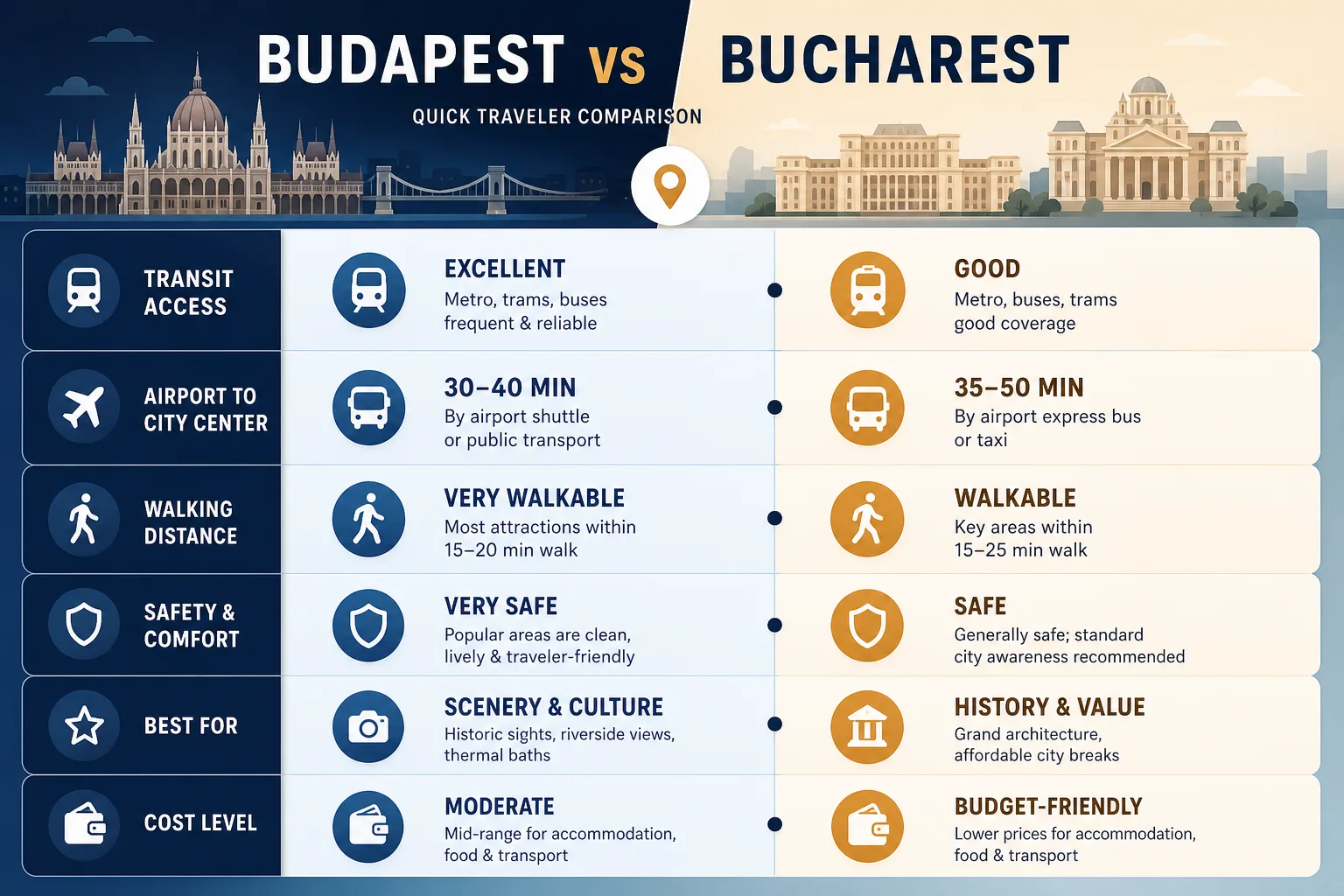
The real decision variables for an anxious traveler are not "which city has more sights." They are: how far apart are the sights, how forgiving is the transit system, and how narrow or wide is the safety risk zone.
| Decision variable | Budapest | Bucharest |
|---|---|---|
| Core walkability | Landmarks cluster tightly; Basilica to Parliament is 800m / 10 min flat | Old Town to Palace of the Parliament is 2.1km / 30 min, partly outside the walkable core |
| Airport to center | No single-seat train; relies on pre-booked transfer or Bolt | Direct CFR Airport Train to Gara de Nord for about 5 RON (~$1.10) |
| Main station transit links | Keleti Palyaudvar connects directly underground to Metro M2 and M4 | Gara de Nord connects directly to Metro M1 and M4 |
| Known risk zones | Concentrated: Vaci Street, District VII ruin bars at night, Metro 1/3, Trams 2/4, Bus 7 | Less concentrated, spread across a larger area |
| Rideshare safety net | Bolt available for fixed fares | Bolt and Uber both available for fixed fares |
| Old Town walking surface | Mostly flat in the historic core | Lipscani Old Town is pedestrian-only with uneven, cobbled streets |
| Best-suited pace | Short, structured days; landmark-hopping on foot | Slower days; comfort with longer, less predictable walks |
The tradeoff in one sentence: Budapest trades a bit of grit for predictability, and Bucharest trades predictability for a more spread-out, less packaged experience.
Choose Budapest If
Choose Budapest if you want a first Eastern European trip where the logistics stay in the background instead of becoming the main event. The historic core is dense enough that you can plan a day around walking, not transferring. Deak Ferenc ter, the city's main transit hub, is a 5-minute walk from St. Stephen's Basilica, and from there it is another flat 10-minute walk to the Hungarian Parliament Building. That means a single mistake, like getting off at the wrong stop, rarely costs you more than a short walk back.
Budapest also suits travelers who want a defined mental map of where to be careful. The pickpocketing risk is not evenly spread across the city; it concentrates on Vaci Street, inside District VII ruin bars at night, and on specific transit lines: Metro 1 and 3, Trams 2 and 4, and Bus 7. Knowing exactly which four or five spots deserve extra attention is far less taxing than feeling generally on guard everywhere.
If you want to reach Buda Castle without overthinking it, the walk from the Szechenyi Chain Bridge takes about 20 minutes, using either walking paths or the Castle Hill Funicular. That is a manageable outing for a traveler who tires of decision-making, not just physical walking.
Choose Bucharest If
Choose Bucharest if you are not a first-timer to independent European travel and you are looking for a city with a different texture: fewer manicured tourist corridors, a slower pace, and a downtown that rewards wandering rather than checklist-hopping. Bucharest's Lipscani Old Town is pedestrian-only, which removes traffic-crossing anxiety even though the cobbled streets are uneven underfoot.
Bucharest also makes sense if your top priority is a simple airport arrival. The CFR Airport Train runs directly from Henri Coand International Airport to Gara de Nord for about 5 RON, roughly $1.10, and Gara de Nord connects straight into Metro lines M1 and M4. That is a genuinely low-friction first hour in the country, arguably simpler than Budapest's airport situation.
Choose Bucharest if the idea of a 30-minute walk from the Old Town to the Palace of the Parliament, or a 10 to 15 minute walk along Calea Victoriei from Piata Universitatii to the Romanian Athenaeum, sounds like a pleasant stretch of the legs rather than an unwelcome logistics problem.
Who Might Regret Budapest
Budapest is a poor fit for a traveler who has already done the "compact, walkable European capital" trip multiple times and is craving something that feels less optimized for tourists. If your disappointment risk is boredom or a sense of sameness, Budapest's efficiency can start to feel sterile rather than reassuring.
It is also a mismatch for travelers who specifically enjoy testing themselves against slightly harder logistics as part of the trip's appeal. Someone who treats getting mildly lost as part of the adventure may find Budapest's tight, well-marked core almost too easy, and end up wishing they had picked a city with more room to improvise.
Finally, if you plan to spend most nights in District VII's ruin bar scene without adjusting your guard, Budapest will not protect you from the exact risk it flags. The concentration of theft risk there is well documented, and ignoring it because "the rest of the city felt safe" is the most common way this destination disappoints an otherwise well-prepared visitor.
Who Might Regret Bucharest
Bucharest is a difficult choice for a traveler whose anxiety is triggered specifically by not knowing how far away something is. The 2.1-kilometer walk from the Old Town to the Palace of the Parliament, or any similar cross-town walk, can feel much longer when you are unsure of the route and the surroundings are less continuously touristy than Budapest's core.
It is also a mismatch for anyone who wants a single, simple mental map of "where to be careful." Because Bucharest's safety picture is less concentrated into a short list of named streets and lines, an anxious traveler may end up generalizing caution across the whole city, which is more mentally tiring over a multi-day trip than Budapest's narrower risk zones.
Travelers expecting the same postcard density as Budapest, wall-to-wall landmarks within a 10-minute radius, are also likely to feel a expectation mismatch. Bucharest's sights are real and worthwhile, but they are not clustered the same way, and a visitor who assumed otherwise may spend more of the trip in transit than anticipated.
Key Friction Comparison
Expectation mismatch. Many first-time visitors assume all Eastern European capitals share Prague's or Budapest's dense, photogenic core. Bucharest does not fit that mold as tightly. Its major sights, the Old Town, Calea Victoriei, the Romanian Athenaeum, and the Palace of the Parliament, are real destinations, but they are connected by longer stretches of ordinary city rather than a continuous historic district. Anxious travelers who arrive expecting Budapest-style density will feel the gap immediately. Budapest, by contrast, mostly delivers what the postcards promise within a short walking radius.
Safety. Both cities are broadly safe for tourists, but the shape of the risk differs. Budapest's theft risk is concentrated and nameable: Vaci Street, District VII ruin bars after dark, and Metro lines 1 and 3, Trams 2 and 4, and Bus 7. That specificity is genuinely useful for an anxious planner, since it converts a vague fear into a short checklist. Bucharest does not offer the same tight list of named hotspots in the available data, which means a cautious traveler has to stay generally alert rather than targeting a handful of known areas.
Transit and stations. Budapest's Keleti Palyaudvar connects directly underground to Metro lines M2 and M4, which limits the amount of outdoor, unfamiliar wayfinding needed right after a train arrival. Bucharest's Gara de Nord connects directly to Metro M1 and M4 as well, and its airport link, the CFR Airport Train, is a straightforward and cheap single trip for about 5 RON. Where the two diverge is on foot: Budapest's landmark walks are consistently short and flat (the Basilica to Parliament walk is 800 meters and 10 minutes; Deak Ferenc ter to the Basilica is 5 minutes), while Bucharest's comparable walks run longer and less continuously pedestrian-friendly, such as the 30-minute Old Town to Palace of the Parliament walk. For a traveler whose fatigue and anxiety build with distance and uncertainty, Budapest's shorter, more predictable walks reduce cumulative stress across a multi-day trip in a way Bucharest's longer routes do not.
Use this simple checklist to sanity-check which friction points matter most for your own trip:
- Do you want a short, nameable list of "watch out here" spots, rather than general vigilance everywhere? Favor Budapest.
- Do you want the cheapest, simplest single-step airport transfer, even if the rest of the city asks more of you? Favor Bucharest.
- Do you want most major landmarks within a 10 to 20 minute walk of each other? Favor Budapest.
- Are you comfortable with 30-plus minute walks between major sights, sometimes off the main tourist track? Bucharest works fine.
- Does uneven, cobbled pedestrian pavement bother your joints or balance? Weigh Budapest's flatter core more heavily.
Final Recommendation
For the specific traveler this article is written for, someone new to Eastern Europe who gets anxious about transit systems, unfamiliar streets, and general safety, Budapest is the recommended choice. Its compact core turns most of the trip into short, flat, predictable walks. Its safety risks are well-documented and narrow enough to plan around instead of worrying about generally. And its main station's direct underground Metro access removes one of the most anxiety-inducing moments of any trip: the first walk from an unfamiliar train platform into an unfamiliar city.
Choose Budapest if this is your first solo or anxious trip to the region, if you want a short itinerary that does not require heavy logistics planning, or if you specifically want to know where to be careful rather than being careful everywhere. Do not choose Budapest if you have already experienced this kind of dense, well-trodden European center before and are looking for something rougher around the edges.
Choose Bucharest instead only if you already have some independent travel experience, are comfortable with longer and less predictable walks, and are drawn to a city that has not been fully smoothed over for tourists. Do not choose Bucharest as a first Eastern European trip if the idea of a 30-minute walk through unfamiliar streets, or a safety picture that is not neatly confined to a handful of named spots, sounds stressful rather than interesting.
FAQ
Is Budapest or Bucharest safer for a solo, anxious first-time traveler?
Budapest is the safer default for most anxious first-timers because its known risk zones are narrow and well-documented: pickpocketing concentrated on Vaci Street, inside District VII ruin bars at night, and on Metro lines 1 and 3, Trams 2 and 4, and Bus 7. Once you know to be alert in those specific spots, the rest of the compact center is low-friction. Bucharest is not more dangerous in a violent-crime sense, but its risk picture is less concentrated and the city center is more spread out, which means more unfamiliar ground to cover.
Which city has an easier airport-to-city-center transfer?
Bucharest's airport transfer is arguably the simpler mechanical process: the direct CFR Airport Train runs from Henri Coanda International Airport to Gara de Nord for about 5 RON (roughly $1.10), and Gara de Nord connects directly to Metro lines M1 and M4. Budapest does not have a single-seat train link from its airport into the center, so most anxious travelers rely on a pre-booked transfer or the Bolt app instead. If airport simplicity alone were the deciding factor, Bucharest would win, but that is only one leg of the trip.
Do I need to worry about getting lost on foot in either city?
Less so in Budapest. The core sights sit close together: St. Stephen's Basilica to the Hungarian Parliament Building is a flat 800-meter, 10-minute walk, and Deak Ferenc ter to St. Stephen's Basilica is just 5 minutes on foot. Bucharest's equivalent walks are longer and cover less predictable ground, such as the 2.1-kilometer, 30-minute walk from the Old Town to the Palace of the Parliament, much of it outside the pedestrian core.
Is Bucharest a bad choice for a first trip to Eastern Europe?
No, but it asks more of an anxious traveler. Bucharest rewards people who enjoy a slower, more improvisational pace and do not mind covering more ground between sights on foot or by transferring between Metro lines. If cobbled, pedestrian-only streets in the Old Town, longer walks, and a more spread-out layout sound tiring rather than charming, Bucharest will add friction that Budapest would not.
Which city is better if I only have two or three days and want to see the main sights without overplanning?
Budapest. Its landmarks cluster tightly enough that a short trip does not require heavy logistics: the walk from the Szechenyi Chain Bridge up to the Buda Castle District takes about 20 minutes, and the Basilica-to-Parliament walk is 10 minutes. A short Bucharest trip works too, but the distances between the Old Town, Calea Victoriei, and the Palace of the Parliament mean more transit planning to avoid wasted time.