city-matchups
Florence or Bologna for Food-Focused Travelers Who Hate Museum Lines and Crowded Streets?
A direct verdict for foodies choosing between Florence and Bologna: which city delivers better meals with less crowd stress, and who should skip Florence entirely.
Quick Verdict
If you are choosing between Florence and Bologna primarily for food, and crowds genuinely wear you down, choose Bologna.
Bologna gives you real trattoria cooking at local prices, walkable arcaded streets, and a food culture that was not built around tourist turnover. Florence gives you world-class art and a beautiful historic core, but its food scene in the center is priced and paced for high-volume tourism, and the crowds around the Duomo and Uffizi are not a minor inconvenience, they are a daily planning problem.
Choose Bologna if your trip is organized around meals, not monuments, and you want to eat well without fighting for a table or a sidewalk.
Choose Florence only if specific landmarks (the Uffizi, the Accademia, the Duomo) are non-negotiable for you, and you are willing to plan reservations and timed entries weeks ahead to get them.
Do not choose Florence if your main goal is relaxed, food-first travel and you are hoping the crowds will be manageable outside peak months. Florence's congestion is structural, not seasonal, because the city draws over 16 million visitors a year into a historic center that has not grown to match.
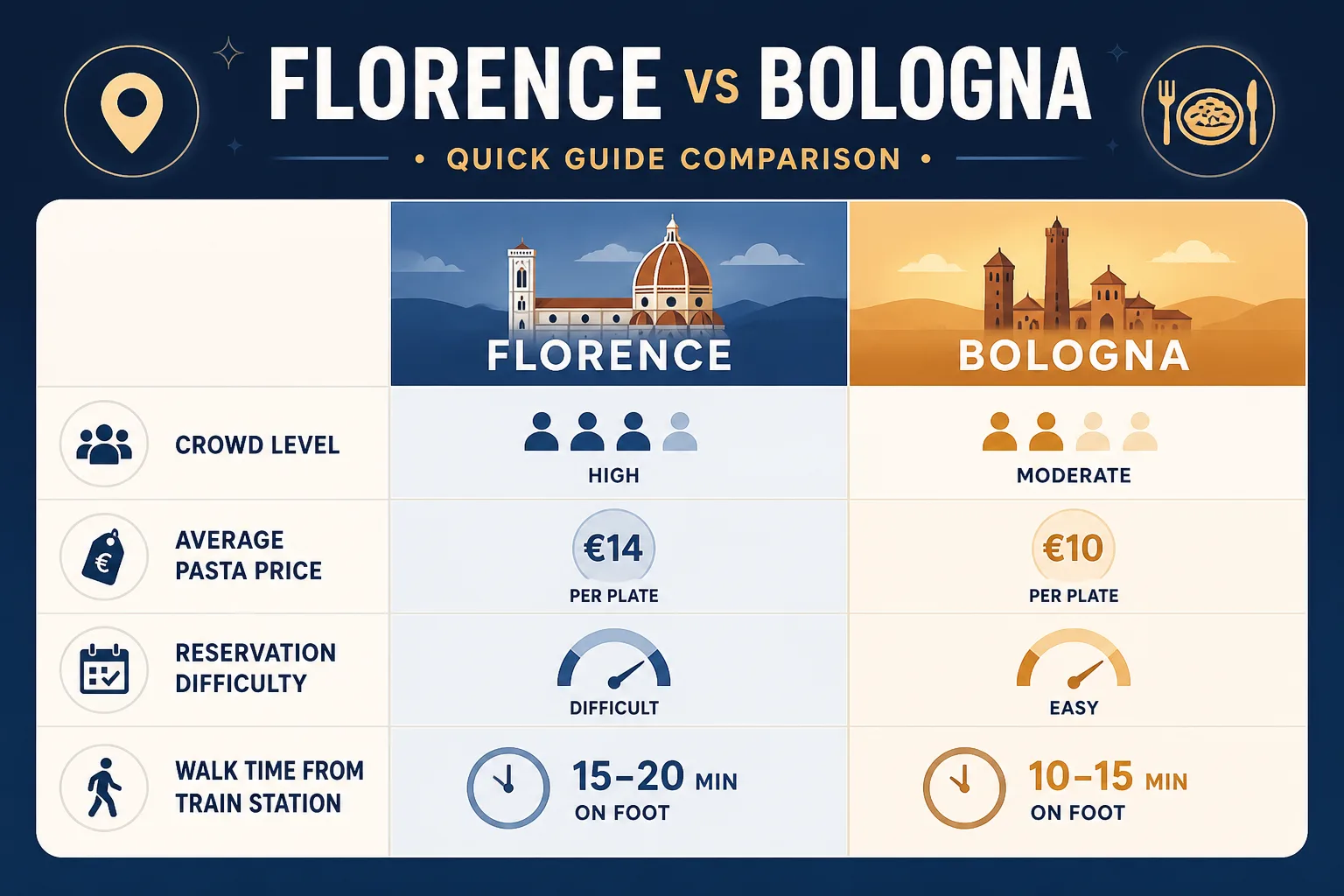 Editorial illustration: A clean comparison table graphic with two columns labeled Florence and Bologna.
At a Glance Table
| Decision variable | Florence | Bologna |
|---|---|---|
| Best for | Landmark-first travelers who need the Uffizi or Accademia | Food-first travelers who want calm streets and real trattoria cooking |
| Typical crowd pressure | High year-round around Duomo and Uffizi; 16M+ annual visitors | Noticeably lower; tourism is present but not the city's main identity |
| Average main dish price (historic center) | $25 to $40 (22 to 35 euros) for a tourist-area pasta or main | 17 to 28 dollars (8 to 18 euros) for a primo like tagliatelle al ragu |
| Reservation pressure | Museums require timed, nominative tickets booked far ahead; top trattorias also book out | Some top spots book weeks ahead; several respected trattorias are walk-in only |
| Walk from main station to center | 650 to 900 meters, 10 to 15 minutes, mostly open streets | 1.5 km, 15 to 25 minutes, fully covered by porticoes |
| Accommodation cost | Mid-range hotels average $180 to $280 per night | About 25 to 30 percent lower than Florence for comparable quality |
| Museum-fatigue risk | High if you try to "see everything" | Low; Bologna is not built around a must-see museum circuit |
The pattern here is consistent: Florence charges a premium in money, time, and crowd tolerance for landmark access. Bologna trades landmark density for food quality, lower cost, and physical comfort.
Choose Florence If
Choose Florence if a specific, named artwork or building is the actual reason for your trip. If you have been planning to stand in front of Michelangelo's David or walk through the Uffizi's collection for years, that is a legitimate priority that Bologna cannot substitute for.
Choose Florence if you are willing to do the reservation homework. Timed-entry, nominative tickets for the Accademia and Uffizi need to be booked well in advance, and the same discipline applies to popular restaurants in the historic center. Travelers who enjoy building a tight, pre-booked itinerary will find Florence's friction manageable because they are planning around it rather than reacting to it.
Choose Florence if you are combining it with a broader Tuscany trip and only need two or three focused days in the city itself. A short, well-planned Florence stay avoids the fatigue that comes from trying to stretch the city into five or six days of wandering that it was not really built to support comfortably.
Choose Bologna If
Choose Bologna if food is the actual point of the trip, not a byproduct of sightseeing. Bologna's primo dishes, tagliatelle al ragu, tortellini in brodo, are both cheaper and more central to daily life than Florence's tourist-district equivalents, which means you are eating what locals eat at prices closer to local rates.
Choose Bologna if crowd density itself is a trip-ruining factor for you, not just an annoyance. A city where the flagship walk from the train station to the main piazza is sheltered, spacious, and not jammed with tour groups is a fundamentally different daily experience than fighting through Duomo-adjacent foot traffic.
Choose Bologna if you want lower costs without a quality tradeoff. The 25 to 30 percent lower accommodation cost compounds with cheaper, better-value meals, which matters most to travelers on a fixed multi-day budget rather than a single splurge trip.
Who Might Regret Choosing Florence
Travelers who arrive in Florence expecting a relaxed, food-led few days often underestimate how much the city's layout concentrates tourists into a small radius around the Duomo, Ponte Vecchio, and Uffizi. If your itinerary has you crossing that radius multiple times a day, the crowd fatigue accumulates fast, even outside the busiest months.
Travelers who skip advance reservations are the second regret pattern. Showing up without a timed Uffizi or Accademia ticket usually means not getting in at all, and showing up at a well-known trattoria without a booking usually means a long wait or a worse table. The disappointment is specific: paying premium historic-center prices for a rushed, standing-room meal because nothing was booked ahead.
A third regret pattern is the traveler who picks Florence purely because it is the more famous name, without actually caring about the Renaissance art that justifies its crowd tax. If the museums were never the priority, the crowds become pure cost with no corresponding payoff.
Who Might Regret Choosing Bologna
Travelers who choose Bologna assuming it has Florence-equivalent must-see landmarks will be disappointed. Bologna's appeal is atmosphere and food, not a checklist of world-famous sights, so a traveler who needs a landmark-dense itinerary to feel like the trip "counted" may find Bologna feels quieter than expected, in a way that reads as underwhelming rather than restful.
Travelers who assume every Bologna trattoria is walk-in friendly will also be caught out. Some of the city's most talked-about spots, like Trattoria di Via Serra and Osteria Bottega, require booking weeks in advance, the same discipline Florence demands. Arriving without a plan at those specific places produces the same wasted-trip disappointment as Florence, just at a smaller number of restaurants.
A third regret pattern is the traveler who picks Bologna purely for lower prices without checking whether the food itself matches their taste. Bologna's cuisine is rich, meat- and butter-forward comfort food; a traveler expecting lighter Tuscan-style dishes or a broader international food scene may find the daily menu options narrower than anticipated.
Key Friction Comparison
Crowds. Florence's congestion is concentrated and constant, driven by 16 million-plus annual visitors funneling through a compact historic core. Bologna absorbs tourism without it dominating the streetscape, so the same afternoon walk feels like a different category of experience, not just a quieter version of the same one.
Tourist traps. Florence's historic-center restaurants pricing a standard pasta at $25 to $40 is a direct marker of tourist-trap pricing, since the same dish costs meaningfully less a short walk outside the core or in Bologna generally. Bologna's primo prices, 17 to 28 dollars, sit closer to what the dish actually costs to make and serve, because the city's food economy is not built primarily around tourist turnover.
Dining reservations. Both cities require planning for their most in-demand tables, Florence for its landmark trattorias and Bologna for spots like Trattoria di Via Serra and Osteria Bottega. The difference is what happens when you do not plan: Florence's historic center offers fewer reliable walk-in alternatives, while Bologna has respected no-reservation options like Osteria dell'Orsa and Sfoglia Rina that still deliver a real meal.
Museum fatigue. Florence all but requires museum time to justify the trip, and that time comes with timed-entry logistics, ticket lines, and gallery crowds layered on top of street crowds. Bologna removes this pressure almost entirely; there is no equivalent must-do museum circuit demanding advance booking and stamina, which suits travelers who find museum days more draining than restorative.
Practically, this means: if crowds and reservations are your two biggest sources of trip stress, Bologna reduces both at once. Florence reduces neither unless you accept the planning burden of booking everything, tickets and tables alike, well ahead of arrival.
Final Recommendation
Choose Bologna if you are a food-focused, crowd-sensitive traveler with 3 days to spend and no specific, non-negotiable landmark pulling you to Florence. It delivers better food value, calmer streets, lower costs, and a lower planning burden, and it does all of this without asking you to give up quality for convenience.
Choose Florence only if a specific museum or monument is the actual reason for the trip, and only if you are prepared to book tickets and tables weeks in advance rather than hoping to wing it. In that specific case, the crowd and cost premium is the price of admission for something Bologna genuinely cannot replace.
Do not choose Florence by default just because it is the more recognizable name on a map. For this specific traveler profile, food-focused, crowd-averse, planning a short trip, the recognizable name is not the better answer.
If you have more than 3 days, the strongest option is to base in Bologna and take a single high-speed train day trip into Florence, roughly 33 to 40 minutes each way, to see one or two priority sights without absorbing Florence's daily crowd tax for your entire stay.
FAQ
Is Bologna really better than Florence for food, or just less crowded? Both. Bologna's food identity is built around everyday trattoria cooking like tagliatelle al ragu and tortellini in brodo, priced for locals as much as visitors. Florence's historic center food scene is heavily oriented toward tourist turnover, which pushes prices up without necessarily raising quality. Bologna wins on food value and crowd comfort at the same time, which is unusual.
Can I do Florence and Bologna as a two-city trip instead of choosing one? Yes, and it works well logistically. High-speed trains connect Florence Santa Maria Novella and Bologna Centrale in 33 to 40 minutes, with advance fares from about 10 to 20 euros. If you have 4 or more days, base in Bologna and day-trip to Florence for a half-day of must-see sights, rather than basing in Florence and fighting crowds every day.
Do I need to book restaurants in advance in Bologna too? Some, yes. Trattoria di Via Serra takes phone bookings up to 30 days ahead and Osteria Bottega requires email reservations weeks out. But Bologna also has well-regarded walk-in-only spots like Osteria dell'Orsa and Sfoglia Rina, so a reservation-averse traveler still has real options. Florence's popular trattorias require similar or tighter advance booking, with fewer reliable walk-in alternatives in the historic center.
Will I regret skipping Florence's museums if I choose Bologna instead? Only if the Uffizi or Accademia is genuinely a top priority for you. If your trip is primarily about food and calm streets rather than specific artworks, skipping Florence's museum lines is not a loss. If seeing Michelangelo's David or the Uffizi collection matters enough that you would regret missing it, that single priority may outweigh the crowd tradeoff, and a short Florence add-on trip is worth the friction.
Is Bologna walkable, or does it require a lot of transit? Bologna is very walkable and unusually comfortable for foot traffic because most of the historic center is covered by sheltered porticoes, including the 1.5 kilometer walk from Bologna Centrale to Piazza Maggiore. Florence's core sights are also walkable and close together, but the sidewalks and piazzas are frequently jammed with tour groups, which turns a short walk into a slow, congested one.