travel-decisions
Is Busan Too Steep and Stair-Heavy for Multigenerational Trips with Seniors?
A traveler-fit breakdown of Busan's hills, stairs, and transit for family groups traveling with elderly parents or relatives who have limited mobility.
Quick Verdict
Busan works for multigenerational trips if the itinerary sticks to its flat districts. It does not work if the plan centers on its hillside villages.
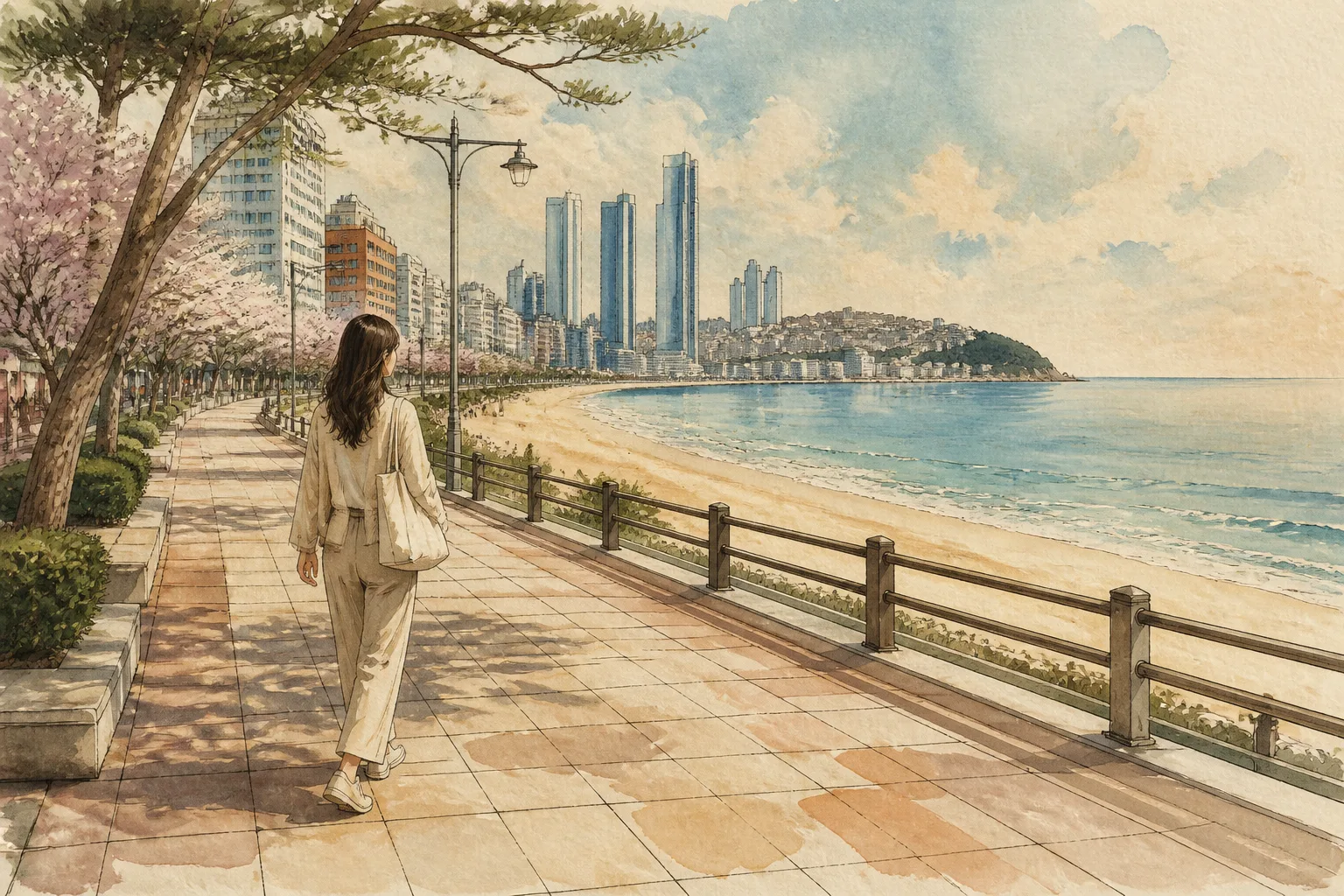
Haeundae's beachfront, coastal trail, and pedestrian avenue are flat, paved, and served by an elevator-equipped subway station. Gamcheon Culture Village, Huinnyeoul Culture Village, and Haedong Yonggungsa Temple are a different city entirely: narrow stairs, steep alleys, and no step-free bypass at any of them. A family that builds its trip around Haeundae and uses taxis for occasional hillside visits will have a manageable trip. A family that plans a walking-heavy day through Gamcheon and Huinnyeoul back to back, expecting Busan to feel like a flat coastal city throughout, will find the trip harder than expected.
Choose Busan if your group can tolerate some stairs in short bursts and is willing to pay for taxis on hillside days. Skip or heavily restructure the trip if any relative cannot manage stairs at all, since several signature sights simply have none of the workarounds a first-time reader might assume exist.
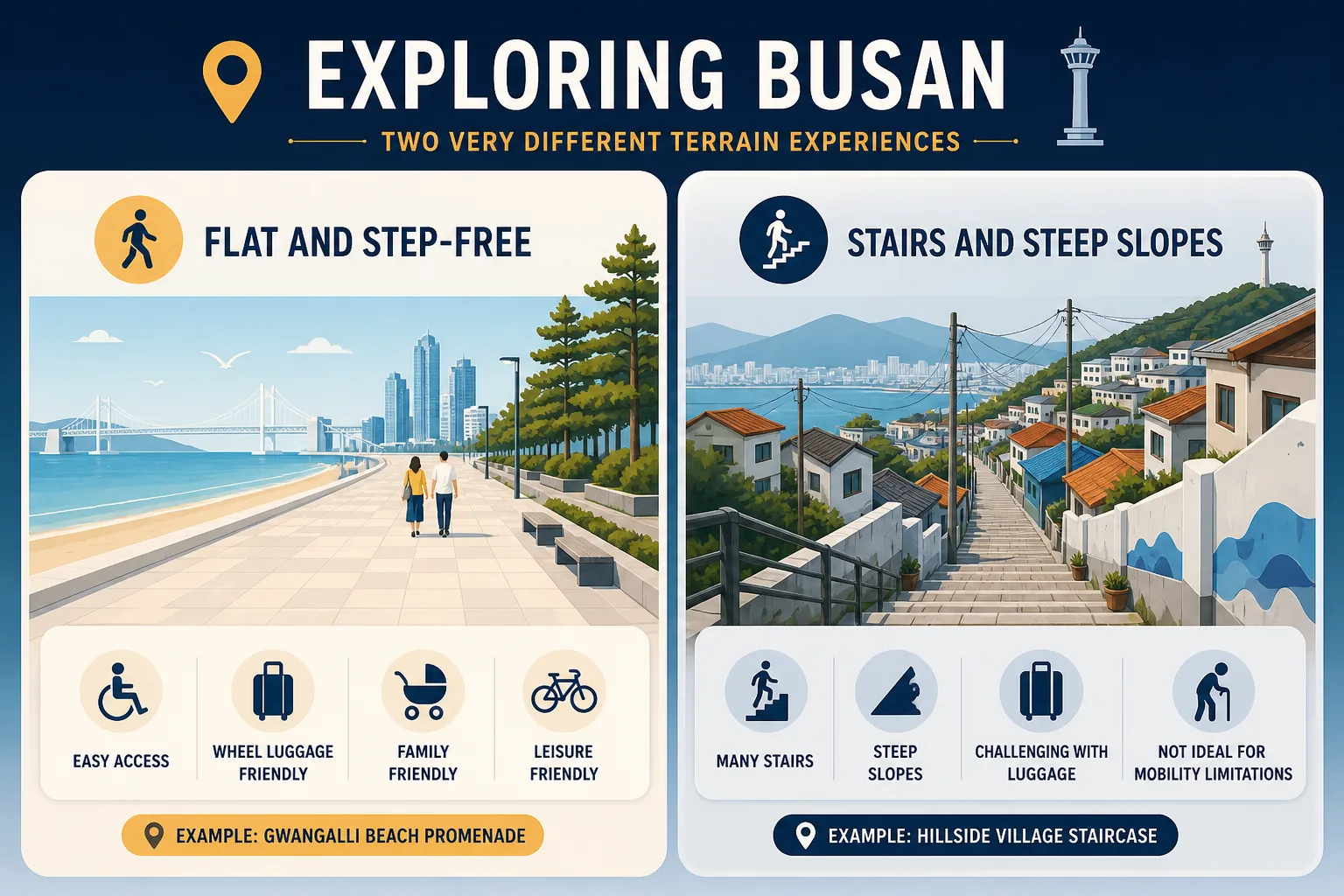 Editorial illustration: A simple side-by-side comparison layout with short labeled sections representing flat.
Traveler Type Table
The real variable in Busan is not "is this person elderly." It is how much sustained stair climbing and uphill walking a specific relative can tolerate in one day, and whether the group is willing to pay for taxis instead of walking or bussing.
| Decision variable | Mixed-mobility group decision |
|---|---|
| Daily stair tolerance | Set the plan by the least mobile member, not the group average |
| Willingness to taxi instead of walk | Decide the taxi limit before choosing hillside stops |
| Itinerary density | Leave slack after stair-heavy stops for the whole group |
| Reaction to "no bypass" sites | Make the site optional or skip it when it exceeds the group's boundary |
Best for First-Time Visitors
First-time visitors to Busan traveling with parents or grandparents often assume the city is uniformly walkable because the coastline looks that way in photos. It is not. Haeundae is flat and easy, but Gamcheon Culture Village's inner alleys do not allow vehicle drop-offs, and the site includes a 148-step staircase with no shortcut.
A first-time multigenerational group should treat Busan as two cities stitched together. One is flat, paved, and elevator-served. The other is stairs and slopes with no barrier-free version. Building the first two days around Haeundae before attempting any hillside village gives the group a baseline read on how the least mobile member handles walking before committing to a harder day.
Mixed-Mobility Group Planning Protocol
Use the least mobile person's actual stair tolerance as the group's planning constraint. Do not build the day around the average member and ask one person to catch up later.
- Set the stair boundary first. Decide whether the least mobile person can handle no stairs, a short stair section, or one sustained stair-heavy visit. If a site exceeds that boundary, make it optional or leave it out; do not treat a no-step-free-route site as a problem that better timing will solve.
- Choose together or split before leaving the base. If everyone stays together, choose the flat route and accept that the hillside site may be skipped. If the group splits, agree on the meeting point and time before the mobile subgroup leaves, with a nearby rest point for the person who stays behind.
- Build a flat fallback day. Keep Haeundae or another already-planned flat area available as the default day when the group has less energy than expected. Do not stack Gamcheon, Huinnyeoul, and Haedong Yonggungsa as interchangeable stops on the same day.
- Set taxi limits before booking the itinerary. Decide how many taxi legs and what daily taxi budget the group accepts. If a hillside plan exceeds that limit, drop the hillside stop or convert the day to the flat fallback instead of replacing the taxi with a long uphill walk.
- Protect recovery time. Put a rest block and an easy return route after any stair-heavy visit. The next decision is whether the group can still enjoy the following day, not whether one more landmark can fit today.
This protocol keeps the group decision concrete: stay together on a flat plan, split only with a named meeting and rest point, or skip the hillside stop when its stair and taxi requirements do not fit the least mobile person's limit.
Best for Low-Stress Travelers
Low-stress travelers who want a businesslike, low-friction trip should default to taxis over buses and walking on any day that includes a hillside site. Standard city buses in Busan are not always low-floor, and standing on winding hillside routes is common, which adds real physical strain for anyone unsteady on their feet.
A taxi from Toseong Station to Gamcheon Culture Village takes 5 to 7 minutes, compared to nearly an hour walking uphill. A taxi to Huinnyeoul Culture Village from Nampo Station takes about 10 minutes, versus a 12-minute bus ride that still ends with hillside walking. For a low-stress, multigenerational plan, the taxi fare is a small cost against a large reduction in fatigue risk.
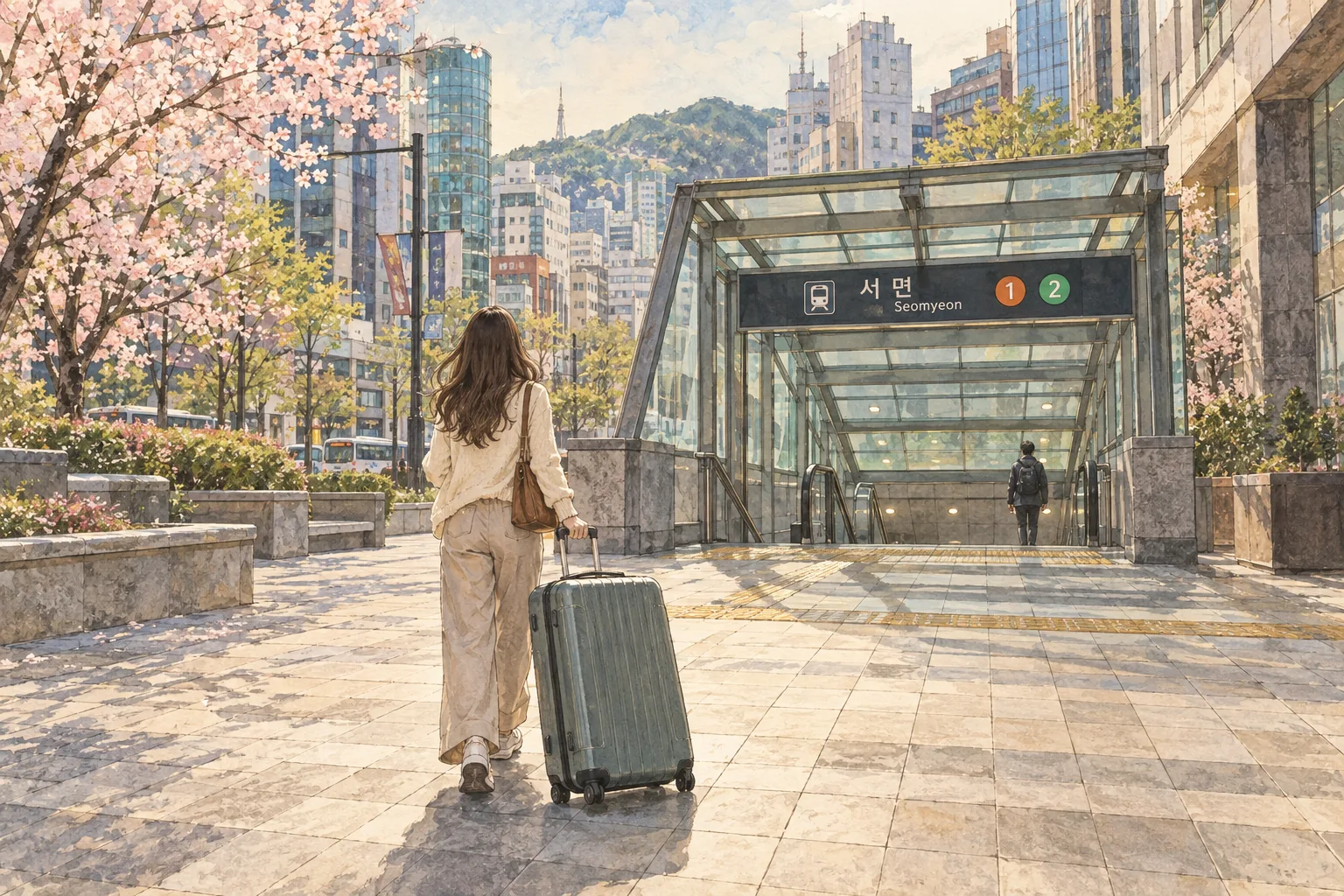
This same logic applies inside the subway system. Elevators exist at Busan Metro stations, but they are often placed far from the ticket gates, and major transfer hubs like Seomyeon Station require long walks between lines. A low-stress plan should budget extra transfer time at these hubs rather than assume elevator access means a short walk.
Common Mismatches
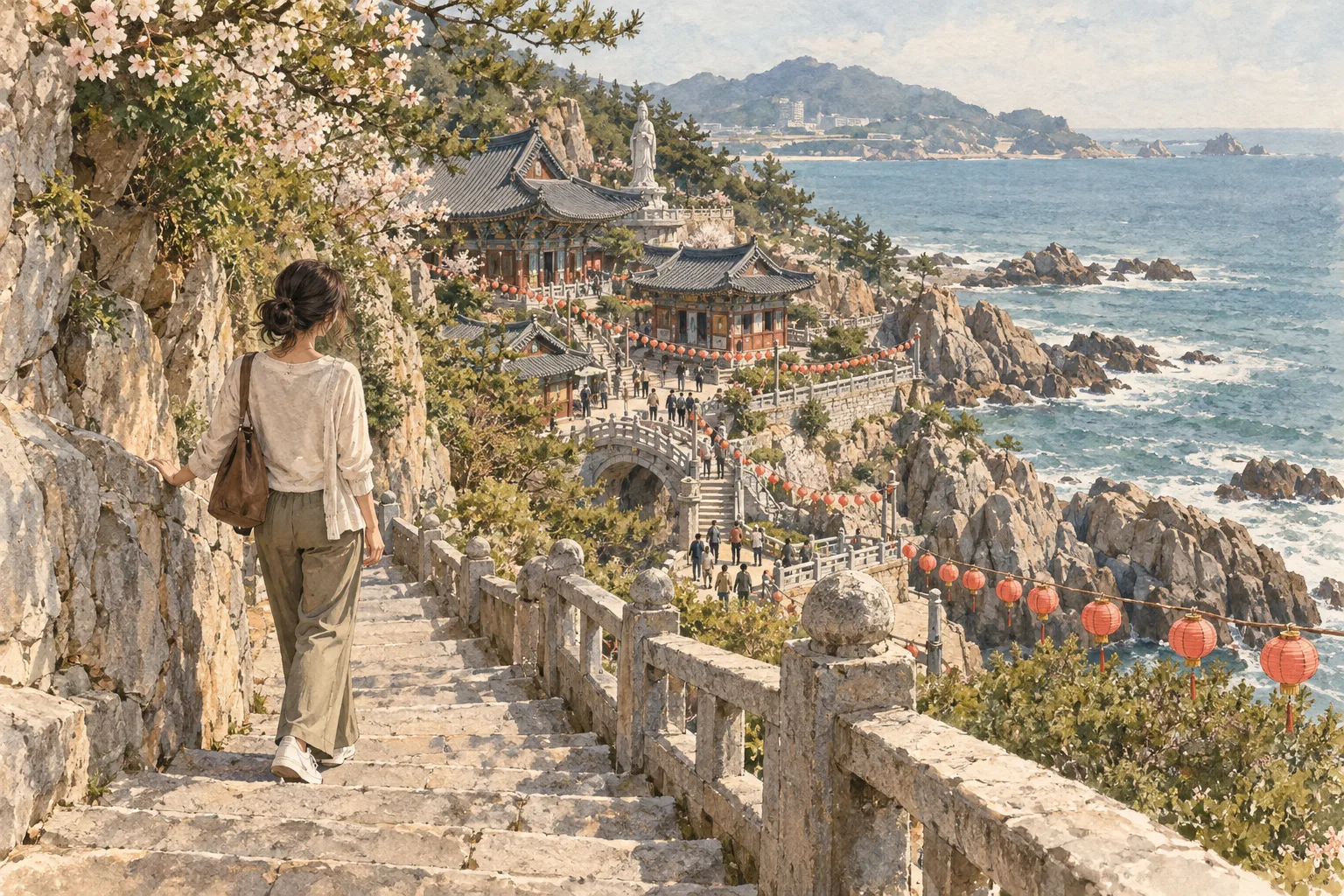
The most common disappointment pattern is assuming Busan is broadly accessible because its most-photographed spot, Haeundae, is flat. Families who build an itinerary from Instagram images of the beach, then discover Gamcheon's stairs or Haedong Yonggungsa's 108 steps on arrival, are the group most likely to regret the trip.
A second mismatch: assuming bus travel is a safe fallback for anyone who cannot walk hillside distances. Standard city buses are not always low-floor, and standing through winding hillside routes can be worse than walking short distances at a slow pace. Families who default to public buses to save money on hillside days often create more physical strain than they intended.
A third mismatch involves Taejongdae. As of July 2026, the Danubi Train inside the park is suspended due to mechanical failure, with free shuttle buses running as a temporary substitute. Families expecting the train to carry a mobility-limited relative around the park loop should confirm current shuttle service before relying on it, since a suspended attraction with an informal replacement is a common source of on-the-ground disappointment.
The traveler type most likely to misread Busan is the first-time multigenerational planner who treats "coastal city" as shorthand for "flat city." Busan is a coastal city built into hills, and the hills are where the disappointment happens.
Final Match Recommendation
Choose Busan if your group can commit to a flat-first itinerary anchored in Haeundae, treat hillside villages as optional add-ons rather than must-see stops, and budget for taxis on any day that includes stairs. This works best when the group can agree on those constraints before booking the itinerary.
Do not choose Busan as a hillside-village-centered trip if any relative cannot manage stairs at all. Gamcheon Culture Village, Huinnyeoul Culture Village, and Haedong Yonggungsa Temple have no step-free bypass, and no amount of pre-trip research changes that fact on the ground.
The deciding question for most families is not "is Busan accessible," but "can we restructure the itinerary around the flat half of the city and treat the stair-heavy half as optional." Groups who answer yes tend to have a good trip. Groups who answer no, or who do not ask the question at all, are the ones most likely to end the day early and frustrated.
FAQ
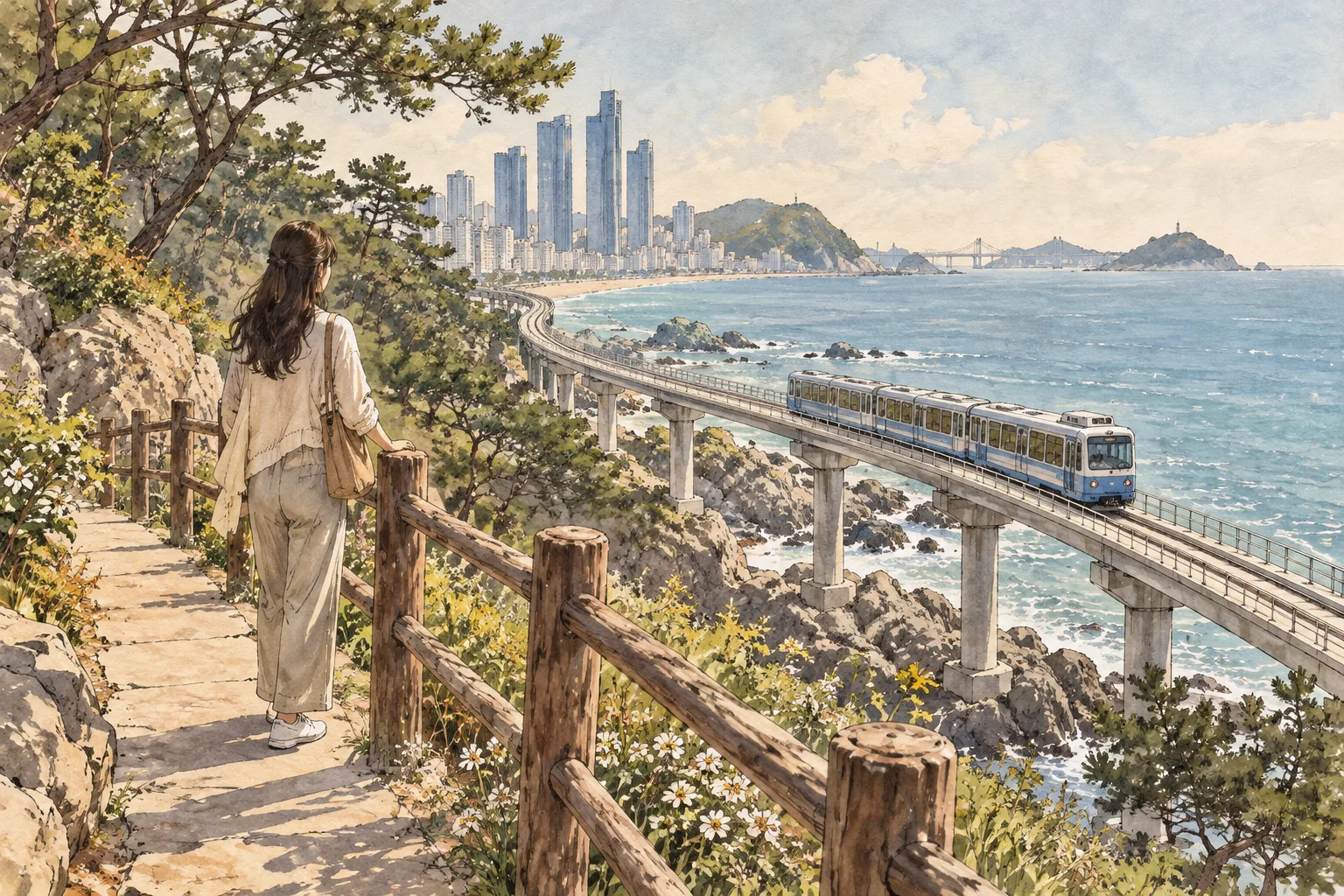
Is Busan wheelchair accessible? Parts of it are. Haeundae's beachfront, Dongbaek Park Coastal Trail, and Gunam-ro are flat and paved, and Haeundae Subway Station has elevators. Gamcheon Culture Village, Huinnyeoul Culture Village, and Haedong Yonggungsa Temple have no step-free routes, so a single-city plan built around those three spots is not wheelchair friendly.
Can seniors visit Gamcheon Culture Village? Seniors with steady mobility and no stair restrictions can visit if they go slowly and use taxis instead of walking uphill. Seniors who cannot manage sustained stairs, including the 148-step "Stairs to See Stars," should treat it as a skip or a very short photo-stop only.
What is the easiest area of Busan for elderly relatives? Haeundae is the easiest base. The beachfront promenade, coastal trail, and pedestrian avenue are flat and paved, and the subway station has elevators, which removes most of the walking fatigue that affects the hillside villages.
Do we need taxis for a multigenerational Busan trip? Plan on using taxis for hillside areas. Walking from Toseong Station to Gamcheon Culture Village takes nearly an hour uphill, while a taxi takes 5 to 7 minutes, and standard city buses on winding hillside routes are not always low-floor.
Is Taejongdae still manageable for seniors right now? It is more limited than usual. The Danubi Train inside Taejongdae Resort Park was suspended in July 2026 due to mechanical failure, and free shuttle buses are running as a temporary replacement, so confirm current shuttle coverage before planning a full loop on foot.