travel-decisions
Is Rome in Winter Actually Less Crowded, or Is That a Travel Myth?
A decision-focused look at whether winter really thins Rome's crowds, who benefits from the off-season, and where the myth breaks down.
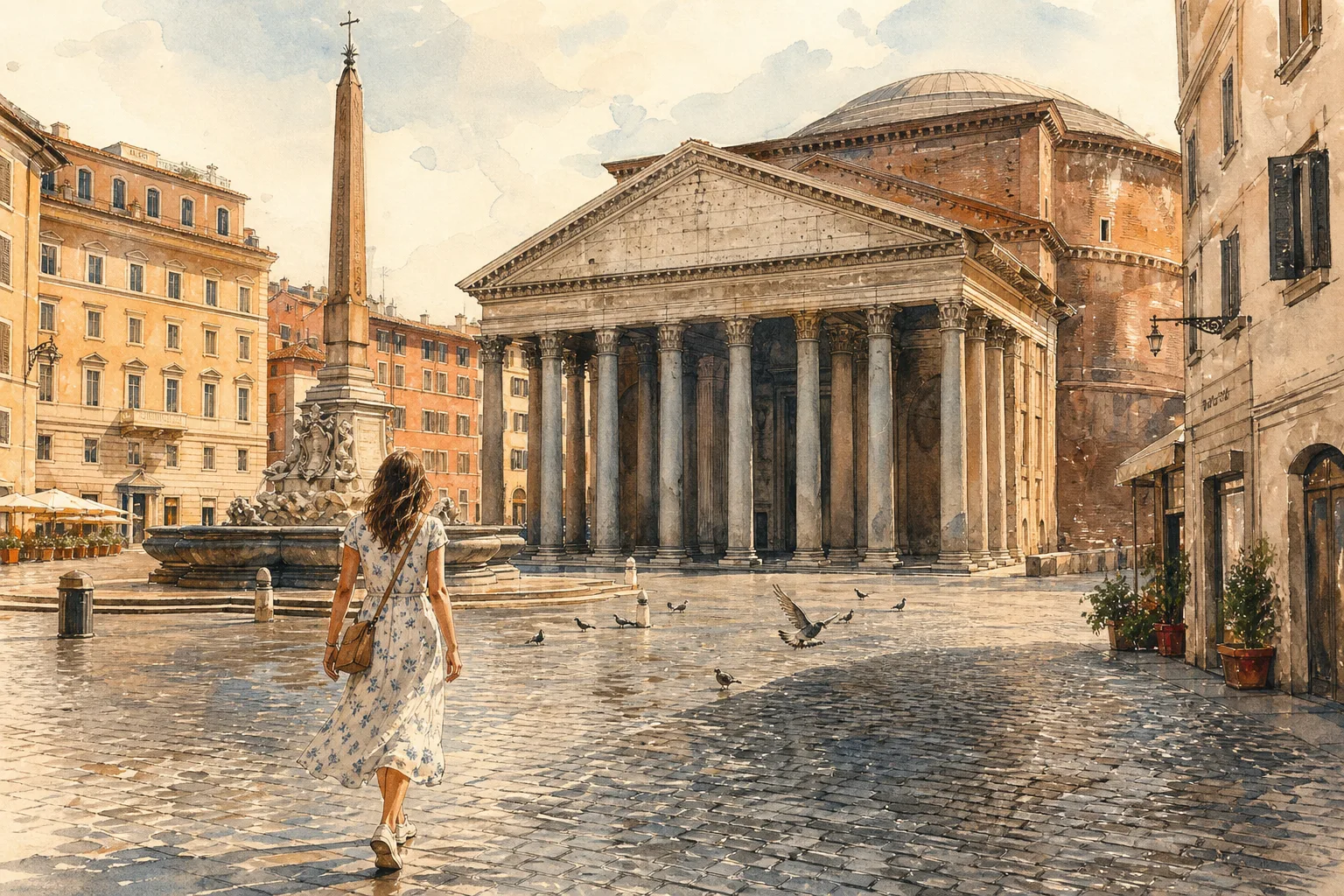
The expectation behind winter Rome is simple: fewer people, shorter lines, lower prices, and a calmer first encounter with the city. Most of that is true on average. The myth part is assuming it is true everywhere, every day, and at every sight.
This guide tests the claim by friction, not by mood, and flags where the numbers come from so you can verify before you book.
Quick Verdict
Winter Rome is typically less crowded than summer in most places, most of the time, but the relief is concentrated in side streets, neighborhood trattorias, smaller museums, and early mornings. The Vatican Museums, Colosseum, and Trevi Fountain remain busy at peak hours, and the holiday window from late December through January 6 behaves more like shoulder season.
- Choose winter Rome if you are a first-time visitor who prioritizes calm sightseeing, a low-stress planner, a slow traveler who likes long cafe sits, or a value-led traveler watching hotel costs.
- Skip winter Rome if you want long daylight hours, reliable outdoor dining, warm-weather photos, or a packed itinerary that depends on golden-hour light.
The honest summary: winter buys you breathing room and savings, not an empty city.
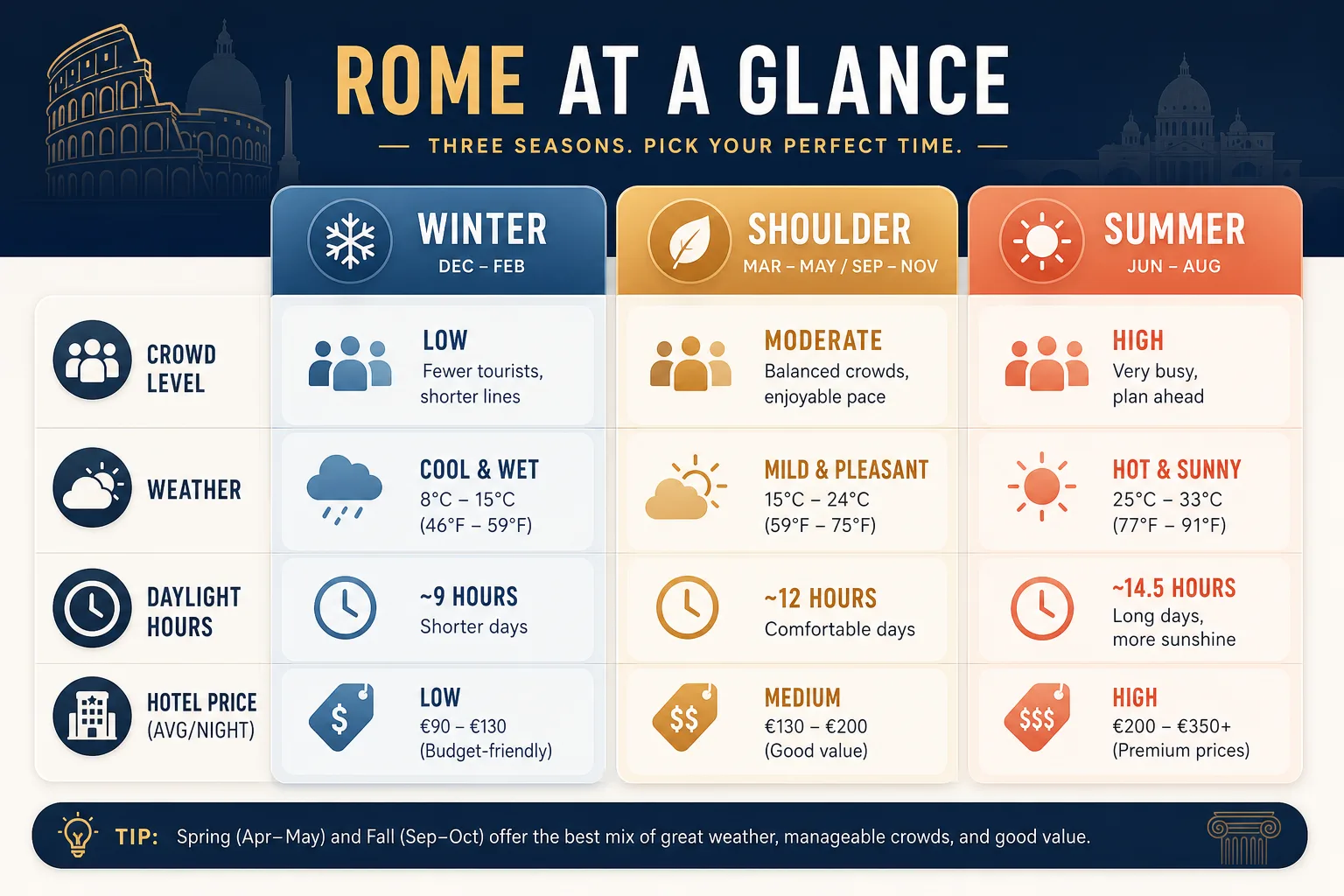 Winter is not uniformly quiet: holidays, the Vatican, and weather all push the tradeoff around.
The Real Friction Behind the Winter Myth
The crowd story is only one of four pressures that move together in Rome.
Crowd pressure. Sight-specific. The Vatican Museums on a Saturday in February still funnel thousands of people through one corridor. The Colosseum still hits its timed-entry cap on weekends. The Trevi Fountain area is busy at midday year-round, and starting February 2, 2026, a 2 euro ticket is required daily from 9:00 AM to 10:00 PM to access the lower basin, while the upper Piazza stays free (per the City of Rome tourism office announcements covered by Italian press in early 2026). The photo-stop crowd around the upper level does not actually disperse.
Weather discomfort. Rome winters are mild compared to northern Europe but damp. Expect cool rain, wind around exposed sights, and chilly evenings outdoors. Cobblestones get slick. Outdoor restaurant terraces, a major part of the Rome experience, are mostly under plastic or closed.
Short daylight. In December and January, usable light typically runs from about 7:30 AM to 5:00 PM. That compresses sightseeing windows, especially if you want exterior photos at the Forum or a daylight walk between the Colosseum and the Vatican (about 4.2 kilometers, 45 to 53 minutes on foot).
Booking pressure. Lower than summer, but not zero. According to the official Pantheon ticketing portal (museiitaliani), the entry fee is 5 euro and is scheduled to rise to 7 euro on July 1, 2026, and since March 10, 2026 online ticket names can be changed only once and up to 72 hours before the visit. The Colosseum Archaeological Park's official ticketing pages indicate that for visits from May 9, 2026 onward, ticket names can be changed only once and no later than 7 days before the visit, and from May 4, 2026, physical Colosseum tickets are sold only at the main ticket office in Colosseum Square. Winter does not relax any of this.
Friction Table: Winter vs Shoulder vs Summer
| Decision variable | Winter (mid-Jan to Feb) | Shoulder (Apr, late Sep, Oct) | Summer (Jun to Aug) |
|---|---|---|---|
| General crowd density | Typically the lowest window | Moderate, rising on weekends | Highest, sustained all day |
| Vatican and Colosseum lines | Real but shorter, still timed-entry | Long, especially weekends | Long all day, often sold out |
| Weather feel | Cool, damp, roughly 5 to 14 C typical | Mild, occasional rain | Hot, often 30 C plus, humid |
| Usable daylight | About 9 to 10 hours | 12 to 13 hours | 14 to 15 hours |
| Outdoor dining | Limited, mostly enclosed | Excellent | Excellent but hot midday |
| Mid-range 3-star hotel rate | Typically 70 to 150 euro per night | Generally mid-range | Often roughly double winter at the same property |
| Tourist tax (unchanged) | 3 euro per person per night at lower-tier, up to 7 to 9 euro at 5-star | Same | Same |
| Booking pressure | Low to moderate | Moderate to high | High, book weeks ahead |
| Holiday spikes | Dec 23 to Jan 6 behaves like shoulder | Easter week spikes | Ferragosto closures |
Hotel rates and the summer multiplier above reflect typical mid-range 3-star booking-platform ranges for central Rome, not a single official source. Treat them as a planning estimate and check actual prices for your specific dates and property.
A few fixed costs to factor in: the 7-day public transport pass for subway, buses, and trams is 24 euro year-round (Roma Mobilita, the city transit operator), and the Leonardo Express from Fiumicino to Roma Termini runs every 15 to 30 minutes, takes 32 minutes, and costs 14 euro one-way (Trenitalia). These do not get cheaper in winter, so the savings story is mostly about hotels.
Who Will Feel the Tradeoff Most
Likely to enjoy winter Rome:
- First-time visitors who want to actually see the inside of the Vatican Museums without shuffling shoulder to shoulder.
- Low-stress planners who would rather walk into a trattoria at 8 PM without a reservation than chase a list of sights.
- Slow travelers who like long cafe mornings, indoor museums, and quiet neighborhood walks in Trastevere or Monti.
- Value-led travelers who can shift dates into mid-January or February for hotel rates that typically run well below summer.
Likely to regret winter Rome:
- Travelers expecting warm-weather Italy: sunlit aperitivo on a terrace, evening passeggiata in short sleeves, day trips to the coast.
- Photo and style-led travelers building around bright outdoor light and pastel facades under blue sky.
- Tight 2 to 3 day itineraries that cannot absorb a full rainy day or a 4 PM sunset.
- Anyone who treats the Vatican and Colosseum as the whole point of the trip and expects winter to make them feel empty. They will not.
How to Reduce the Friction Without Switching Seasons
If winter still fits, these adjustments matter more than they do in summer.
- Front-load the marquee sights. Book the Vatican Museums first-entry slot through the official Vatican ticketing site, and the Colosseum opening hour through the Colosseum Archaeological Park ticketing portal. The crowd gap between 8:30 AM and 11 AM is typically the biggest off-peak effect winter gives you.
- Treat midday as outdoor time, evenings as indoor time. Use short daylight on the Forum, Palatine, Appian Way, and exterior walking. Save Borghese, Capitoline, and Vatican Museums interiors for late afternoon.
- Pick a hotel inside the walking core. From Trevi, the Pantheon is a 10 to 15 minute walk (700 to 800 meters), and the Colosseum is 15 to 20 minutes (about 1.5 kilometers). A central base lets you skip transit on rainy days entirely.
- Avoid the holiday window if your goal is quiet. December 23 through January 6 has Christmas markets, Vatican events, and Italian domestic travel. Crowds tend to rebound sharply.
- Pre-book Pantheon and Colosseum entries with the correct name. Both portals now allow only one name change per ticket and require it well before the visit (72 hours for the Pantheon, 7 days for the Colosseum), so lock in the right traveler name the first time.
- Pack for damp, not arctic. Waterproof shoes with grip beat heavy coats. Cobblestones plus light rain is the real comfort issue.
- Buy the 7-day transit pass only if your hotel is outside the historic core. Inside the core, you will mostly walk.
Better Alternatives If Winter Does Not Fit
If the tradeoff sounds wrong for your trip, the honest redirects are:
- Late March to mid-April (before Easter week). Mild weather, daylight returning, crowds rising but not yet at peak. A solid general-purpose Rome window.
- Late September to mid-October. Warm enough for outdoor dining, summer crowds receding, lower hotel rates than July or August.
- Early November. A quieter shoulder option with mild days and shorter lines, before holiday traffic begins.
- Mid-January to February for a different city. If your real goal is a quiet, walkable European capital in winter, Florence and Bologna deliver a similar off-season feel with smaller scale and shorter sight queues than Rome.
Summer (June to August) is the worst fit for anyone whose underlying motivation was actually crowd avoidance. Heat plus density plus peak pricing is the opposite of the winter promise.
Decision Checklist Before You Book
Run through these before committing to winter dates.
- My priority is calmer sights and lower cost, not warm weather or long daylight.
- I am avoiding December 23 to January 6 unless I specifically want the holiday atmosphere.
- I am willing to start sightseeing by 8:30 AM at least twice.
- I have at least 4 full days, so one rainy day will not break the itinerary.
- My hotel is inside or adjacent to the historic core, so I can walk in bad weather.
- I have pre-booked Vatican, Colosseum, and Pantheon entries on the official portals with the correct traveler names.
- I have packed waterproof, grippy walking shoes and a real rain layer.
- I accept that the Vatican Museums and Colosseum will still have lines, just shorter ones.
- I am not relying on outdoor terrace dining or sunset photography as the main experience.
If most of these are yes, the winter myth is working in your favor. If three or more are no, shoulder season is the safer call.
FAQ
Is Rome actually less crowded in winter? On average yes, but unevenly. Mid-January through early February is typically the low point for general foot traffic and hotel demand. The Vatican, Colosseum, and Trevi area still draw steady lines at midday, and the week around Christmas, New Year, and Epiphany can feel as busy as shoulder season.
Which winter weeks are usually the quietest in Rome? The clearest off-peak window is roughly January 8 through the end of February, after Epiphany and before pre-Easter traffic builds. Expect cool, sometimes rainy days and shorter daylight, but generally easier hotel pricing and shorter waits at second-tier sights.
Do I still need to pre-book the Colosseum and Vatican in winter? Yes for both, especially weekends and any day around a holiday. Winter reduces queues but does not eliminate timed-entry caps. Booking ahead also matters because the Colosseum Archaeological Park's ticketing pages confirm that for visits from May 9, 2026, ticket names can be changed only once and no later than 7 days before the visit.
Is winter Rome a bad idea for first-time visitors? Not necessarily. First-timers who prioritize calm sightseeing and lower costs over long sunny days often do well in winter. First-timers who want outdoor evenings, long walking days, and a classic Mediterranean feel should pick April to early June or late September to October instead.
How much can I actually save by going in winter? Based on typical booking-platform rates for central Rome 3-star properties, mid-range hotels in mid-January through February commonly fall in the 70 to 150 euro per night range, which can be roughly half of the same property's summer rate. Flights and many tours discount as well. Fixed costs do not move: tourist tax stays at 3 to 9 euro per person per night depending on hotel tier, the Pantheon fee is currently 5 euro (rising to 7 euro on July 1, 2026), the Leonardo Express is 14 euro, and the 7-day transit pass is 24 euro.
Will I be cold the whole time? No, but you will be damp some of the time. Typical winter days run cool rather than freezing. The real comfort issue is wind around open sights and rain on cobblestones, not temperature. Layering and waterproof footwear handle most of it.