where-to-stay
Should You Stay Near Arashiyama in Kyoto?
A decision-focused guide to staying near Arashiyama in Kyoto: who it fits, who will regret it, and how to weigh quiet mornings against transit friction.
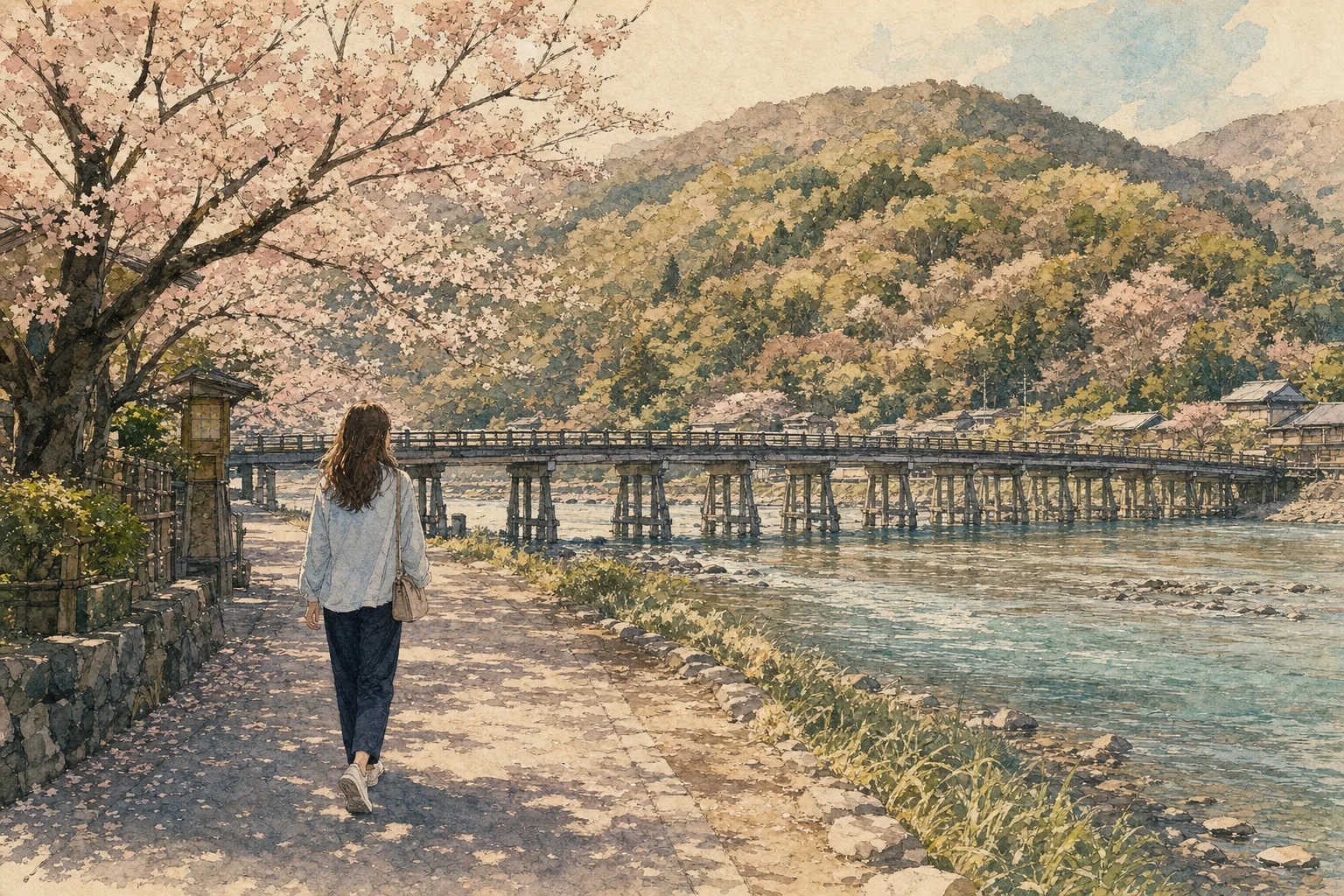
Quick Answer
Stay near Arashiyama only if you specifically want a quiet, atmosphere-led night by the river and you are happy to eat at your hotel. For almost everyone else on a first Kyoto trip, Arashiyama is a better day trip than a base.
Choose Arashiyama as your base if you are:
- A slow traveler or atmosphere-first traveler who values mornings by Togetsukyo Bridge over checking off temples.
- Staying at a ryokan where dinner and breakfast are included on site.
- Spending three or more nights in Kyoto and can "spend" one night out west.
Do not base in Arashiyama if you are:
- A first-time visitor who wants to hit Fushimi Inari, Kiyomizudera, Gion, and the Higashiyama temples efficiently.
- A low-stress planner who hates repeated train transfers at the end of a long day.
- Traveling with large suitcases and expecting to use city buses, which prohibit large luggage.
- Hoping to wander out for dinner and drinks at 8 PM.
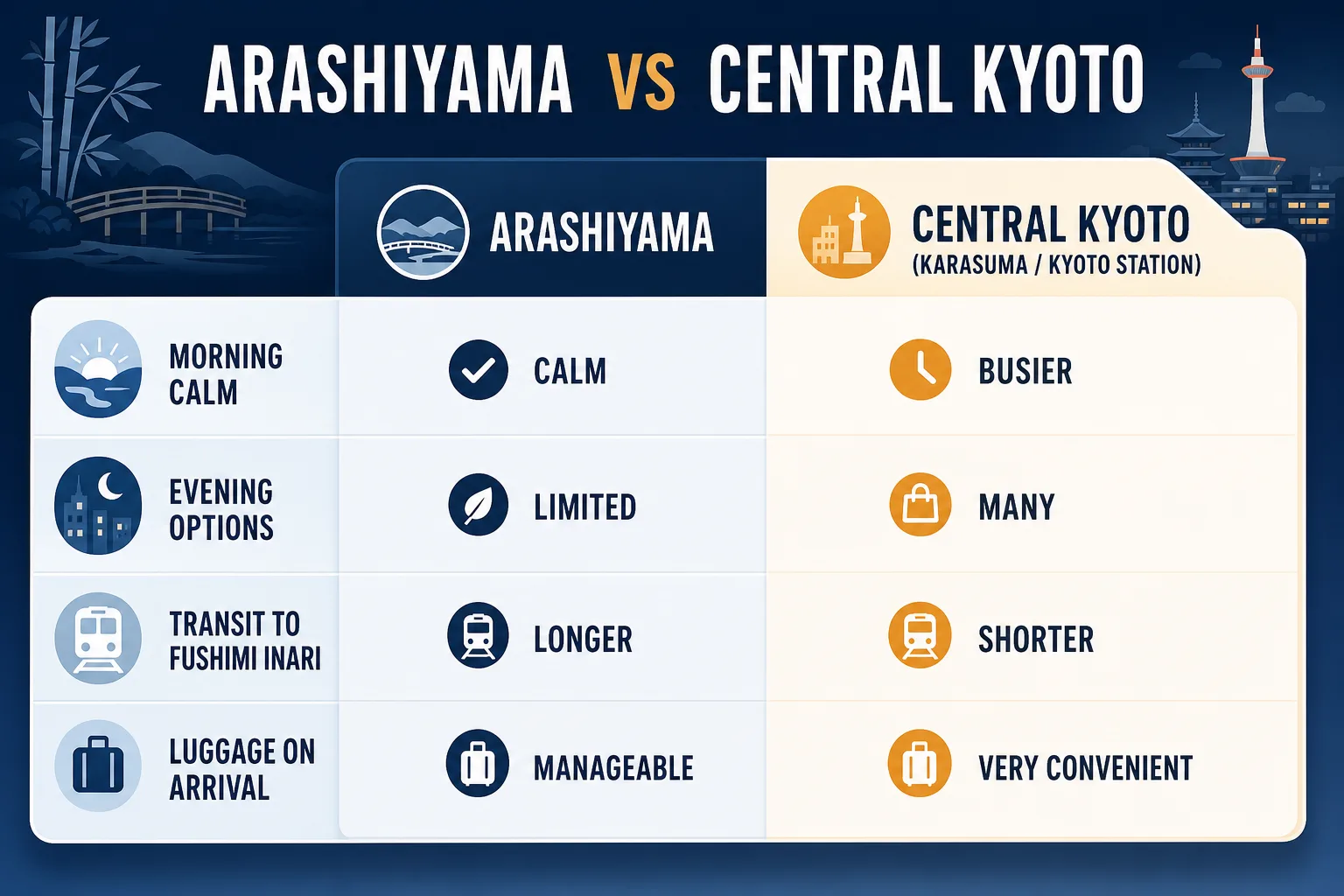
Hotel Location Risk Summary
Arashiyama's appeal is real, but the risk profile is specific. The same things that make it beautiful (a riverside setting at the western edge of the city, wooded hills, a small village feel) are what make it logistically isolated.
The main risks if you base here:
- Evening dead zone. Most cafes, food stalls, and traditional restaurants in Arashiyama close by 5:00 to 6:00 PM. After dinner, the area goes quiet fast.
- Daily transit tax. Every time you go to central or eastern Kyoto, you pay 15 to 20 minutes each way on the JR Sagano Line, plus walking to and from stations.
- Transfer fatigue to east Kyoto sights. Reaching Fushimi Inari takes 35 to 45 minutes with a transfer at Kyoto Station. Kiyomizudera and Gion are a similar story.
- Luggage friction on arrival. City buses prohibit large suitcases, so your arrival must be planned around JR, Hankyu, the Randen tram, or a taxi.
- Crowd whiplash. From about 11:00 AM to 3:00 PM, Togetsukyo Bridge and the Bamboo Forest area are heavily crowded. If you booked Arashiyama for calm, you will only get it before and after that window.
If any two of those risks would meaningfully damage your trip, base in central Kyoto and visit Arashiyama as a half-day trip instead.
Best Areas at a Glance
Here is the tradeoff in one view. "Central Kyoto" here means the Kyoto Station, Karasuma, or Shijo area, which is what most first-time visitors are actually weighing Arashiyama against.
| Factor | Arashiyama | Central Kyoto (Kyoto Station / Karasuma / Shijo) |
|---|---|---|
| Morning calm by famous sights | Strong (before ~10 AM) | Weak; you have to travel to get it |
| Evening dining options | Very limited after 6 PM | Wide range, late options |
| Transit to Fushimi Inari | 35 to 45 min with transfer | 5 to 15 min direct |
| Transit to Gion / Higashiyama | 25 to 40 min | 10 to 20 min |
| Luggage on arrival | JR, Hankyu, Randen, or taxi only | Direct from Kyoto Station, easy |
| Crowd exposure during day | Heavy 11 AM to 3 PM at top spots | Spread across more districts |
| Best fit | Atmosphere-first, slow travel, ryokan stays | First-timers, low-stress planners, short trips |
Two practical access notes worth knowing before you book:
- JR Sagano Line: Kyoto Station to Saga-Arashiyama in 15 to 20 minutes for 240 yen.
- Randen Arashiyama Station connects to central Kyoto's Shijo-Omiya Station in about 22 minutes by tram.
From Saga-Arashiyama Station, it is about an 11-minute walk to Togetsukyo Bridge and a 10-minute walk to the Bamboo Forest. From Hankyu Arashiyama Station it is about 8 minutes to the bridge, and from Randen Arashiyama Station only about 2 minutes. Pick your station based on where your hotel actually sits, not the name on the booking site.
Best Area by Traveler Type
First-time visitors
Stay in central Kyoto. You will spend most of your time in eastern Kyoto (Gion, Higashiyama, Kiyomizudera) and southern Kyoto (Fushimi Inari). Basing in Arashiyama means you ride the JR Sagano Line every day, twice a day. Visit Arashiyama as a half-day trip, ideally arriving before 9 AM.
Low-stress planners
Stay in central Kyoto, ideally within a 10-minute walk of Kyoto Station, Karasuma, or Shijo. Low-stress trips reward short, direct, repeatable routes. Arashiyama's transfer pattern is the opposite of that.
Slow travelers and atmosphere-first travelers
Arashiyama becomes defensible here, especially for 1 to 2 nights inside a longer Kyoto stay. The early-morning river path and quiet evenings (once you accept that "evening" means in-hotel) are genuinely different from central Kyoto. A ryokan with dinner included removes the biggest friction point.
Travelers with luggage
Do not plan to use city buses. Kyoto City prohibits large suitcases and luggage on city buses, which rules out the most convenient surface route into Arashiyama. Use the JR Sagano Line into Saga-Arashiyama, the Hankyu line into Hankyu Arashiyama, or a taxi. If your hotel is more than a 10-minute walk from any of those stations, reconsider.
Travelers planning long temple-walking days
Central Kyoto wins. You want short transit between Higashiyama, Gion, and Kyoto Station, not a daily 30 to 40 minute return to a hotel on the western edge.
Areas to Be Careful With
Inside Arashiyama itself, "near Arashiyama" can mean very different things in practice.
- Hotels marketed as "Arashiyama" but actually a 20-plus minute walk from the bridge. The atmosphere payoff disappears, and you keep all the transit downside.
- Properties that rely on bus access. With the city bus luggage rule and the discontinuation of the 700 yen Bus One-Day Pass (now replaced by a 1,100 yen Subway and Bus One-Day Pass), bus-dependent stays are less attractive than they used to be.
- Mid-range hotels at central Kyoto prices. If you are paying central Kyoto rates for a non-central location, you are paying for the name, not the location.
- Day-trip-only hotels. If your itinerary already has Arashiyama as a half-day visit, sleeping there too can feel like overdosing on one neighborhood.
Specific disappointment patterns to watch for: arriving in the evening and finding nothing open for dinner; planning a "quick" Fushimi Inari run after breakfast and losing 90 minutes round-trip in transit; trying to bus in with two suitcases and being turned away.
Budget vs Convenience Tradeoff
Arashiyama's hotel pricing does not reliably beat central Kyoto. Ryokan and boutique stays here often price at or above comparable central properties, and that gap is about to matter more.
Kyoto's accommodation tax will increase on March 1, 2026. For rooms priced at 100,000 yen and above, the tax rises tenfold to 10,000 yen per person, per night. If you are eyeing a high-end Arashiyama ryokan (including newly reopening properties such as Kadensho, scheduled to reopen in Arashiyama in 2026), factor that tax change into your real per-night cost.
Honest budget framing:
- Budget travelers: Central Kyoto wins. Cheaper rooms, more food options at all hours, fewer forced taxi rides.
- Mid-range travelers: Central Kyoto usually wins on convenience per yen. Use Arashiyama for a single splurge night if you want the atmosphere.
- High-end travelers: Arashiyama is defensible as a 1 to 2 night ryokan experience, but check the post-March 2026 tax line and confirm dinner is included.
Also note that some on-site costs have crept up. The admission fee for Otagi Nenbutsuji Temple, one of the quieter Arashiyama-area temples, has doubled from 500 to 1,000 yen. None of these increases are deal-breakers individually, but they add up.
Hotel Location Checklist
Use this before you confirm any Arashiyama booking.
- The hotel is within a 10-minute walk of Saga-Arashiyama, Hankyu Arashiyama, or Randen Arashiyama Station.
- You have confirmed how you will arrive with luggage (JR, Hankyu, Randen, or taxi), not by city bus.
- Dinner is either included at the property or you accept eating by 6 PM or returning toward central Kyoto.
- You have checked walking time from your chosen station to the actual hotel, not just the distance as the crow flies.
- If you are a slow traveler or atmosphere-first traveler, you have accepted that evenings will likely end at your hotel or ryokan, not at a restaurant street.
- You have a plan for at least one dinner, either in-hotel or a short evening train back toward central Kyoto.
FAQ
Is Arashiyama a good base for a first trip to Kyoto? For most first-time visitors, no. Arashiyama is a great half-day destination but a weak base. Most temples, dinner options, and night activity are in central Kyoto, and the JR Sagano Line ride back to Kyoto Station takes 15 to 20 minutes plus walking and waiting time on both ends. First-timers usually do better near Kyoto Station, Karasuma, or Gion.
How long does it take to reach Fushimi Inari from Arashiyama? Plan for 35 to 45 minutes door to door, including a transfer at Kyoto Station. If Fushimi Inari, Kiyomizudera, and Gion are high on your list, that round trip will eat into your day every time you go back to the hotel.
Can I take a large suitcase to an Arashiyama hotel by bus? No. Kyoto City officially prohibits large suitcases and luggage on city buses. For Arashiyama, you should arrive by JR Sagano Line to Saga-Arashiyama, by Hankyu to Hankyu Arashiyama, or by taxi. Plan luggage logistics before you book, not after you land.
When is Arashiyama actually quiet? Early morning and after sunset. Togetsukyo Bridge and the Bamboo Forest area are heavily crowded from about 11:00 AM to 3:00 PM. The real reward of staying overnight is being on the riverside path before the day-trip wave arrives from central Kyoto.
Are there enough dinner options if I stay in Arashiyama? Limited. The majority of cafes, food stalls, and traditional restaurants in Arashiyama close by 5:00 or 6:00 PM. If you stay overnight, plan to eat at your ryokan or hotel, or accept a short train ride back toward central Kyoto for dinner.