travel-decisions
Is a Late-Night Arrival in Tokyo a Mistake?
A practical breakdown of whether a cheap late flight into Tokyo wrecks day one, with last-train cutoffs, taxi costs, and hotel-location moves to reduce regret.
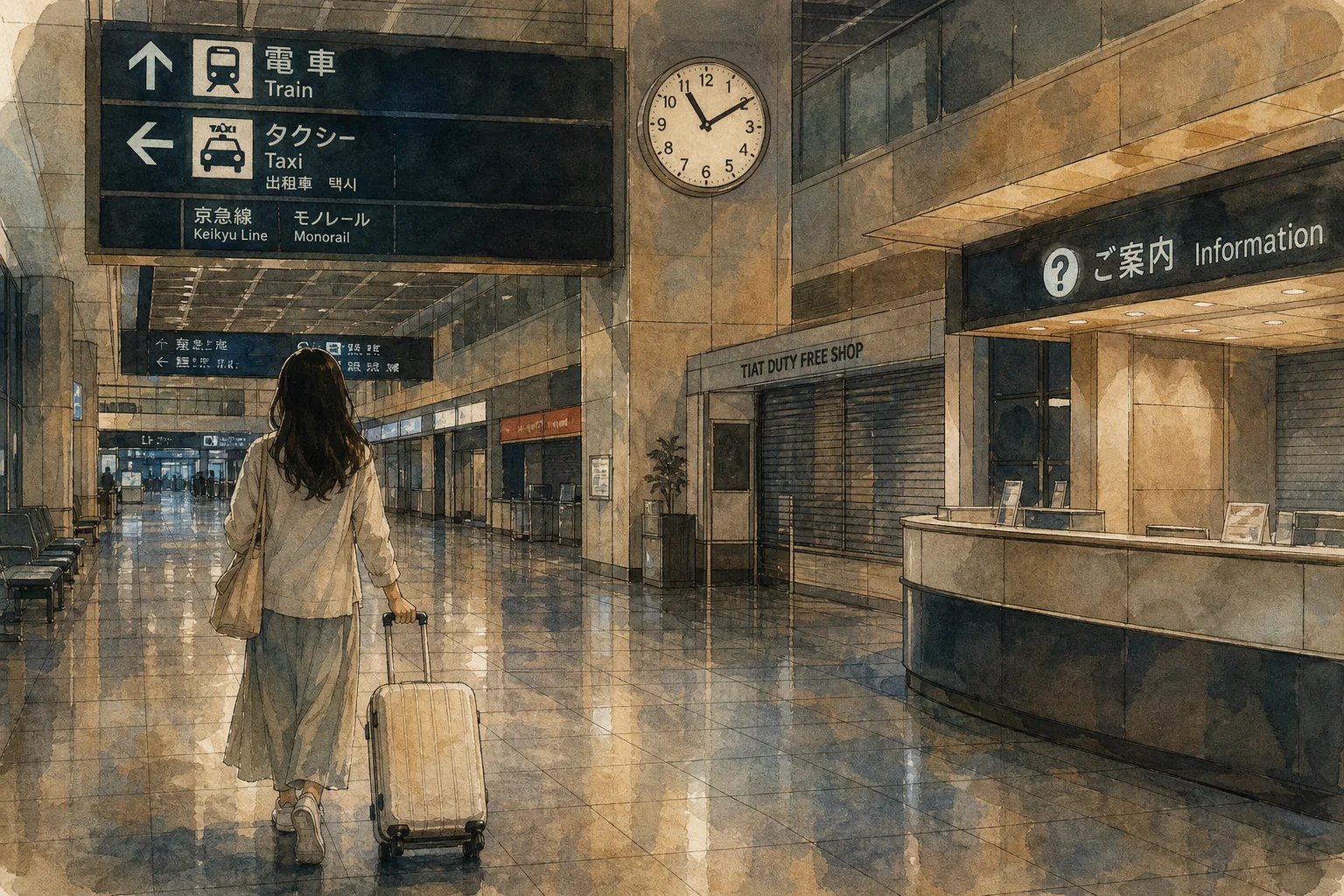
You found a flight to Tokyo that is hundreds of dollars cheaper than the daytime option. The only catch: it lands at 10:40 PM at Narita, or just before midnight at Haneda. Now you are reading forum threads at 1 AM wondering if you just booked yourself a disaster.
A late-night arrival in Tokyo is not automatically a mistake. It becomes a mistake when the airport, your hotel location, and your day-one expectations are mismatched with reality. This article walks through that fit decision so you can either keep the cheap flight without regret or upgrade with a clear reason.
Quick Verdict
A late arrival is fine if you land at Haneda before midnight, you have booked a hotel within easy reach of a train or bus line that is still running, and you have already decided day one will be slow. It is a mistake if you land at Narita after about 9:30 PM, expect to take a train into central Tokyo, and have a packed first-day itinerary booked.
Short version: Haneda late is usually manageable. Narita late is a logistics problem you need to actively solve before you fly.
If you want a faster way to know which traveler type you actually are before judging the risk, try the Travel Personality Quiz.
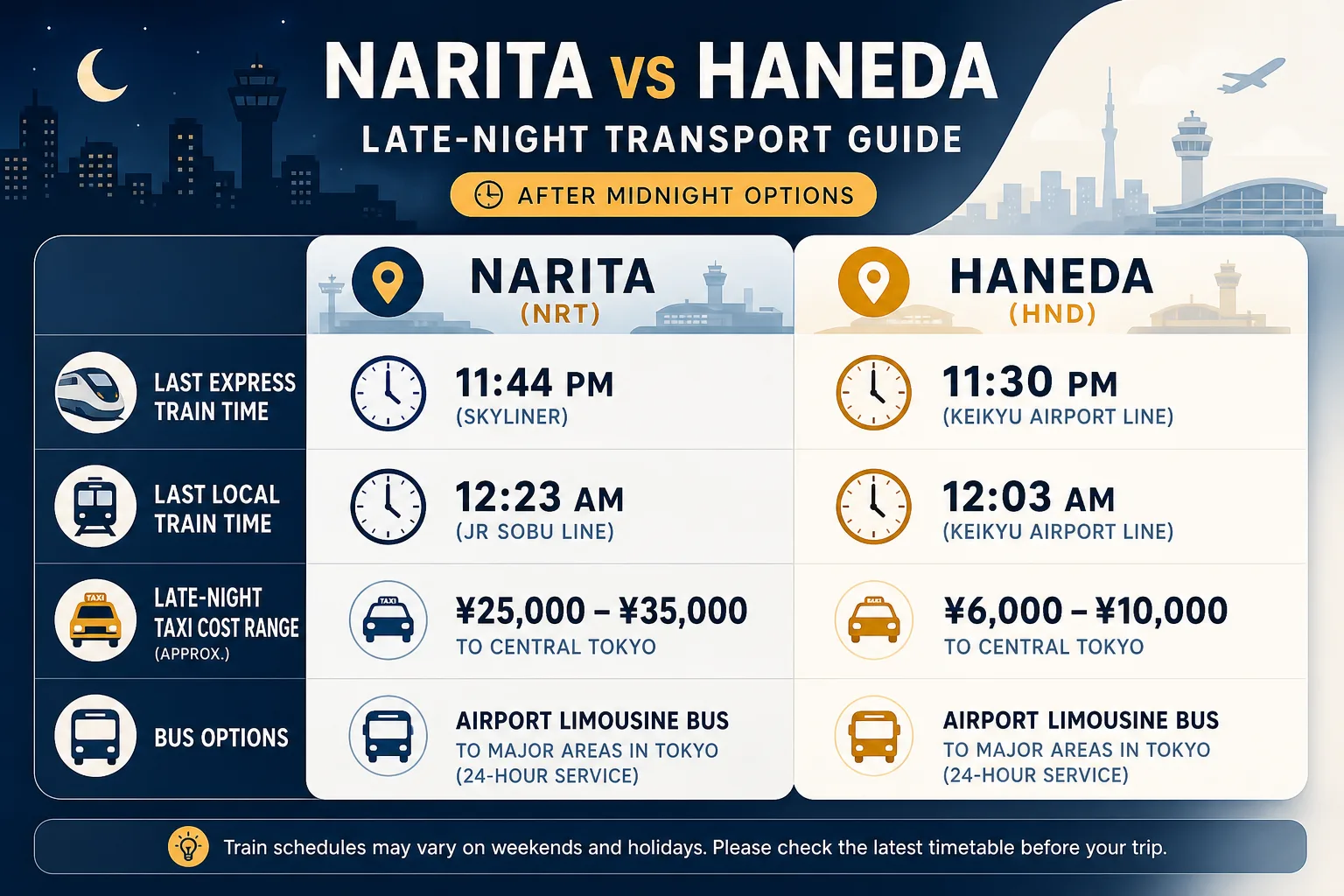 Infographic comparing late-night train times, taxi costs, and bus options from Narita and Haneda airports to central Tokyo.
Who Will Probably Be Fine With It
A late-night arrival works well if any of these describe you:
- You are landing at Haneda before 11:30 PM and booked a hotel near a Keikyu or Tokyo Monorail station.
- You are comfortable using a phone wallet for Mobile Suica or Pasmo and do not need a JR Pass exchange that same night.
- You have already accepted that day one is for sleep, breakfast, and a single relaxed neighborhood, not Shibuya Crossing at sunrise.
- You are traveling light or with a single rolling case, so a taxi or limousine bus is not painful to load.
- You booked an airport-area hotel, or a sleep-pod or onsen complex near the airport, on purpose.
These travelers tend to save real money and lose almost nothing.
Who Might Regret It
A late arrival often turns into a regret when:
- You land at Narita after 9:44 PM and assumed the N'EX would still be running.
- Your hotel is in Shinjuku, Shibuya, Asakusa, or Ginza and you assumed a 30-minute train ride.
- You booked a sunrise Tsukiji food tour, a 9 AM teamLab slot, or a morning day trip for the next day.
- You are traveling with kids, elderly parents, or four large suitcases, and the bus-then-train transfer at midnight is going to break someone.
- You expected to pick up a JR Pass, a pocket Wi-Fi rental, or a tourist transit card at the airport counter on arrival.
The pattern is the same: an assumption that a late landing time is just a number, when it actually changes which transport modes still exist.
Mistake / Consequence Table
This is where the cheap flight either holds up or quietly costs more than you saved.
| Decision you make | What actually happens | Real consequence |
|---|---|---|
| Land at Narita 10:30 PM, plan to take N'EX | Last N'EX from NRT T1 left at 9:44 PM | Forced onto Skyliner, bus, or 27,000+ yen taxi |
| Land at Narita 11:30 PM, plan to take Skyliner | Last Skyliner left at 11:00 PM | Bus to Tokyo Station area or expensive taxi |
| Land at Haneda 11:30 PM, plan Keikyu to Shinagawa | Last Keikyu departs 12:08 AM | Usually fine if customs is quick |
| Take any taxi between 10 PM and 5 AM | 20 percent late-night surcharge applies | Already-high fares get higher |
| Book a JR Pass exchange for arrival night | Counters close at 7 to 8 PM | Lose a half day the next morning fixing it |
| Plan a 9 AM activity for day one | Hotel check-in finishes around 1 to 2 AM | Either skip the activity or arrive exhausted |
The numbers themselves are not the point. The point is that one wrong assumption (which train, which counter, which surcharge) compounds into the next.
Hidden Friction Points
A few specifics that forum answers tend to gloss over:
- Customs and immigration at Tokyo airports typically take 30 to 90 minutes. A flight that lands at 10:00 PM can easily mean exiting arrivals at 11:00 PM or later. Read your landing time as your exit time minus an hour.
- Narita is 60 to 80 km east of Tokyo. Even outside of last-train issues, the trip itself is 1 to 2 hours. Haneda is 14 to 17 km from central Tokyo, with trips to major hubs in 13 to 20 minutes and to Shinjuku in 30 to 45 minutes.
- The last JR Narita Express from Narita Terminal 1 to Tokyo, Shinjuku, and Shibuya leaves at 9:44 PM. The last Keisei Skyliner from Terminal 1 to Nippori and Ueno leaves at 11:00 PM. After that, your options are bus or taxi.
- A late-night taxi from Narita to Shinjuku, Shibuya, or Minato runs 27,000 to 30,000 yen and up, before expressway tolls. From Haneda it is much cheaper but still hit with the 20 percent late-night surcharge between 10 PM and 5 AM.
- JR East Travel Service Centers (for JR Pass exchange) close at 8 PM at Haneda and Narita T2/T3, and 7 PM at Narita T1. Late arrivals cannot exchange that night.
- The physical PASMO Passport tourist card was discontinued in October 2024. Set up Mobile Suica or Mobile Pasmo on your phone before you land, especially if you arrive after most service counters close.
- First-night hotel location matters more than star rating. A 3-star near Shinagawa or Hamamatsucho beats a 4-star deep in a residential area you have to taxi to.
How to Make It Easier
Concrete moves, ordered by impact:
- Prefer Haneda over Narita when the late flight choice is close in price. The transit math is fundamentally different.
- Book your first-night hotel near a station on the line your airport actually uses. From Haneda, that means Keikyu (Shinagawa, Sengakuji) or Monorail (Hamamatsucho). From Narita, that means Keisei (Nippori, Ueno) or N'EX stations.
- Set up Mobile Suica or Mobile Pasmo in your phone wallet before departure. Top up with a card. Skip every late-night ticket machine.
- If you land at Narita after 9 PM and your hotel is far from Nippori or Ueno, book an airport-area hotel for night one and travel into the city refreshed in the morning. Natural Hot Springs Heiwajima near Haneda offers overnight packages for 3,000 to 4,500 yen and runs a dedicated midnight shuttle from Haneda Terminal 3, which is a popular budget solution.
- Pre-book a limousine bus seat if it serves your hotel area. Late-night and early-morning Haneda buses to Shinjuku, Ikebukuro, and Shibuya cost only 2,200 to 3,000 yen.
- Move JR Pass exchange, pocket Wi-Fi pickup, and SIM activation to the morning of day two, not the night of day one.
- Replan day one. Treat it as breakfast plus one neighborhood, ending early. Move any timed activity to day two or later.
See the Hotel Location Checklist for a station-by-station way to pressure-test your first-night booking.
Better Alternatives If This Is Not Your Fit
If reading the section above made you tense, the late flight is probably not the right call for you. Consider:
- Pay the premium for a daytime arrival, especially into Haneda. The cost difference often disappears once you add a late taxi and a wasted day one.
- Keep the cheap late flight, but only into Haneda, and book a capsule or business hotel within one train stop of the airport for the first night. Move to your real hotel the next morning.
- If only Narita late flights fit your budget, book a hotel near Nippori or Ueno on the Keisei Skyliner line and target the 11:00 PM last Skyliner with a buffer. If your landing time does not support that buffer, default to an airport-area hotel.
- Travelers who really value a smooth arrival should look at flights landing between 1 PM and 7 PM, which give the most flexibility for transit, counters, and hotel check-in.
Pre-Booking Self-Checklist
Run through this before you commit to the late flight or accept the booking you already made:
- I know my scheduled landing time and have added 60 minutes for customs to estimate when I will actually exit arrivals.
- I know which airport I am landing at (NRT or HND) and the last train time from that airport on the line my hotel sits on.
- My first-night hotel is within a 10 minute walk of a station on that line, or I have a bus or taxi plan that does not depend on the train.
- I have a realistic taxi budget if everything else fails (Haneda: lower hundreds of dollars; Narita: 27,000 to 30,000+ yen).
- I have set up Mobile Suica or Mobile Pasmo, or accepted I will buy single tickets at machines.
- I have not booked any morning activity for day one that I would be upset to miss.
- If I need a JR Pass, I have planned the exchange for day two during counter hours.
- I have a backup plan for an airport-area hotel if my flight is delayed by 1 to 2 hours.
If you can check every box, the late arrival is a fine decision. If three or more are uncertain, either change the flight or change the hotel.
FAQ
What time is too late to land in Tokyo if I want public transit? At Narita, plan to clear customs before about 9:00 PM for the last N'EX, or before about 10:30 PM for the last Skyliner. At Haneda, the last Keikyu train to Shinagawa leaves at 12:08 AM, giving more margin. After those times, you are on a bus, a taxi, or staying near the airport.
Is a late arrival worse at Narita or Haneda? Significantly worse at Narita. It is 60 to 80 km from central Tokyo with a late-night taxi running 27,000 to 30,000 yen plus tolls. Haneda is 14 to 17 km out, has trains until just after midnight, and has late buses to major hubs for 2,200 to 3,000 yen.
Should I book a hotel near the airport for the first night? Often yes if you exit arrivals after the last express train. An airport-area hotel, or a place like Natural Hot Springs Heiwajima near Haneda with a midnight shuttle, is frequently cheaper than a late taxi and lets you start day one rested from a central hotel.
Will a late arrival ruin my first day in Tokyo? Only if you planned a full day. A late arrival plus a 9 AM teamLab booking is the actual mistake. A late arrival plus a slow breakfast and one easy neighborhood is fine.
Can I still get a Suica or PASMO card late at night? The physical PASMO Passport tourist card was discontinued in October 2024, so do not rely on tourist cards at the counter. Set up Mobile Suica or Mobile Pasmo on your phone before you fly. JR Pass exchange counters close by 7 to 8 PM and will need to wait until the next morning.
Is the late-night taxi surcharge avoidable? No. Japanese taxis apply a 20 percent surcharge between 10:00 PM and 5:00 AM nationwide. The only ways around it are taking a train or bus instead, or waiting until after 5 AM, which is almost never the right tradeoff after a long-haul flight.