travel-decisions
Is Madrid a Bad Fit for Travelers Who Want Walkable Old-Town Charm Like Florence?
Madrid is walkable and atmospheric, but it does not feel like Florence. A direct fit verdict for travelers who chase compact old-town charm.
Quick Verdict
Madrid is walkable and atmospheric, but it is not Florence. If your favorite memory of Florence is stepping out of a small hotel and reaching every major sight in 10 minutes through one continuous medieval old town, Madrid will partially deliver and partially disappoint.
Strong fit if you want:
- a walkable capital with grand plazas and lively evening streets
- art and food at world-capital scale, not small-town scale
- a base where you can spend three to five days and still find new neighborhoods
Weak fit if you want:
- a single compact old town you never have to leave
- a tightly medieval, Renaissance-era streetscape
- a small-city pace where the whole tourist core fits inside a 1 km circle
The honest read: Madrid is closer to a walkable Paris-lite than to Florence. Pick it for atmosphere and street life, not for old-town containment.
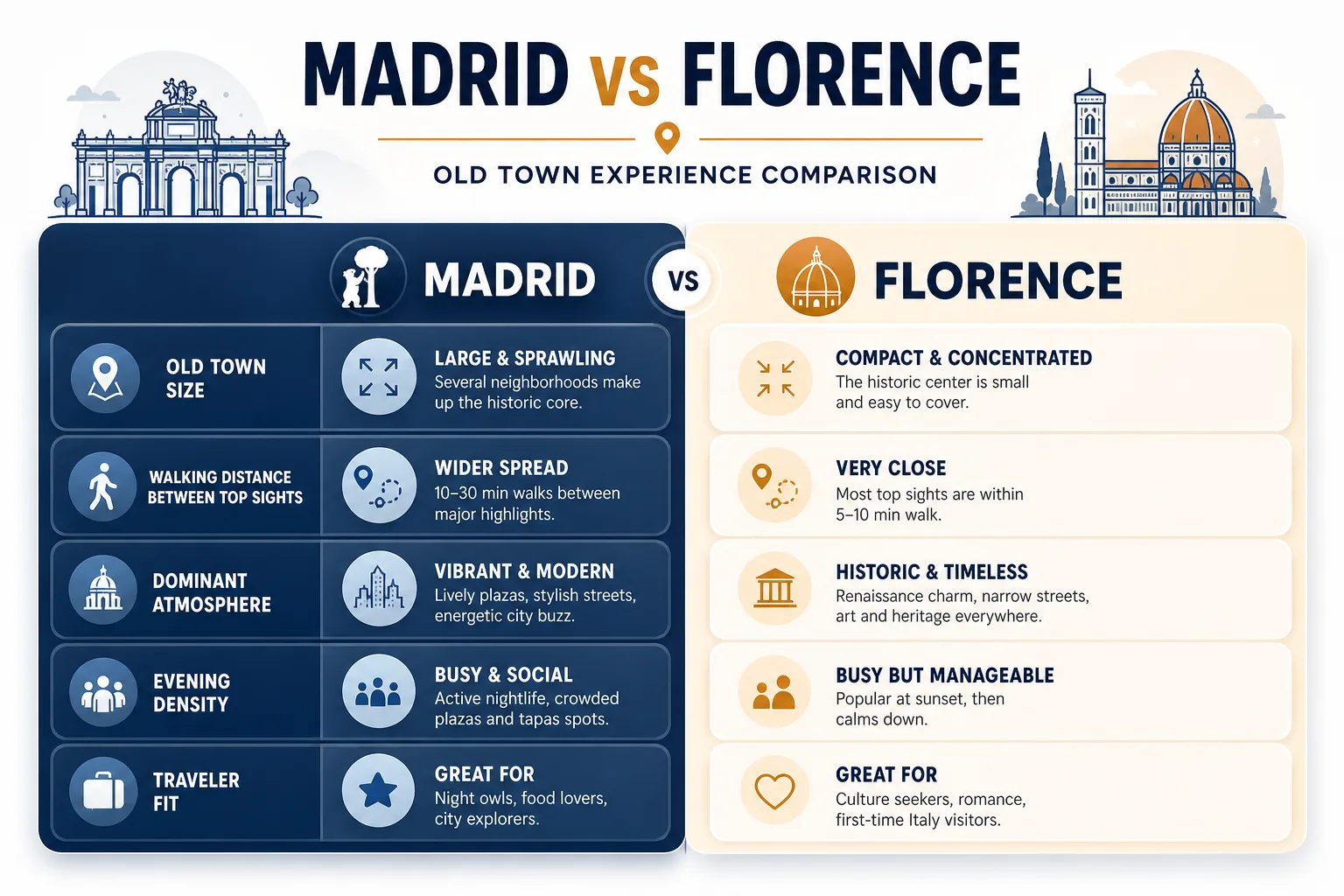 A comparison chart contrasting the old town experiences of Madrid and Florence.
Best for First-Time Visitors
First-time visitors who loved Florence usually want two things: easy orientation and a constant sense of being inside the historic core. Madrid delivers the first more than the second.
The central spine from Puerta del Sol to Plaza Mayor is a 3 to 5 minute walk, and from there you can reach La Latina, Las Letras, and the Royal Palace area on foot without ever opening a map. That is enough to feel oriented on day one.
What it does not give you is the Florence trick of every street looking 500 years old. Madrid's historic center mixes 17th to 19th century facades with modern shopfronts and wide boulevards. For an atmosphere_first first-timer, that is fine. For an old_town_lover who wants every corner to read as "old," it can feel diluted.
If this is your first trip and you want both walkability and an unbroken historic feel, give yourself a hotel inside the Sol to La Latina ring and treat the rest of Madrid as optional.
Best for Couples
Couples coming off a Florence trip usually book Madrid hoping for the same long, slow evening: aperitivo, wander, dinner, wander, gelato. Madrid does this well, just at a louder volume.
La Latina on a weekend evening, Plaza de Santa Ana in Las Letras, and the small streets around Mercado de San Miguel all give you the dense, social, walk-everywhere atmosphere couples remember from Florence. Tapas crawls naturally replace the long sit-down dinner, which suits travelers who like to keep moving.
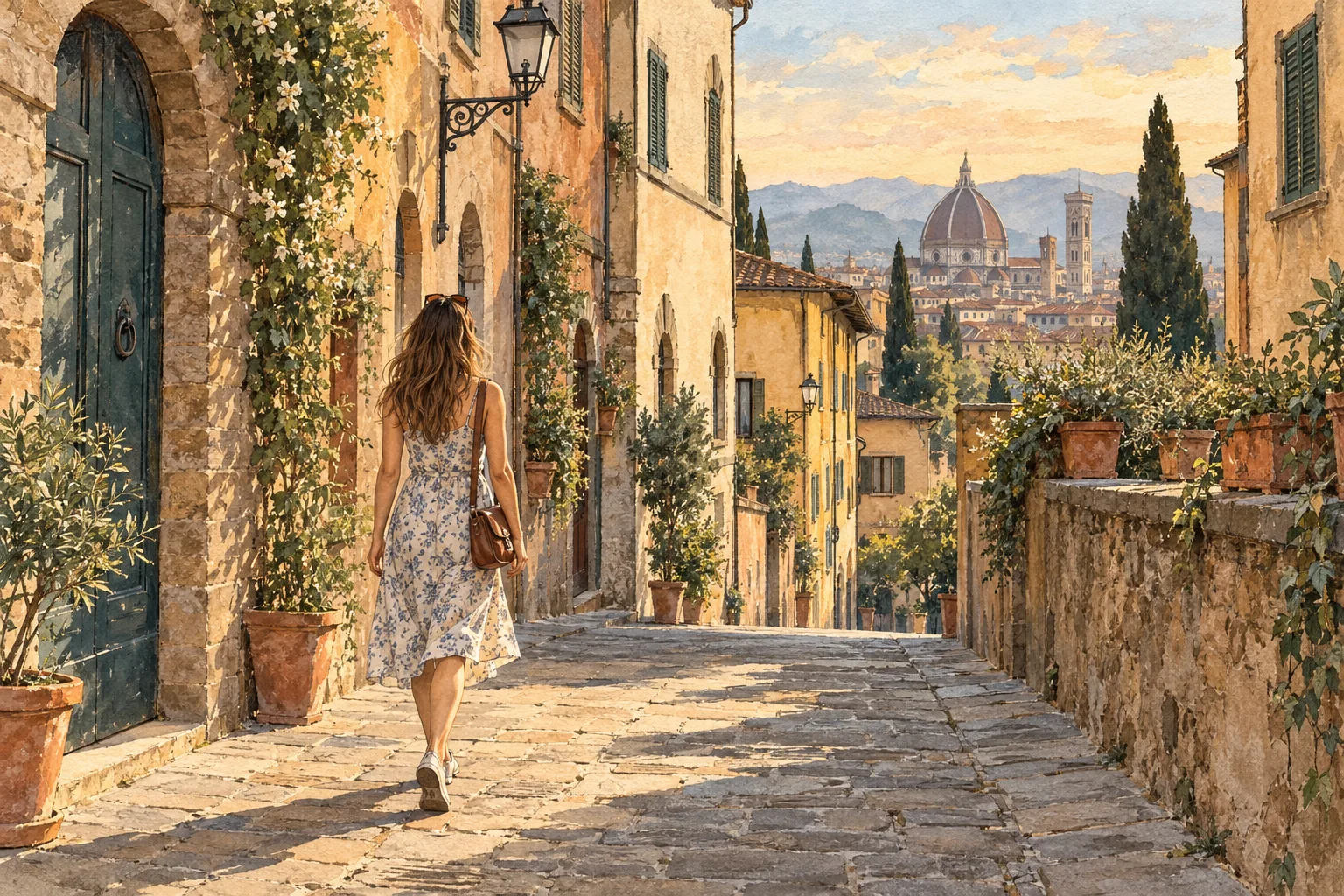
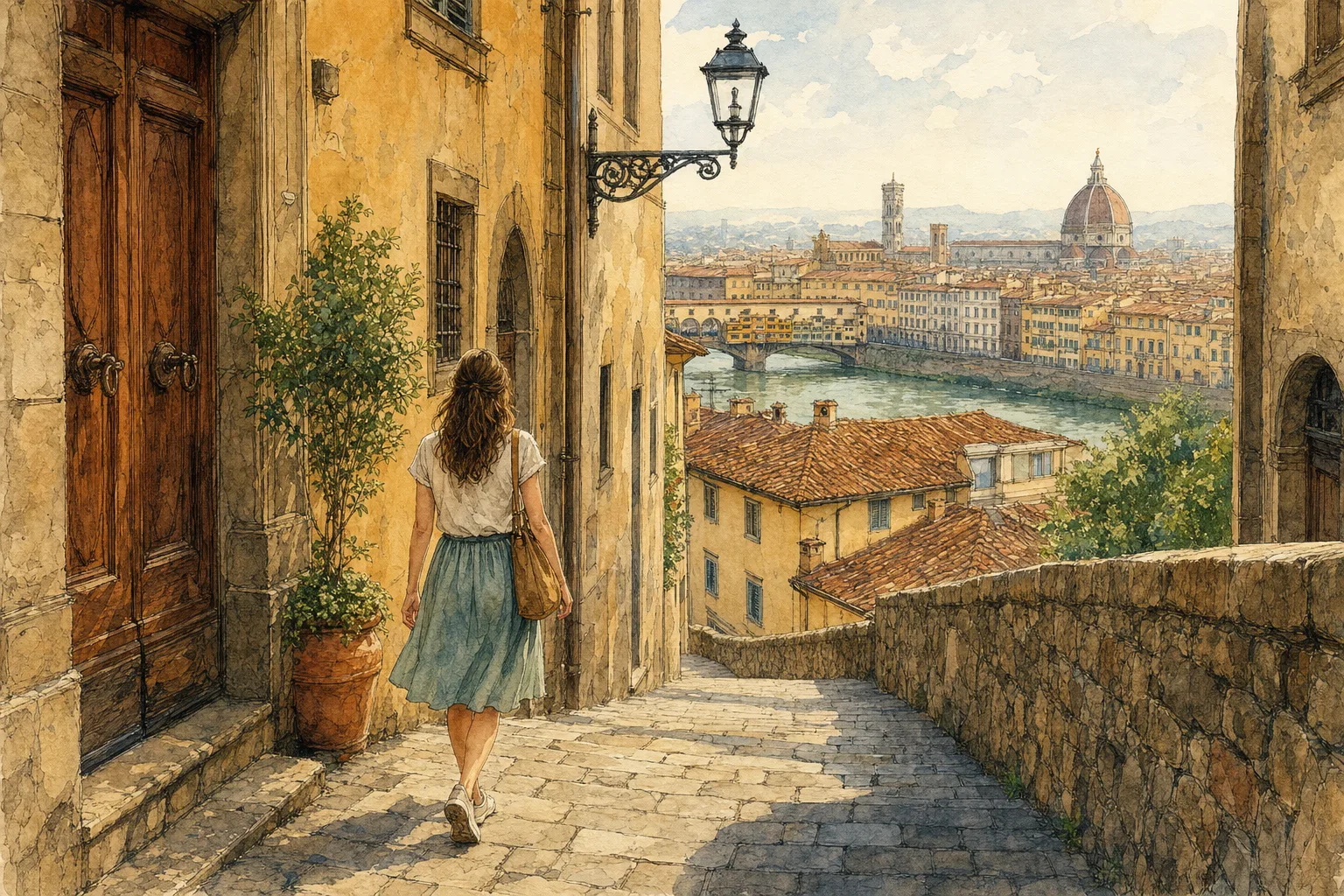
Where it diverges: Madrid's romantic moments are urban, not pastoral. There is no equivalent of crossing the Arno at sunset and seeing hills. The romance here is plaza-and-streetlight romance, not Tuscan-view romance. Couples who want that quieter postcard feel will be happier extending into Segovia or Toledo for a day.
Best for Slow Travelers
Slow travelers who pick a city for mood rather than a checklist tend to enjoy Madrid more than they expect. The decision point is whether you can let go of the Florence template.
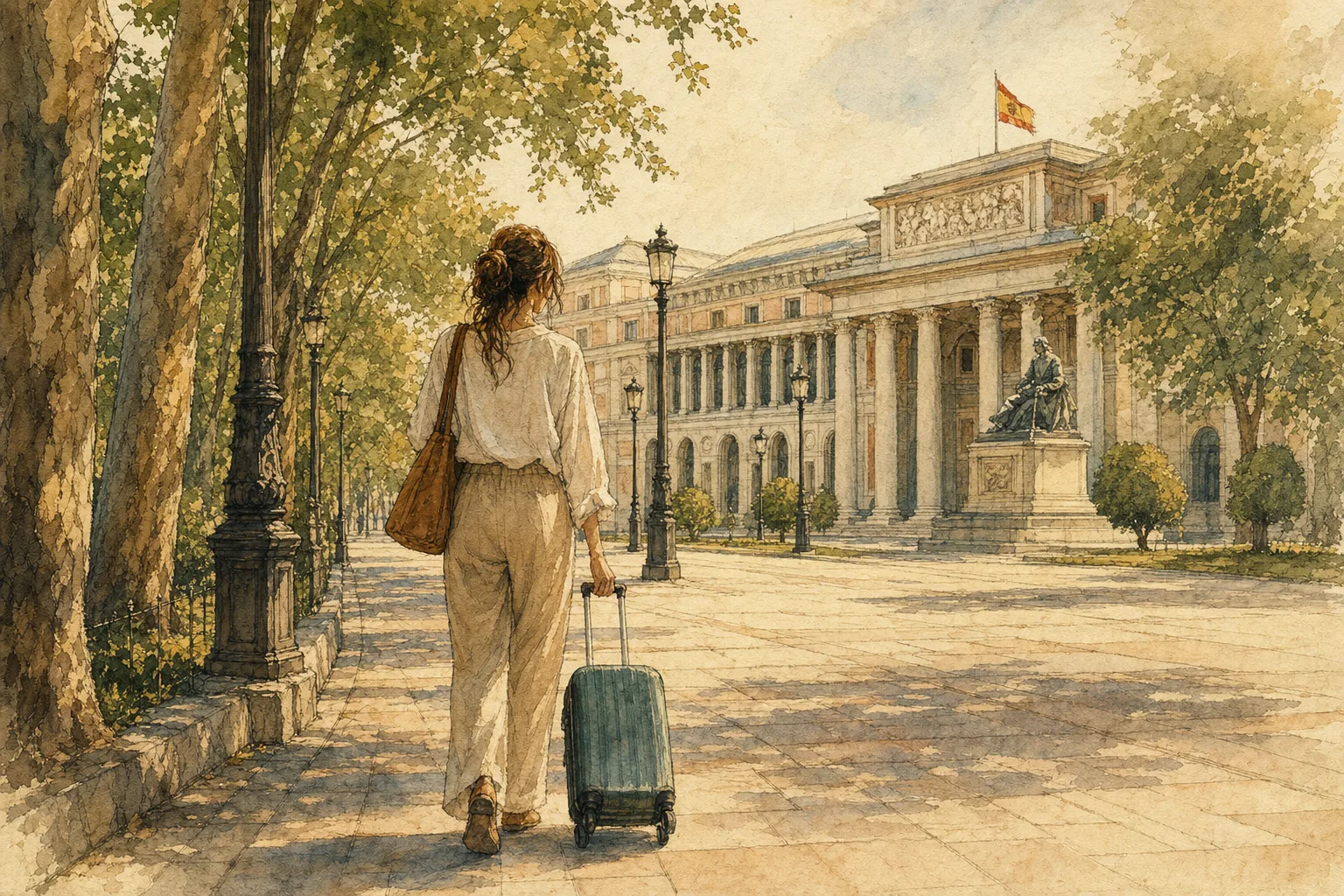
Madrid rewards repetition. Returning to the same cafe in Las Letras three mornings in a row, walking the Paseo del Prado in the evening when the light softens, sitting in Plaza de la Paja with no plan, all of that is exactly the slow-traveler payoff. The 2.8 km museum walk from the Prado to the Reina Sofia, about 30 to 35 minutes, is also a natural slow-day route.
The catch for slow travelers is scale. Florence lets you "exhaust" the old town in two or three days and then just live in it. Madrid keeps offering new neighborhoods (Chueca, Malasana, Lavapies, Retiro edge) that pull you outward. If you treat the central ring as your whole stay and ignore the rest, you get a Florence-like rhythm. If you try to see everything, you lose it.
Best for Low-Stress Travelers
Low-stress travelers care about one thing more than atmosphere: not having to think. Madrid scores well here on logistics and less well on expectation management.
Logistics are easy. Metro Line 8 connects Adolfo Suarez Madrid-Barajas Airport to Nuevos Ministerios in 12 to 20 minutes. From Atocha train station, walking to a central apartment takes roughly 25 minutes, or a few metro stops. The metro runs from 6:00 AM to 1:30 AM, which covers late dinners without taxi anxiety.
The stress, when it shows up, is expectation_mismatch. Travelers who pictured Florence and arrive into Madrid's wide avenues and modern traffic sometimes spend a half day adjusting. If you go in expecting a walkable capital with old-town pockets rather than a single old town, your stress drops to near zero. From 2026, note that smoking and vaping are also banned on all bar and restaurant terraces, which makes outdoor seating more comfortable for sensitive travelers.
Traveler Type Table
This is the actual gap most readers are deciding about.
| Decision variable | Madrid | Florence |
|---|---|---|
| Old-town footprint | 3 to 5 km between key central sites | Roughly 1 km dense core |
| Sol to Plaza Mayor walk | 3 to 5 minutes | n/a, but comparable cluster walks |
| Dominant atmosphere | Capital city, grand plazas, lively tapas streets | Compact Renaissance old town |
| Evening density | Spread across 4 to 5 neighborhoods | Concentrated in one core |
| Day-trip vibe | Need 3 to 5 days to feel it | 2 days covers the core |
| Best months | Apr to May, Sep to Oct (15 to 25 C) | Spring and early fall |
| Fit for old_town_lover | Partial | Strong |
| Fit for atmosphere_first | Strong | Strong |
Read it this way: if the row that matters most to you is "old-town footprint," Madrid is a weak fit. If it is "evening atmosphere," Madrid is competitive.
Common Mismatches
The travelers who regret choosing Madrid almost always share one of these patterns:
- They booked Madrid expecting a Florence-sized historic core and felt the center was "too spread out."
- They stayed outside the Sol to La Latina ring to save money, then spent the trip on the metro instead of walking, which killed the old-town feeling they wanted.
- They went in August chasing 30 to 50 percent lower hotel rates, and ran into 32 to 38 C heat plus closed local shops and restaurants, which drains the street life that makes Madrid worth visiting.
- They tried to "see all of Madrid" in three days and never let any neighborhood settle into a Florence-style rhythm.
- They expected the photo-perfect uniform medieval streetscape of Florence and read Madrid's mix of eras as "not historic enough."
Quick self-check before you book:
- I understand Madrid's center is 3 to 5 km across, not 1 km
- I am willing to stay in the central ring even if it costs more
- I am going in a shoulder month, or I have a plan for August heat and closures
- I am okay with a capital-city feel, not a Tuscan old-town feel
- I have at least three full days to let the city settle
If you cannot check at least four of those, the fit is shaky.
Final Match Recommendation
Choose Madrid if you are an atmosphere-led traveler who wants walkable street life, late dinners, world-class museums on one easy 30 minute walk, and a base where logistics (airport in 12 to 20 minutes, metro until 1:30 AM, no tourist tax) get out of your way.
Skip Madrid, or pair it with Toledo or Segovia, if your Florence love was specifically about a tiny, contained, uniformly historic old town you never had to leave. Madrid will keep nudging you outward, and that is its strength, not a flaw to fight.
The cleanest decision rule: if you would describe your ideal trip as "I want to live inside a small old town," Madrid is a weak fit. If you would describe it as "I want to walk a real city all evening and feel its atmosphere," Madrid is a strong fit.
FAQ
See the FAQ block above for direct answers on compactness, walking-only trips, best months, tourist apartments, and tourist tax.