travel-decisions
Is Rome Too Tiring If You Can't Walk All Day?
A decision-focused guide for travelers worried Rome will exhaust them. Cobblestones, stairs, heat, and how to plan a low-walking trip that still works.
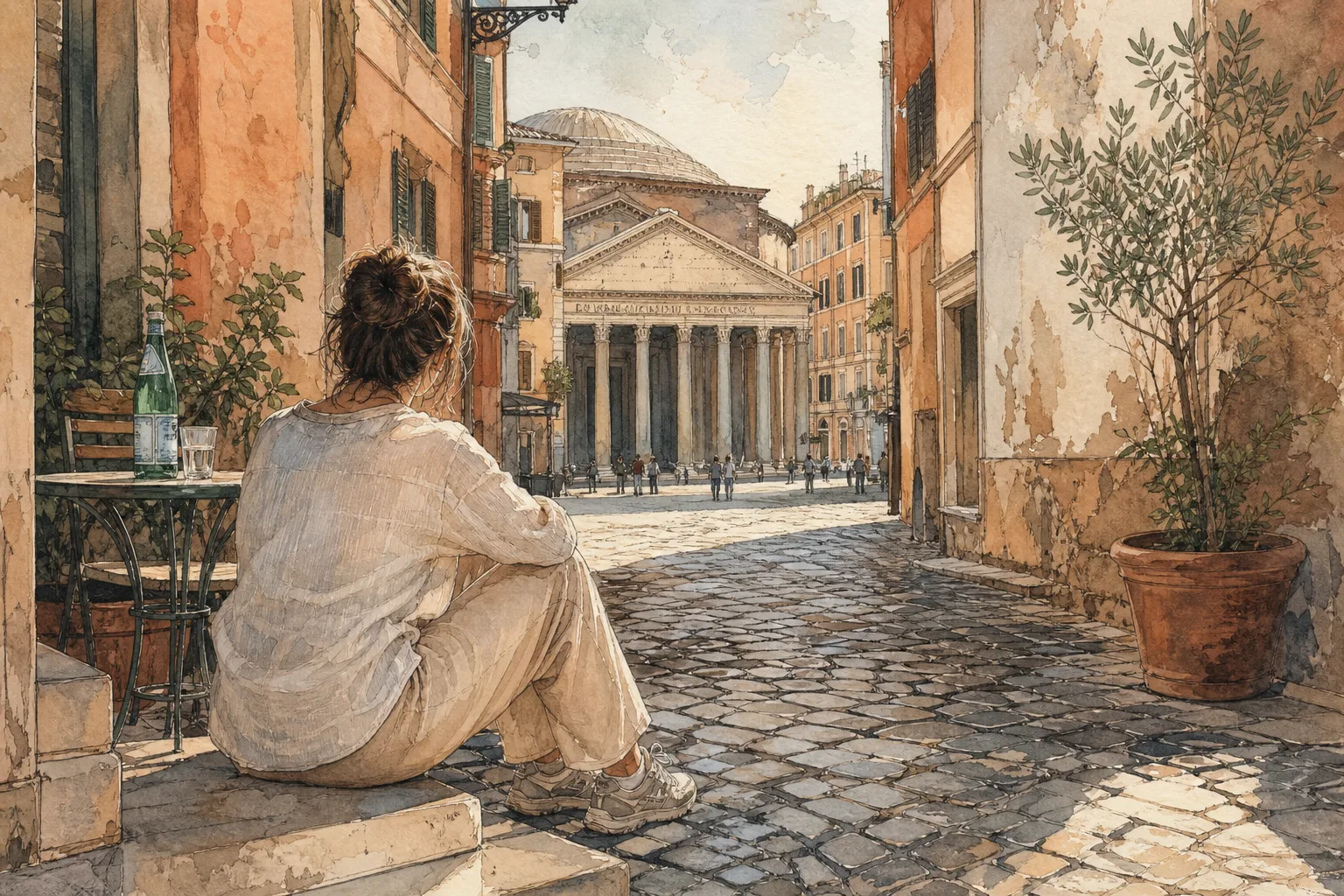
Rome looks compact on a map, but the city punishes anyone who plans it like a flat European capital. Cobblestones, hills, partial metro access, and heat add up fast. The question is not whether Rome is beautiful. It is whether the version of Rome you can actually do is still worth the trip.
Quick Verdict
Rome is a workable destination for travelers who cannot walk all day, but only if you redesign the trip around pacing instead of around a sight list.
Strong fit if you:
- Are willing to stay 5 nights or more so you can spread sights out
- Will sleep in a flat neighborhood like Prati and use taxis between zones
- Can accept seeing fewer landmarks in exchange for finishing each day intact
Weak fit if you:
- Have only 2 to 3 days and want to see everything
- Cannot stand or walk for 20 to 30 minutes at a stretch without sitting
- Are traveling in July or August with no afternoon rest built in
If you are in the weak-fit group, scroll to Better Alternatives before booking.
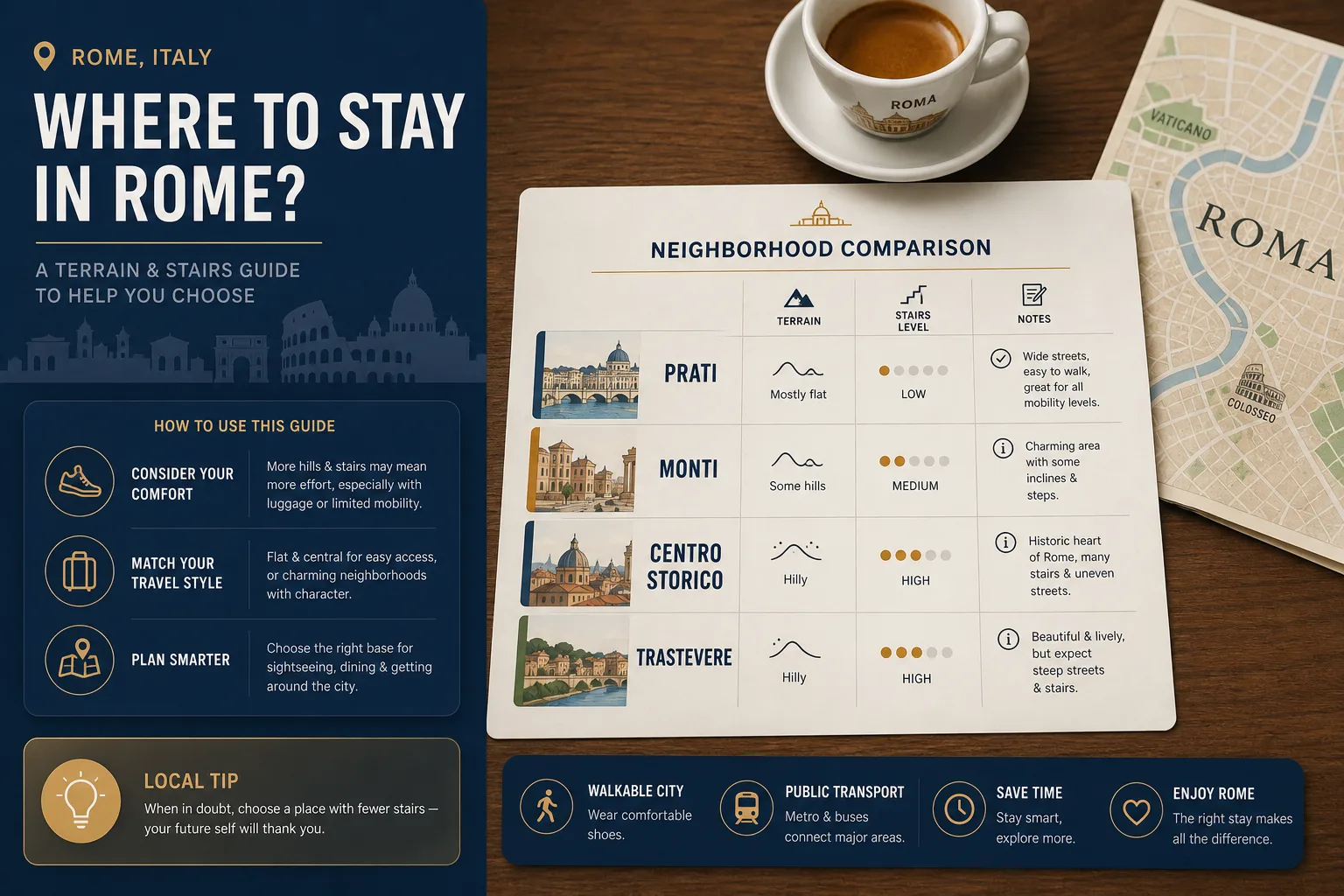 An infographic comparing the terrain and stairs difficulty across different neighborhoods in Rome to help travelers plan their stay based on mobility.
The Real Friction: Why Rome Tires People Out
Rome is not tiring because the distances are huge. It is tiring because the surfaces, the inclines, and the schedule pressure all stack at once.
Cobblestones (sampietrini). Walking on Rome's volcanic basalt cobblestones requires 17 percent more energy than walking on flat surfaces. That is a measured difference, not a feeling. Over a 3 km sightseeing day, your body is doing closer to 3.5 km of work, on uneven ground that also stresses ankles and knees.
Stairs and long sightseeing walks. Many central metro stations, especially on the older Line A (Spagna, Barberini, Repubblica, Vittorio Emanuele), have no standard lifts. Major sights like the Colosseum and the Vatican Museums involve significant indoor walking even after you arrive. The walk from the Colosseum to the Trevi Fountain alone is about 1.6 km and takes 20 to 25 minutes at a steady pace, mostly on cobblestones.
Summer heat and fatigue. Rome in June through September is hot, often above 32 C in the afternoon. The classic American itinerary of walking from 9 a.m. to 7 p.m. will break most low-stamina travelers in a single day.
Schedule pressure. This is the friction people underestimate. Rome rewards slow days. Most trip plans assume fast ones. The mismatch is what produces the "Rome was exhausting" story.
Friction Table: Where the Tiredness Actually Comes From
| Friction source | Why it hits low-walking travelers | Practical workaround |
|---|---|---|
| Sampietrini cobblestones | 17 percent more energy per step, ankle and knee stress | Stay in Prati (flat, smooth sidewalks); avoid Monti's steep cobbled lanes |
| Metro stairs | 4 stations fully inaccessible, 14 need advance stair-lift booking | Use Metro C (Porta Metronia, Colosseo-Fori Imperiali opened Dec 16, 2025) where possible; otherwise taxi |
| Long sight-to-sight walks | Colosseum to Trevi is 1.6 km / 20-25 min on uneven ground | Split sights across days; take a taxi between zones, not within them |
| Summer heat | Afternoon fatigue compounds with cobblestone effort | Sightsee 8-11 a.m., rest 12-4 p.m., return 5-8 p.m. |
| Taxi access | Cannot hail on the street; must use stands or apps | Pre-install FreeNow or Uber; note fixed 50 euro Fiumicino fare |
| Schedule pressure | Trying to see everything in 3 days | Plan one major sight per day, nothing else mandatory |
Who Will Feel It Most
Not every low-walking traveler experiences Rome the same way. The hardest-hit profiles are:
- Travelers with knee, hip, or foot pain. Cobblestones are the dominant problem. Even short walks become disproportionately tiring.
- Older travelers staying centrally without an elevator. Many central buildings have stairs to reach the apartment door, on top of the city's own stairs.
- First-time visitors on a 2 to 3 day stop. The compressed schedule forces long walking days that a longer trip would not require.
- Summer travelers without an air-conditioned base. Heat plus cobblestones is the combination that ends trips early.
If you fit two or more of these, your trip design matters more than your destination choice.
How to Reduce the Friction
You can take roughly 60 to 70 percent of the physical load off a Rome trip with five decisions made before you arrive.
- Pick a flat neighborhood. Prati, north of the Vatican, has flat terrain and smooth concrete or asphalt sidewalks with very few cobblestones. It is the single biggest stamina decision you can make.
- Avoid Monti as a base. It is charming but highly hilly with steep, narrow cobblestone streets. Visit it once, do not sleep there.
- Use taxis between zones, not within them. Walking inside one piazza is fine. Walking from the Colosseum to the Vatican is not. Book through FreeNow or Uber since street hailing does not work in Rome.
- Plan one major sight per day. The Vatican Museums alone is a full day for a low-walking traveler. Pairing it with anything else is the mistake.
- Schedule a real afternoon break. Go back to the hotel between roughly noon and 4 p.m., especially May through September. This is not optional in summer.
Extra leverage points:
- At the Vatican Museums, certified disabled visitors get free admission, priority entry for themselves and a companion, and free manual wheelchair rentals.
- Starting February 2, 2026, the new 2 euro Trevi Fountain basin-level entry fee (9 a.m. to 10 p.m.) is waived for disabled visitors.
- The Pantheon entry fee goes from 5 to 7 euros on July 1, 2026, so budget accordingly.
Better Alternatives If Rome Is the Wrong Fit
If the friction table looks worse than the appeal, swap rather than force it.
- Florence for art and walkable scale, but warning: also has cobblestones and hills. Better only if you would have stayed under 3 days in Rome anyway.
- Venice for no traffic and short distances, with the major caveat of bridges and steps. Good for slow strollers, bad for stair-avoiders.
- A Tuscan or Umbrian base with day trips. Hotel with pool, drive or transfer to small towns, much shorter walking days. Best fit for travelers who want Italy but not a city marathon.
- A river cruise that stops in Rome for a day. You see the highlights with a guided pace and a guaranteed return to a comfortable room.
The honest tradeoff: Rome at full strength is unmatched. Rome at half strength is still better than most second-choice cities. The wrong move is Rome at a quarter of your strength on day 3 because days 1 and 2 broke you.
Decision Checklist Before You Book
Run through this list. If you can answer yes to most of them, book Rome.
- I have at least 5 nights in Rome, ideally 6 to 7.
- My hotel is in Prati or another flat area with an elevator.
- I have built in an afternoon rest block every day.
- I am planning no more than one major sight per day.
- I have FreeNow or Uber installed and know taxis cannot be hailed on the street.
- I am not traveling in late July or August, or I have strong air conditioning if I am.
- I have checked whether my Vatican Museum or other sight tickets allow disability or companion access.
- I am willing to skip sights I cannot reach comfortably, instead of pushing through.
Three or more unchecked boxes is a sign to either restructure the trip or reconsider the destination.
FAQ
Can I see Rome without walking 20,000 steps a day? Yes, if you accept a slower pace. Most travelers can cover the major sights over 5 to 7 days by limiting each day to one main site, using taxis between zones, and resting in the afternoon.
Are taxis a realistic way to get around Rome with limited mobility? Taxis are practical, but you cannot hail them on the street. You need to walk to a taxi stand or book through apps like FreeNow or Uber. Fixed-rate fares like the 50 euro ride from Fiumicino Airport make airport transfers predictable.
Is the Rome Metro usable if I cannot handle stairs? Partially. Four stations are completely inaccessible and 14 require advance staff booking for stair-lifts. Older Line A stops like Spagna, Barberini, Repubblica, and Vittorio Emanuele lack standard lifts. The newer Metro C stations Porta Metronia and Colosseo-Fori Imperiali, opened December 16, 2025, have modern elevators and are the most accessible option near the Colosseum.
Which neighborhood is easiest if I want to walk less? Prati, north of the Vatican, has flat terrain and smooth concrete sidewalks with very few cobblestones. Monti, by contrast, is hilly with steep narrow cobblestone streets and is much harder on joints. Choose Prati as your base and visit Monti briefly, not the other way around.
Do I get any discounts or skip-the-line access with a disability? At the Vatican Museums, visitors with certified invalidity receive free admission, priority entry for themselves and a companion, and free manual wheelchair rentals. The 2 euro Trevi Fountain basin-level entry fee starting February 2, 2026 is also waived for disabled visitors. Bring documentation in English or Italian when possible.