travel-decisions
Is Venice Good for Travelers Who Want Quiet Nights?
A traveler-fit guide to deciding whether Venice suits quiet-night travelers, couples, and low-stress planners who care more about restful evenings than nightlife.
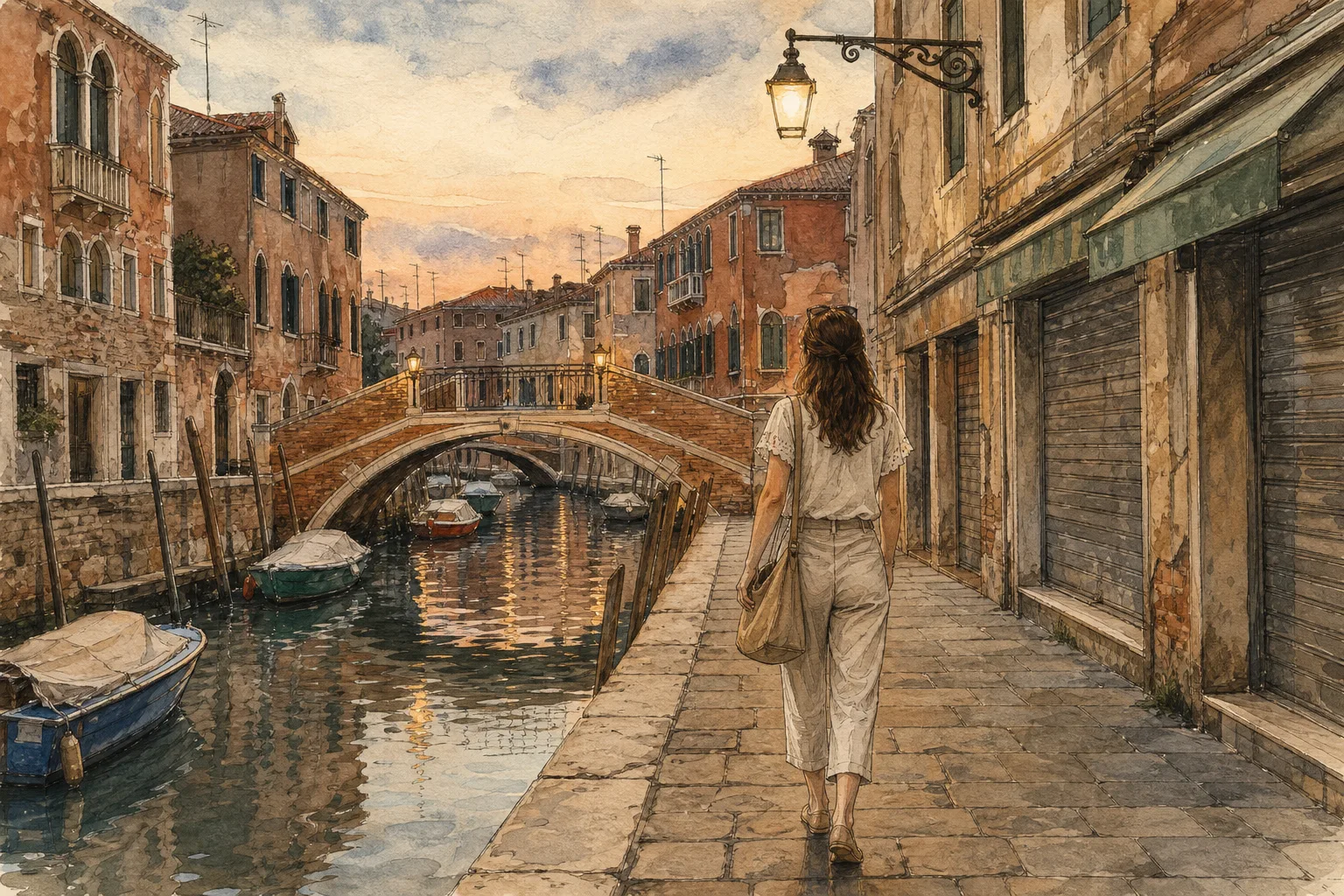
Venice has a reputation problem for quiet-night travelers. The daytime images of crowded squares and packed vaporetti suggest a city that never settles down. The reality is more specific: Venice can be one of the quietest major European cities after dark, but only if you choose the right sestiere and the right season. Get either wrong and you will hear footsteps, suitcase wheels, and late diners until well past midnight.
Quick Verdict
Venice is a strong fit for travelers who want quiet nights if you stay in a residential sestiere away from the central nightlife corridors, travel outside peak summer when possible, and accept a longer walk to St. Mark's in exchange for calm evenings.
It is a weak fit if you want to be steps from the main sights, are price-anchored to the cheapest central rooms, or expect a lively dinner scene without the noise that comes with it. The city's new nightlife ordinance has shortened the loud-music window in central zones, but the structural source of nighttime noise, narrow stone alleys that amplify every footfall, has not changed.
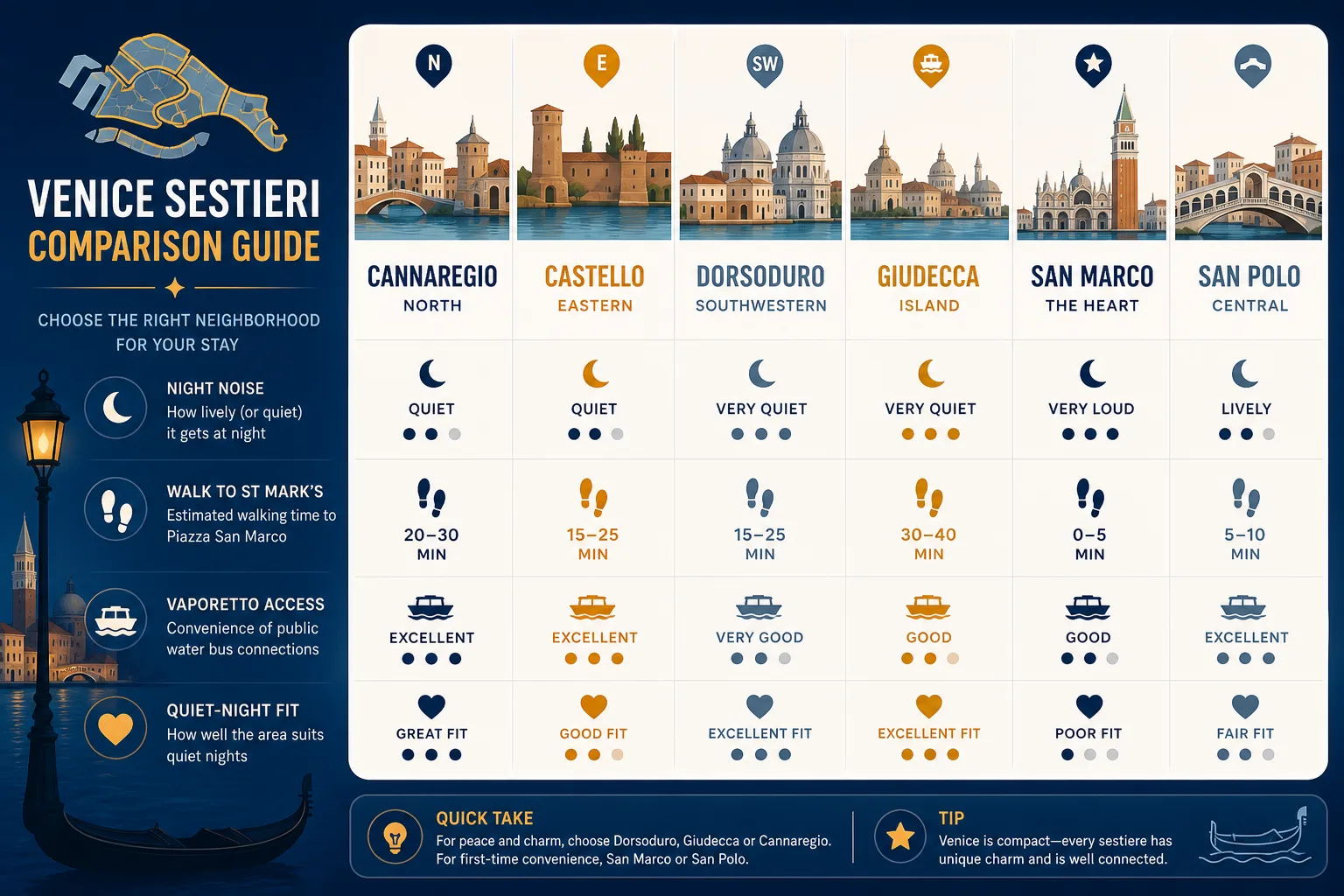 An infographic comparison guide of Venice neighborhoods rating them on noise levels, walking times, and suitability for quiet nights.
Best for First-Time Visitors Who Also Want Calm
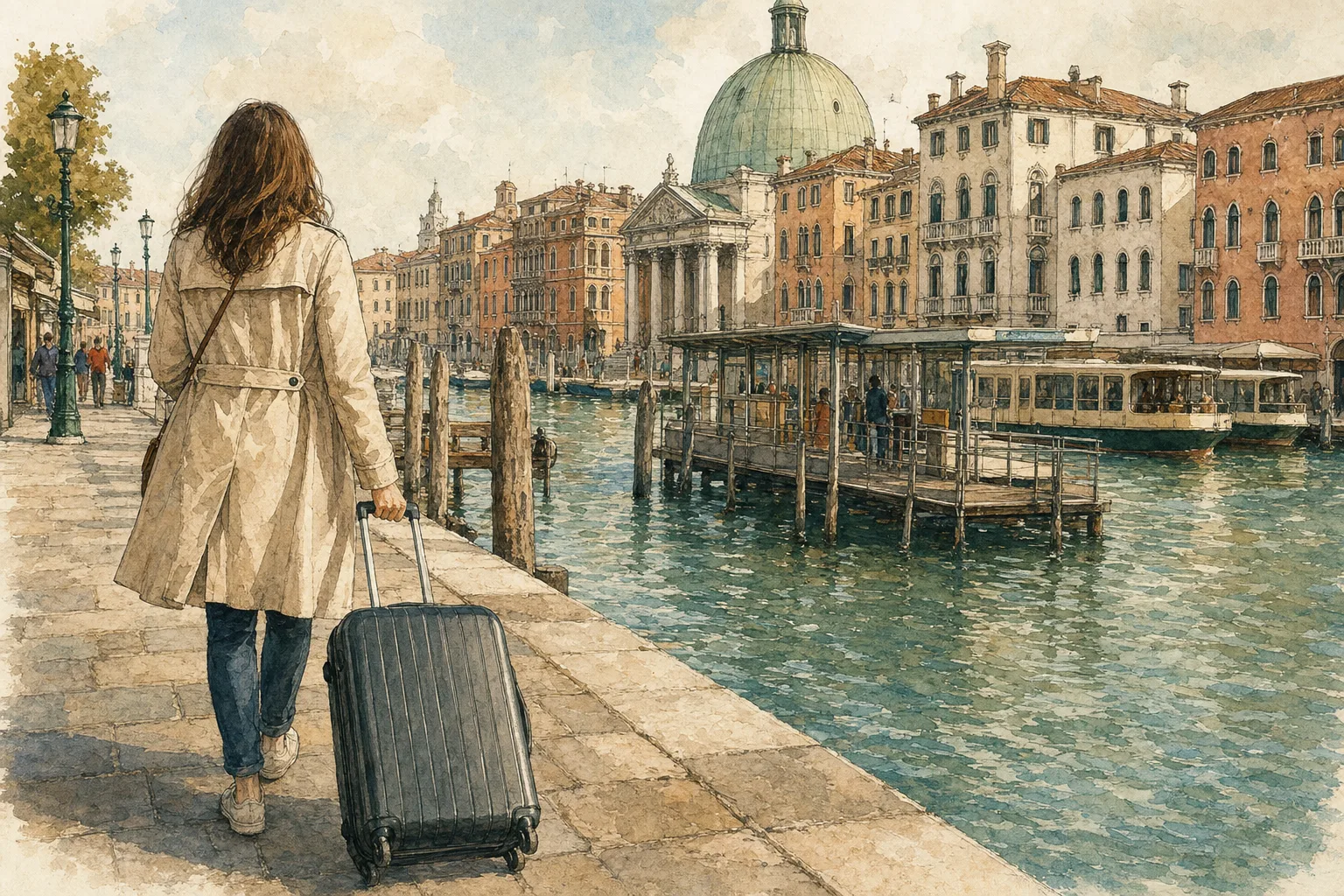
First-time visitors often default to San Marco or near-Rialto stays to minimize confusion. That decision works against quiet nights. The central corridor between Santa Lucia station and St. Mark's runs through some of the loudest evening foot traffic in the city, and the walk itself takes 28 to 45 minutes with luggage.
A better setup for a calm first visit:
- Stay in northern Cannaregio or eastern Castello.
- Use vaporetto Line 2 from the station to Rialto, then walk, for about a 22-minute total trip to the central area.
- Treat St. Mark's as a half-day visit, not a base.
You still see everything. You just sleep in a part of Venice that residents actually live in.
Best for Couples Who Want a Slow Evening
Couples are the strongest natural fit for quiet-night Venice. The city rewards slow dinners, post-dinner walks across empty bridges, and rooms with shuttered windows over small canals. The friction is hotel selection. A couple paying around the city average of about 212 USD per night should expect that price to buy either central location or genuine quiet, rarely both.
Two reliable patterns for couples:
- Southwestern Dorsoduro near the Zattere waterfront for evening walks along open water rather than narrow alleys.
- Giudecca for the strongest contrast: lagoon views, almost no nightlife, and a short vaporetto hop back to the main island.
Best for Slow Travelers Who Stay Multiple Nights
Slow travelers benefit most from quiet-sestiere Venice because the calm only reveals itself after the first day. The rhythm of a residential neighborhood, including morning market deliveries, the same cafe each afternoon, empty 10 PM streets, requires three or four nights to register.
For trips of four nights or more, the math also improves. October averages roughly 110 USD per night for hotels, compared to about 278 USD in February, so a slow shoulder-season stay in a quiet sestiere can cost less than a rushed two-night peak-season visit in a noisy central room.
Best for Low-Stress Planners
Low-stress planners care about predictability more than novelty. Venice cooperates here in three specific ways:
- Night transit is predictable: Line N runs from about 11:30 PM to 5 AM.
- The 2024 nightlife ordinance caps loud music at 11 PM in Rialto, Santa Margherita, and Strada Nuova, with last call at 1:30 AM and seated-only service after 1 AM.
- No cars means no traffic noise, no horns, no late-night ride-share clusters under your window.
The remaining variables you control are sestiere choice, room orientation (interior courtyard versus canal-facing on a busy calle), and season. That is a short list, which is exactly what low-stress planning needs.
Traveler Type Table
| Traveler type | Quiet-night fit in Venice | Best sestiere | Main tradeoff |
|---|---|---|---|
| Quiet-night couple | Strong | Southwestern Dorsoduro, Giudecca | Longer walk or vaporetto to St. Mark's |
| Low-stress planner | Strong if sestiere chosen well | Northern Cannaregio, eastern Castello | Less name recognition when booking |
| Slow traveler, 4+ nights | Strong | Any quiet sestiere | Requires shoulder-season timing to maximize calm |
| First-timer wanting central base | Moderate | San Marco with inner-courtyard room | Noise risk from nearby calli and tour foot traffic |
| Nightlife-seeking traveler | Weak as quiet-night fit | Around Santa Margherita | The reason to come is the reason it is loud |
| Budget-led traveler | Mixed | Mestre or Marghera mainland | Calmer and cheaper (Marghera around 88 USD), but loses on-island evenings |
The pattern is consistent: the closer you stay to the loud-music zones the ordinance was written for, the more you depend on luck and room orientation. The further you stay, the more reliably the city delivers quiet nights.
Common Mismatches and Regret Patterns
Several specific mismatches show up repeatedly for quiet-night travelers in Venice.
- Booking a "central" room over a restaurant calle in San Marco or near Rialto. Even with the 11 PM music cutoff, dinner service, foot traffic, and luggage wheels on stone continue late.
- Visiting in peak summer (June to August) expecting evening calm. Over 100,000 daily visitors do not all leave on the last train, and heat keeps windows open, which removes any sound buffer.
- Choosing a hotel on a "main" pedestrian artery like Strada Nuova for convenience. It is convenient because everyone walks it, including late.
- Confusing the daytime crowd fatigue with the actual evening profile of a sestiere. Cannaregio's Strada Nuova is busy by day and regulated at night, but the quiet northern Cannaregio is a different experience block by block.
- Treating Mestre as equivalent to staying in Venice. It is calmer, but the late return across the causeway adds a logistical step that low-stress planners often regret.
The 5 EUR day-tripper entry fee in 2025 applies on 54 selected high-traffic days between 8:30 AM and 4:00 PM. It is not a quiet-night signal, but the days it is charged are precisely the days when evening foot traffic also peaks.
Final Match Recommendation
Choose Venice for quiet nights if you are a couple, a slow traveler, or a low-stress planner willing to stay in northern Cannaregio, eastern Castello, southwestern Dorsoduro, or Giudecca, and willing to treat St. Mark's as a destination rather than a doorstep. Shoulder months, especially October, give you the cleanest combination of calm evenings, manageable temperatures, and lower hotel prices.
Skip Venice for quiet nights if your priority is staying within a 5-minute walk of major sights, if you cannot move beyond the cheapest central rooms (which are usually cheap for noise reasons), or if you are visiting in peak summer for only two nights. In those cases, the structural mismatch between expectation and city behavior is too high, and another Italian city with quieter central districts will serve you better.
Quiet-Night Venice Checklist
Use this before booking:
- Sestiere is northern Cannaregio, eastern Castello, southwestern Dorsoduro, or Giudecca
- Room is on an interior courtyard or a small residential canal, not a busy calle
- Trip dates avoid June through August, and avoid Carnival
- Walk time to St. Mark's is acceptable (20 to 30 minutes is normal from quiet areas)
- Night vaporetto Line N stop is within reasonable walking distance for late returns
- Hotel description does not mention "lively," "vibrant nightlife," or "steps from Rialto"
- You have read recent guest reviews specifically for noise after 10 PM
FAQ
Is Venice actually quiet at night? Parts of it are. Central nightlife clusters around Rialto, Santa Margherita, and Strada Nuova, where a city ordinance now requires loud music to stop after 11 PM and venues to close by 2 AM. Residential pockets in northern Cannaregio, eastern Castello, southwestern Dorsoduro, and Giudecca are noticeably quieter, often nearly silent after the last dinner service.
Which Venice neighborhoods are best for travelers who want quiet nights? Northern Cannaregio, eastern Castello, southwestern Dorsoduro, and Giudecca are the most commonly cited quiet sestieri. They trade central walk times for calm evenings and easier sleep.
Can I stay near St. Mark's and still have quiet nights? Possible but risky. San Marco is central to foot traffic and tour groups during the day, and evenings can still carry sound from nearby restaurant streets. If you choose San Marco, prioritize a room on an inner courtyard rather than a canal-facing front room over a busy calle.
Is staying in Mestre a better quiet-night option? Mestre and Marghera on the mainland are cheaper and generally calmer at night, but you lose the evening-in-Venice atmosphere and add a transit step each way. Better for budget-led travelers than for couples who want the quiet-canal feeling itself.
How late do vaporetti run if I return after dinner? The night vaporetto Line N runs roughly 11:30 PM to 5 AM, every 20 to 30 minutes early on and hourly after about 1:30 AM. That covers most calm-evening returns from a late dinner without needing to rush.
When is Venice quietest overall? Low season from November to March, excluding Carnival, sees roughly 60 percent fewer tourists. Expect cooler weather and possible acqua alta, but evenings are far calmer than peak summer, when daily visitors exceed 100,000.