where-to-stay
Where to Stay in Rome on a First Trip If You Want to Minimize Walking
A decision-led base guide for first-time Rome visitors who want to cut walking. Compares neighborhoods by metro access, terrain, and arrival friction.
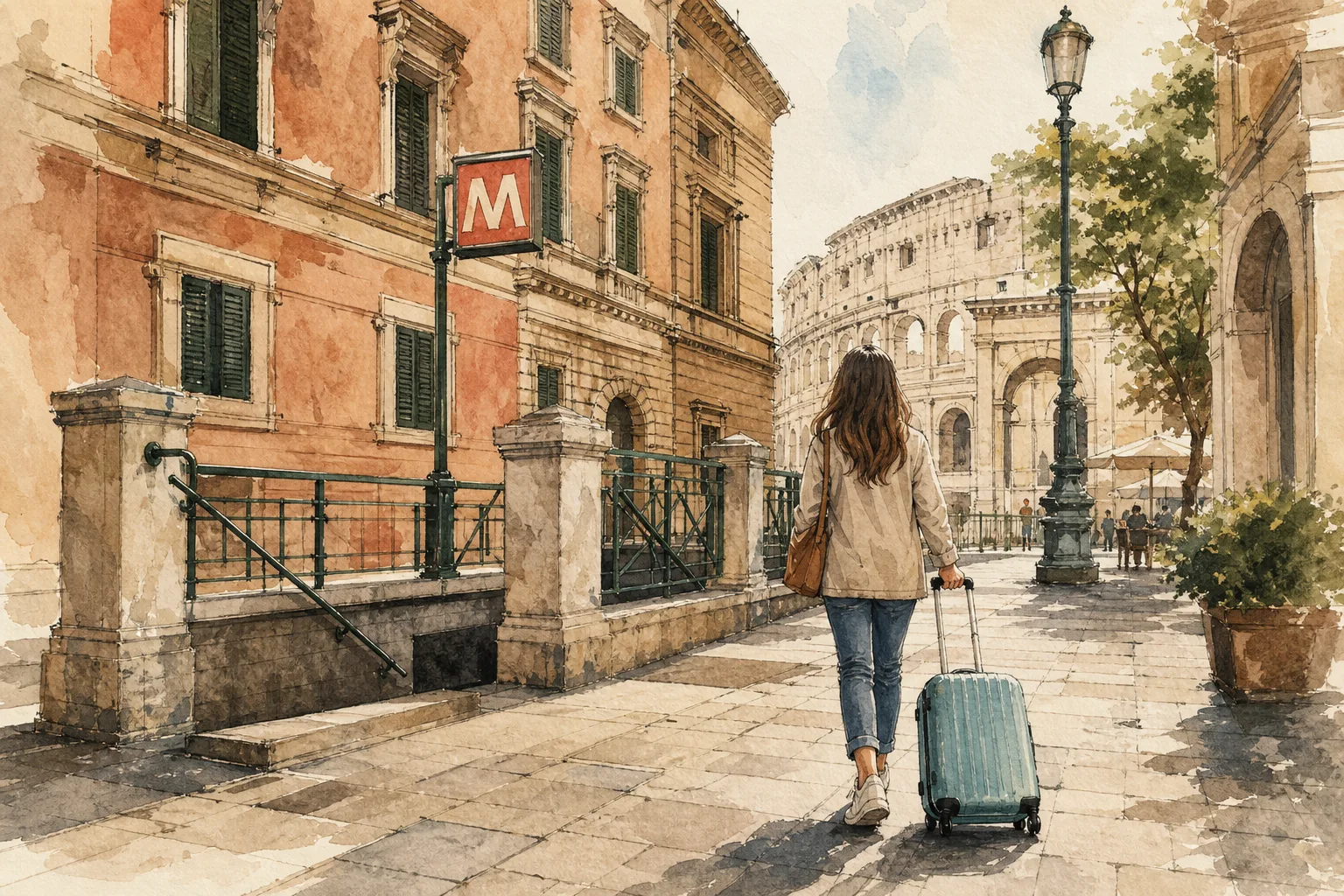
Rome looks compact on a map and walks like a marathon in practice. The Colosseum to the Vatican is roughly 4 kilometers and nearly an hour on foot, and the city has only two metro lines that cross at a single point. If you want to minimize walking on a first trip, the base you pick matters more than the hotel itself.
Quick Answer
For most first-time visitors who want short walking days, the best base is within a 3 to 5 minute flat walk of a Metro Line A or Line B station, ideally near Termini, Cavour, Repubblica, Barberini, or Ottaviano (Prati).
- Choose this approach if you tire easily, travel with a stroller or rolling luggage, want one base for both the Colosseum and the Vatican, or plan to use taxis and metro freely.
- Skip this approach if you want the romantic cobblestone-lane experience as your daily reality, in which case Centro Storico or Trastevere will charm you but make you walk much more.
The single highest-leverage move: book within a few flat blocks of a metro entrance, not just within a "central" neighborhood.
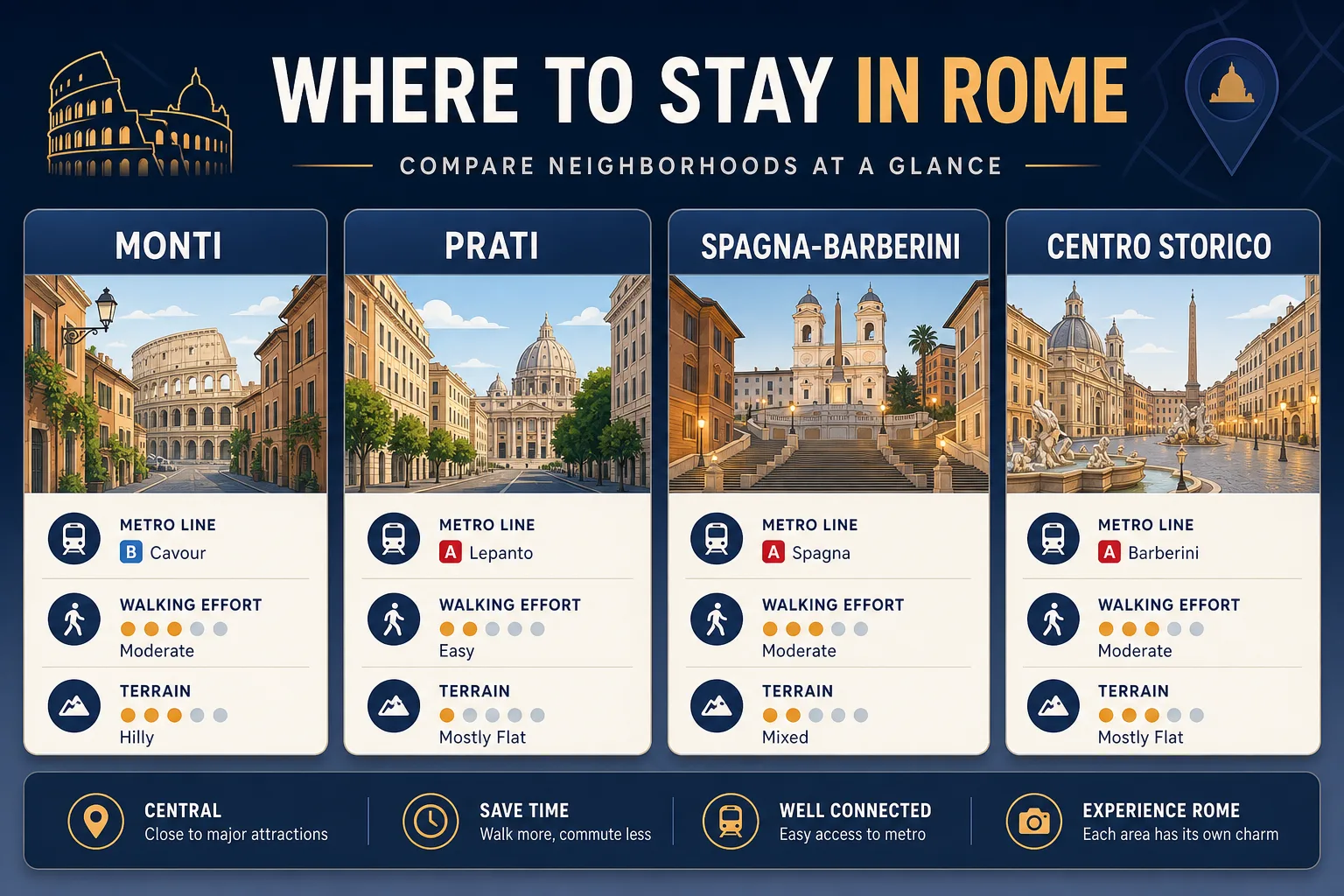 How four central Rome neighborhoods compare on walking effort, terrain, and metro access.
Hotel Location Risk Summary
Rome's specific risks for a low-walking traveler are not the usual ones. They are:
- The metro network is thin. Only Line A and Line B exist for practical sightseeing, and they intersect only at Termini. A hotel "near a metro" on the wrong line can still mean a long transfer.
- Cobblestones and inclines compound fatigue. Distances that look short on Google Maps feel longer because of uneven stone and gentle hills, especially around the Spanish Steps, Aventine, and Trastevere.
- The historic center has no metro inside it. Hotels near Piazza Navona or Campo de' Fiori are charming but force you onto buses, taxis, or long walks for the Vatican and Colosseum.
- Arrival friction is real. Dragging luggage from a bus stop or distant taxi drop-off through cobbled lanes is the worst first impression. Plan the door-to-door path before booking.
- Bus-only neighborhoods look connected but are not. Bus 40 and Bus 64 do connect Termini to the Vatican, but they are crowded, slow in traffic, and a known pickpocket route.
If any two of these risks apply to your group, prioritize a metro-adjacent base over a postcard view.
Best Areas at a Glance
The comparison below ranks neighborhoods specifically by walking effort, not overall appeal.
| Area | Metro access | Walking effort | Terrain | Best for |
|---|---|---|---|---|
| Termini / Repubblica | Lines A and B intersect here | Very low | Flat | Maximum transit efficiency, easy airport arrival |
| Monti (near Cavour) | Line B, one stop from Colosseum and Termini | Low to moderate | Some slopes | Atmosphere plus metro access |
| Prati (near Ottaviano) | Line A, direct to Spagna and Termini | Low | Flat, wide sidewalks | Vatican-side base, stroller-friendly |
| Spagna / Barberini | Line A, both stations have elevators | Low if hotel is near exit | Hilly nearby, elevators help | Shopping, central sightseeing |
| Centro Storico (Navona, Pantheon) | No metro inside | High | Cobblestones everywhere | Travelers who accept walking |
| Trastevere | No metro, tram only | High | Cobblestones, some hills | Evening atmosphere, not low-walking |
| Aventine / Testaccio | Limited metro access | Moderate to high | Hill | Quiet stays, not first-timers minimizing walking |
The pattern is clear: the neighborhoods that show up in glossy travel features (Centro Storico, Trastevere) are the worst fits for minimizing walking. The neighborhoods that minimize walking (Termini, Prati, Monti edge) are less photogenic but far more practical.
Best Area by Traveler Type
First-time visitors who want to see the headline sights
Pick Monti near Cavour station, or Termini's quieter north side. Cavour is one stop from the Colosseum and one stop from Termini, and Termini connects you to Line A for the Vatican via Spagna or Ottaviano. You get one metro transfer to almost everything.
Low-stamina or low-walking travelers
Pick Prati near Ottaviano, or directly next to Repubblica or Barberini. Prati has flat, wide sidewalks and modern blocks, which is rare in Rome. Repubblica and Barberini put you on Line A with short, level walks to the metro entrance.
Older travelers
Pick Prati or the immediate Spagna-Barberini corridor, and verify your hotel is on a flat block. Use the elevator-equipped Spagna and Barberini stations to skip the climb up the Spanish Steps area. Avoid hotels that look central but sit halfway up a side street ramp.
Families with strollers
Pick Prati. Wider sidewalks, fewer cobblestones, flat terrain, and Line A access to both Termini and the Vatican. The Centro Storico is brutal with a stroller because of uneven stones and crowds.
Areas to Be Careful With
These neighborhoods come up constantly in first-time Rome research and quietly cause the most regret for low-walking travelers.
- Centro Storico (Piazza Navona, Pantheon, Campo de' Fiori). Beautiful, but no metro inside the zone. Every Vatican or Colosseum trip becomes a bus ride or a 25 to 40 minute walk over cobblestones. Pick this only if walking is part of your plan.
- Trastevere. Atmospheric in the evening but tram-and-bus only, with cobbled lanes and a steeper hill section near Gianicolo. A poor fit if you tire easily.
- Aventine Hill. Quiet and elegant, but it is literally a hill, and the nearest practical metro is a walk away.
- South Termini / Esquilino fringes. Cheap and metro-adjacent, but some blocks feel uncomfortable late at night. Stay on the north or west side of Termini if you choose this area.
- Anywhere "10 minutes from the Vatican on foot" that is actually past the river. Check the exact walking path, not the straight-line distance.
The recurring pattern: charm and low-walking convenience rarely overlap in Rome. Decide which one you are buying.
Budget vs Convenience Tradeoff
Rome's pricing roughly tracks walking convenience in reverse, which is unusual.
- Centro Storico and Trastevere are often the most expensive precisely because they are atmospheric, even though they make you walk more.
- Prati is mid-range and offers the best convenience-to-price ratio for low-walking travelers.
- Termini and Repubblica include both budget options and excellent four-star hotels, and the location is genuinely efficient. The tradeoff is the area's grit, not its function.
- Monti has crept upward in price but remains reasonable compared to the historic center.
A useful frame: every euro you save by booking a "charming" hotel further from a metro often gets spent back on taxis (typically 7 to 15 euros per ride in the center) or on the cost of being tired by 3pm and skipping a sight. For most low-walking travelers, paying slightly more for a metro-adjacent room in Prati or near Repubblica is the better trade.
If you want to pressure-test the math, estimate your Rome trip cost with and without daily taxis factored in.
Hotel Location Checklist
Before you book, run the specific hotel address (not just the neighborhood) through this list:
- Is the hotel within a 5 minute walk of a Metro Line A or Line B station?
- Is that walk flat, or does it cross a known hill or cobbled lane?
- Does the metro station you would use have an elevator or escalator? (Spagna and Barberini do.)
- From this hotel, can you reach both the Colosseum and the Vatican in under 30 minutes by metro with at most one transfer at Termini?
- Is there a taxi rank within a short walk for late nights or rainy days?
- Can the airport transfer drop you within one block of the hotel door, or will you drag luggage through pedestrian-only lanes?
- Is the immediate block comfortable to walk on at night?
- Are there grocery and pharmacy options within a few flat blocks, so you do not have to walk far for basics?
If you check fewer than six of these, the hotel is probably not minimizing your walking, regardless of how central it looks.
Want a structured version that scores your shortlist? Use the Hotel Location Checklist tool.
Final Recommendation
For a first-time Rome visit where minimizing walking is the priority, book in Prati near Ottaviano if you want flat, stroller-friendly streets and a direct line to Spagna and Termini, or in the Termini-Repubblica corridor if you want maximum transit efficiency and an easy 32 minute Leonardo Express arrival from Fiumicino. Monti near Cavour is the best compromise if you also want some atmosphere.
- Choose this approach if your group includes anyone who tires easily, you have heavy luggage, or you want one base for both the ancient sights and the Vatican.
- Skip this approach if the Centro Storico cobblestone experience is the reason you are coming to Rome, in which case accept the extra walking as part of the trip.
The mistake to avoid is picking a hotel because the neighborhood name sounds romantic and then discovering on day two that every outing starts with a 20 minute walk before the sightseeing even begins.
Still deciding whether Rome is even the right base for a short first trip? See Rome or Florence for a first 3-day Italy trip before locking in your hotel.
FAQ
Is Termini a good base if I want to minimize walking? Termini is the most transit-efficient base in Rome because it is the only point where Metro Line A and Metro Line B intersect, and the Leonardo Express from Fiumicino arrives there in 32 minutes for 14 euros. The area itself is not scenic and some blocks feel rough at night, but if your priority is short walks plus easy metro hops to both the Colosseum and the Vatican, a hotel within two or three flat blocks of the station is hard to beat.
Should I stay near the Colosseum or near the Vatican? If you want one base for both, neither is ideal because the Colosseum and the Vatican are about 4 kilometers apart, which is close to an hour on foot. For minimal walking, stay somewhere with a direct metro link to both, such as near Cavour on Line B for the Colosseum side, with a Line A transfer at Termini for the Vatican.
Is the historic center (Centro Storico) bad for low-stamina travelers? It is beautiful but has no metro stops inside it. From a hotel near Piazza Navona or the Pantheon, you walk to almost everything on cobblestones, and reaching the Vatican or Colosseum still means a bus, a taxi, or a long walk. It works only if you accept the walking or plan to spend on taxis daily.
How do I handle arrival with heavy luggage? From Fiumicino, the simplest options are the Leonardo Express to Termini for 14 euros per adult or the flat 55 euro municipal white taxi to any address inside the Aurelian Walls. If your hotel is more than a few blocks from Termini, the flat-rate taxi is usually worth it on arrival day even if you plan to use transit afterward.
Are the Spanish Steps area hotels too hilly for someone who tires easily? The Spagna and Barberini metro stations both have elevators that bypass the steepest climbs, so a hotel near these stops can actually work well. The trick is checking that your specific hotel sits on a flat block near the metro exit rather than partway up a side street that ramps uphill.
Is the hop-on hop-off bus a good substitute for walking? A 24-hour pass costs roughly 27 to 33 euros and can be useful on the first day for orientation, but it is not a real substitute for a well-placed hotel. Buses get stuck in traffic, stops are not always close to the sight entrance, and you still walk substantially once you get off.