where-to-stay
Where to Stay in Tokyo for a First Trip If You Want Low Station Stress
A decision-focused guide to choosing a Tokyo base that minimizes station chaos, transfer pain, and luggage trouble on your first trip.
Quick Verdict
For a first trip to Tokyo where your main worry is station chaos, the best bases are Ueno (if you arrive at Narita) and Hamamatsucho or Daimon (if you arrive at Haneda). Both areas put you on a direct airport train, near a station that is small enough to navigate on day one, and on lines that still reach the major sightseeing areas.
Choose this approach if you:
- Are visiting Tokyo for the first time and want fewer surprises on arrival.
- Are landing with checked luggage and do not want to transfer twice with bags.
- Plan to come back to your hotel late after dinner or shows.
Do not choose this approach if you:
- Want nightlife on your doorstep (Shibuya or Shinjuku will fit better, with more friction).
- Are an experienced Japan traveler who actively prefers being inside a complex hub.
- Are doing day trips by Shinkansen every day (Tokyo Station or Shinagawa save more time).
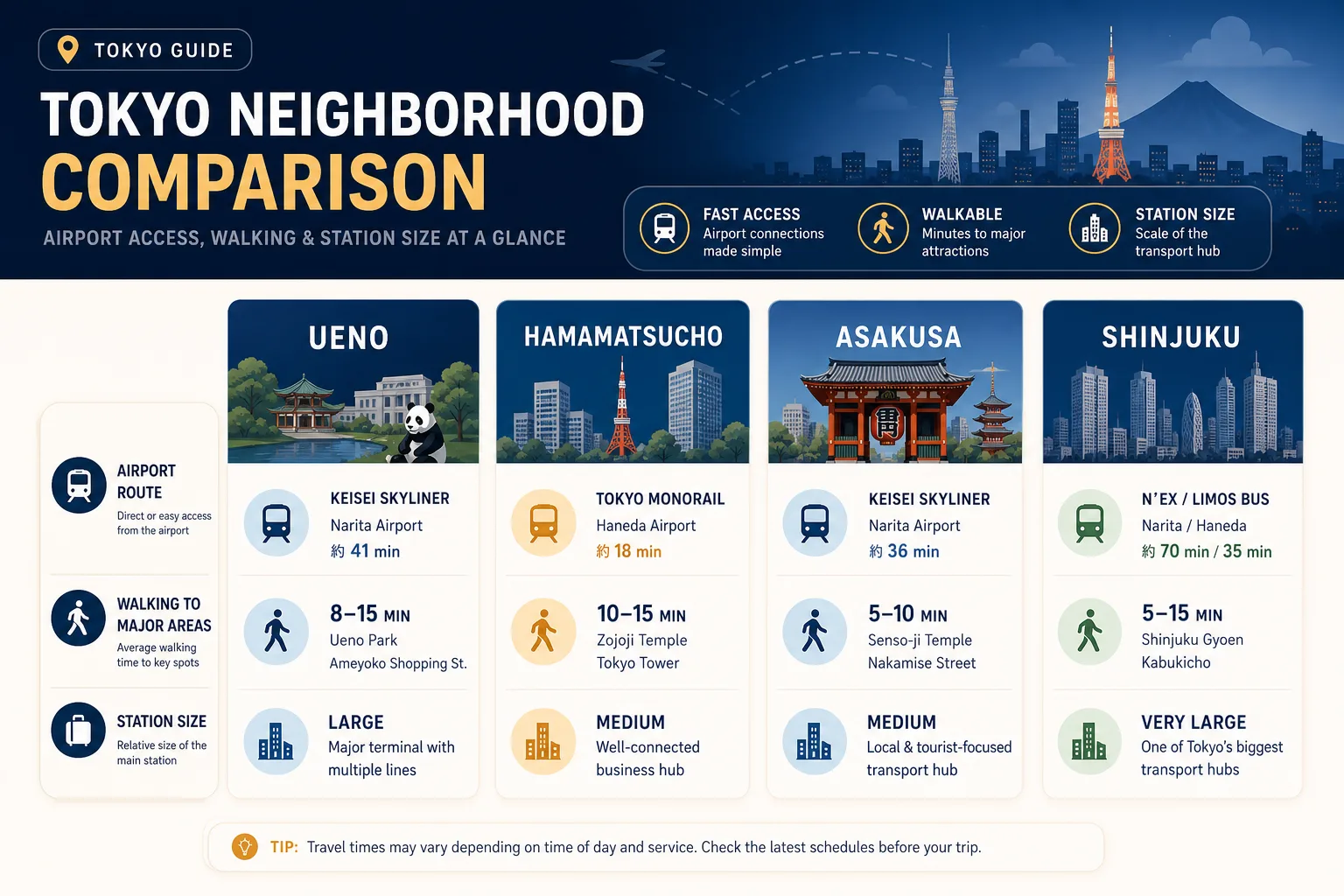 An infographic comparing Tokyo neighborhoods Ueno, Hamamatsucho, Asakusa, and Shinjuku based on airport access, walkability, and station size.
Best for First-Time Visitors
First-time visitors usually underestimate two things: how large Tokyo stations are, and how much energy a luggage transfer eats on day one.
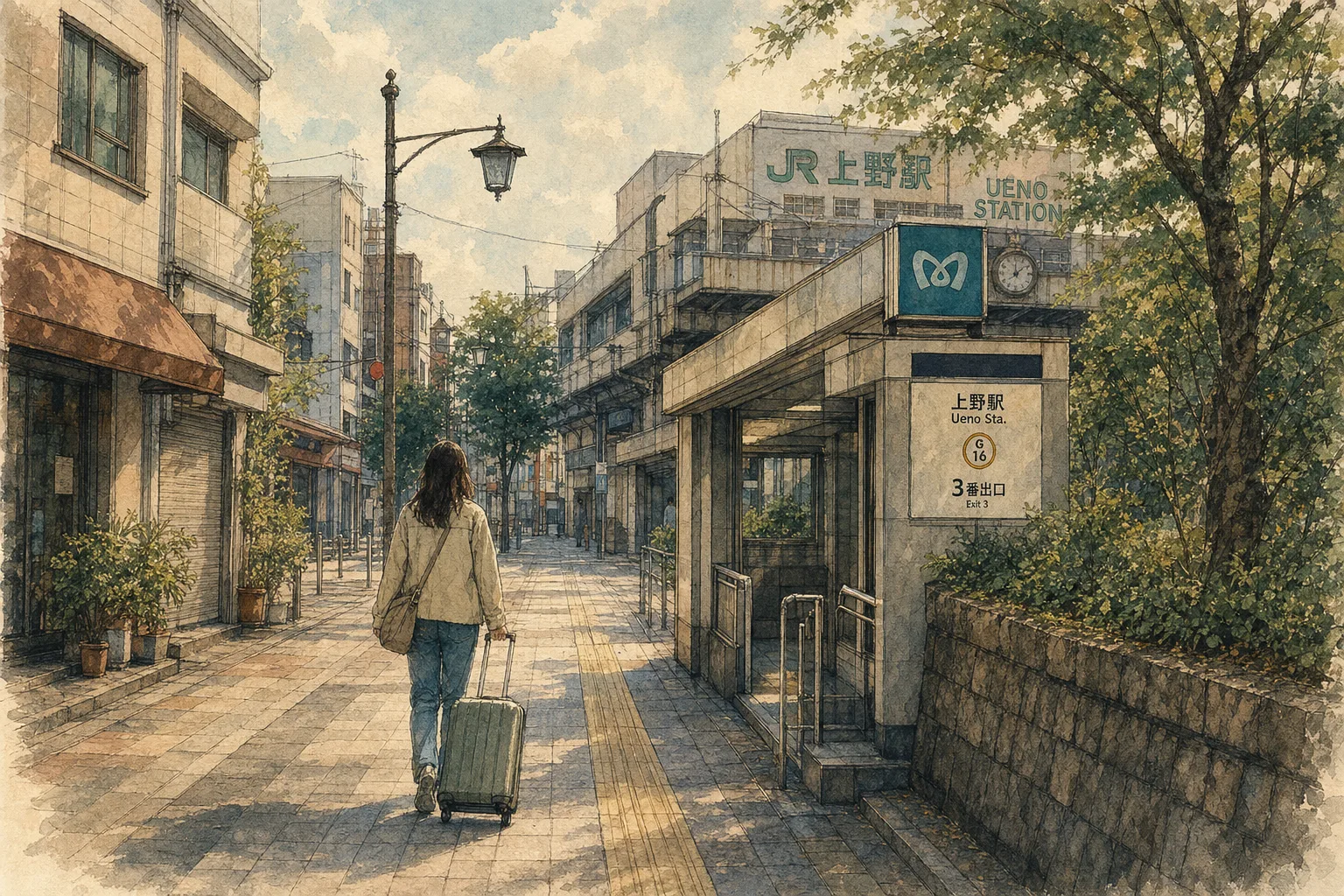
Ueno is a strong first-time base because the Keisei Skyliner from Narita arrives at Keisei-Ueno in 36 minutes for 2,520 yen, and JR Ueno Station is a flat, 6-minute outdoor walk from the Keisei terminal. There are no long underground tunnels or staircases on that walk. From JR Ueno, the Yamanote Line connects directly to Tokyo, Akihabara, Shibuya, Shinjuku, and Harajuku without changing trains.
Hamamatsucho works the same way for Haneda arrivals. The Tokyo Monorail reaches Hamamatsucho in 13 minutes for 500 yen, and the station itself is one of the smaller Yamanote hubs.
Best for Couples
Couples on a first Tokyo trip usually want two things: a quieter neighborhood to come back to at night, and easy access to places like Asakusa, Ginza, and Shibuya during the day.
Ueno fits well because the area around the park is calmer in the evening than Shinjuku or Shibuya, and you can walk to the Ameyoko market and traditional restaurants without using the train. The Toei Asakusa and Tokyo Metro Ginza lines from Ueno reach Asakusa in around five minutes and Ginza in around ten.
Daimon, served by both the Toei Oedo and Toei Asakusa lines, is another good couples choice. Two subway lines under one roof means more late-night return options if dinner runs long, and the Asakusa Line gives you a one-seat ride to Asakusa for sightseeing.
Best for Slow Travelers
If you plan to stay seven nights or more and want to settle in rather than sprint, the priority shifts from speed to friction over time.
Slow travelers benefit from:
- A neighborhood with grocery options and casual restaurants within walking distance.
- A station with elevators and step-free routes (Ueno and Hamamatsucho both qualify).
- A hotel within five minutes of the ticket gates so you do not dread the walk home.
Ueno wins here for many travelers because the park, museums, and traditional shopping streets give you reasons to stay in the neighborhood instead of constantly commuting. Ueno Touganeya Hotel, for example, is a 2-minute flat walk from JR Ueno's main ticket gates and 1 minute from Tokyo Metro Subway Exit 2, which is about as low-friction as central Tokyo gets.
Best for Low-Stress Travelers
For travelers whose main planning filter is "do not let me feel overwhelmed," the decision is mostly about three things: airport route, station complexity, and walking distance to the hotel.
The low-stress shortlist:
- Ueno (Narita arrivals): Skyliner direct, flat walk to JR, smaller station.
- Hamamatsucho or Daimon (Haneda arrivals): Monorail direct, small Yamanote stop, two-subway-line backup at Daimon.
- Asakusa (either airport, but with one transfer): Quiet at night, but no direct Skyliner or Monorail link.
Specific hotels that match this profile include Hotel Mystays Hamamatsucho, a flat 5-minute walk from Hamamatsucho Station, and BAY HOTEL Tokyo Hamamatsucho, a 4-minute walk from both Hamamatsucho Station and Daimon Subway Station. The "two stations within a few minutes" pattern is a strong stress reducer because you almost always have a working route home.
Traveler Type Table
This is where the decision usually lives. Compare on the variables that actually affect your day, not just the neighborhood's reputation.
| Base | Best airport route | Station size | Walk to typical hotel | Late-night backup | Best for |
|---|---|---|---|---|---|
| Ueno | Narita: Keisei Skyliner, 36 min, 2,520 yen | Medium, mostly flat | 2 to 6 min flat | JR Yamanote plus 2 metro lines | First-timers from Narita, slow travelers |
| Hamamatsucho | Haneda: Tokyo Monorail, 13 min, 500 yen | Small Yamanote stop | 4 to 5 min flat | Walk to Daimon for Oedo or Asakusa line | First-timers from Haneda |
| Daimon | Haneda: Monorail to Hamamatsucho, 2 to 4 min walk | Small subway hub | 4 min flat | Two Toei lines under one roof | Couples, late diners |
| Asakusa | Either airport with 1 transfer | Small, calm | Varies, often 5 to 10 min | Mainly Toei Asakusa line | Travelers prioritizing atmosphere over directness |
| Shinjuku | Narita Express or bus | Very large, multi-level | Often 7 to 15 min with stairs | Many lines, but confusing | Repeat visitors, nightlife focus |
Common Mismatches
The most common first-trip regret is not picking the "wrong" neighborhood. It is picking a neighborhood whose strengths do not match your real travel style.
Watch for these patterns:
- Booking Shinjuku because it is famous. You arrive jet-lagged with a suitcase and face one of the largest station complexes in the world, plus a hotel that is often a 10-minute walk with elevators and exits you do not yet understand.
- Booking Tokyo Station area for "central" access. It is central, but the station itself is enormous and the surrounding area empties out at night, which makes dinner harder.
- Booking Asakusa for atmosphere without checking airport access. Asakusa is lovely, but neither airport has a fully direct, no-transfer train, so day one is harder.
- Ignoring luggage rules on Shinkansen day trips. Bags with total dimensions between 160 cm and 250 cm need a free pre-booked reservation on the Tokaido, Sanyo, or Kyushu Shinkansen, or you pay a 1,000 yen cash penalty on board. Bags over 250 cm are not allowed at all.
Final Match Recommendation
If you are arriving at Narita, base in Ueno. The Skyliner plus a 6-minute flat walk to JR Ueno is the single lowest-friction Narita arrival pattern available, and the Yamanote Line covers most of your sightseeing list without transfers.
If you are arriving at Haneda, base in Hamamatsucho or Daimon. The Monorail is short, cheap, and direct, and you have two Toei lines plus the Yamanote within a few minutes of each other for the rest of the week.
Do not choose these areas if your trip is mostly nightlife in Shibuya and Shinjuku, or if you are taking the Shinkansen out of Tokyo more than every other day. In those cases the extra hub complexity of Shinjuku or Shinagawa is worth the stress tradeoff.
One last budget note: Tokyo charges a flat per-person hotel tax of 100 yen per night for room rates between 10,000 and 14,999 yen, and 200 yen per night at 15,000 yen and above. It is small, but factor it in if you are comparing close options.
FAQ
Is Shinjuku a bad first-trip base if I want low station stress? Shinjuku is not bad in general, but it is one of the busiest and most physically confusing stations in the world. For a first visit, a smaller hub like Ueno or Hamamatsucho gives you fewer exits, shorter transfers, and easier luggage handling, while still keeping you on major JR lines.
Should I prioritize airport access or central location for my hotel? On a first trip, prioritize airport access from your specific airport. The Keisei Skyliner reaches Keisei-Ueno from Narita in 36 minutes for 2,520 yen, and the Tokyo Monorail reaches Hamamatsucho from Haneda in 13 minutes for 500 yen. Saving one stressful transfer on day one is worth more than being three minutes closer to Shibuya.
How late do Tokyo trains run, and does that affect where I should stay? Most Tokyo lines stop running between roughly midnight and 1 a.m. Staying near a station that sits on multiple lines, like Daimon with its Toei Oedo and Asakusa lines, gives you more late-night options. If you stay in an area served by only one line, a missed last train means a long taxi ride.
Do I need a Suica card before I arrive, or can I buy one at the airport? Physical, unregistered Suica sales have fully resumed in Central Tokyo, and you can also load a Welcome Suica into Apple Wallet before you arrive if you use an iPhone. The physical PASMO Passport was discontinued in October 2024, so Suica is the simpler default. For lowest friction on arrival, set up the mobile version in advance so you can tap straight through the airport train gates.