travel-decisions
Is One Night in Venice Too Rushed If You Hate Bridges, Boats, and Crowds?
A decision-led guide to whether one night in Venice is enough when bridges, boats, and crowds drain you, with friction fixes and better alternatives.
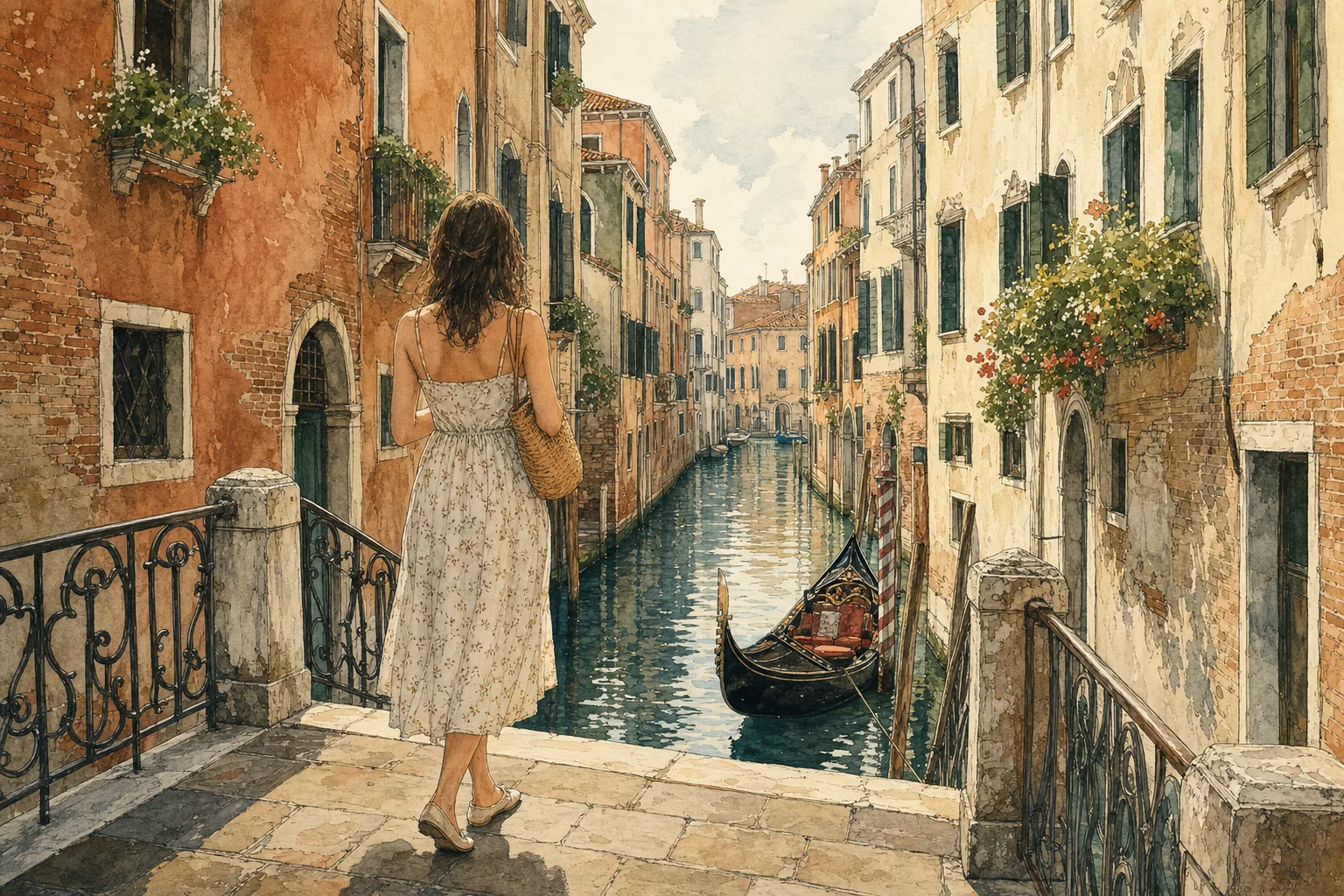
A single night in Venice is one of the most second-guessed choices on an Italy itinerary. The city looks compact on a map, sits on a major rail line, and seems built for a quick stop between Florence and the Dolomites. The problem is that Venice does not behave like a normal city once you arrive. Every block ends in a stepped bridge, every shortcut crosses water, and every famous square fills up by late morning. If bridges, boats, and crowds already drain you elsewhere, one night here can either be a smart, restrained taste of the city or a stressful blur you regret. The deciding factor is rarely the hours on the clock. It is the fit between how Venice actually moves and how you actually travel.
Quick Verdict
One night in Venice is enough if you accept a tight scope: arrive by mid-afternoon, walk a single loop, sleep on the island, and leave the next morning before the day-trip wave lands. That gives you two low-crowd windows (evening and early morning) and only one peak window to manage.
One night is too rushed if you wanted to also visit Murano or Burano by boat, see multiple museums, take a gondola, and eat a slow dinner. Compressing all of that into roughly 18 waking hours, on a route that forces stepped bridges and pedestrian bottlenecks, is where the regret comes from. The fee, the boats, and the bridges are not the real problem. The real problem is matching ambition to a city that punishes hurry.
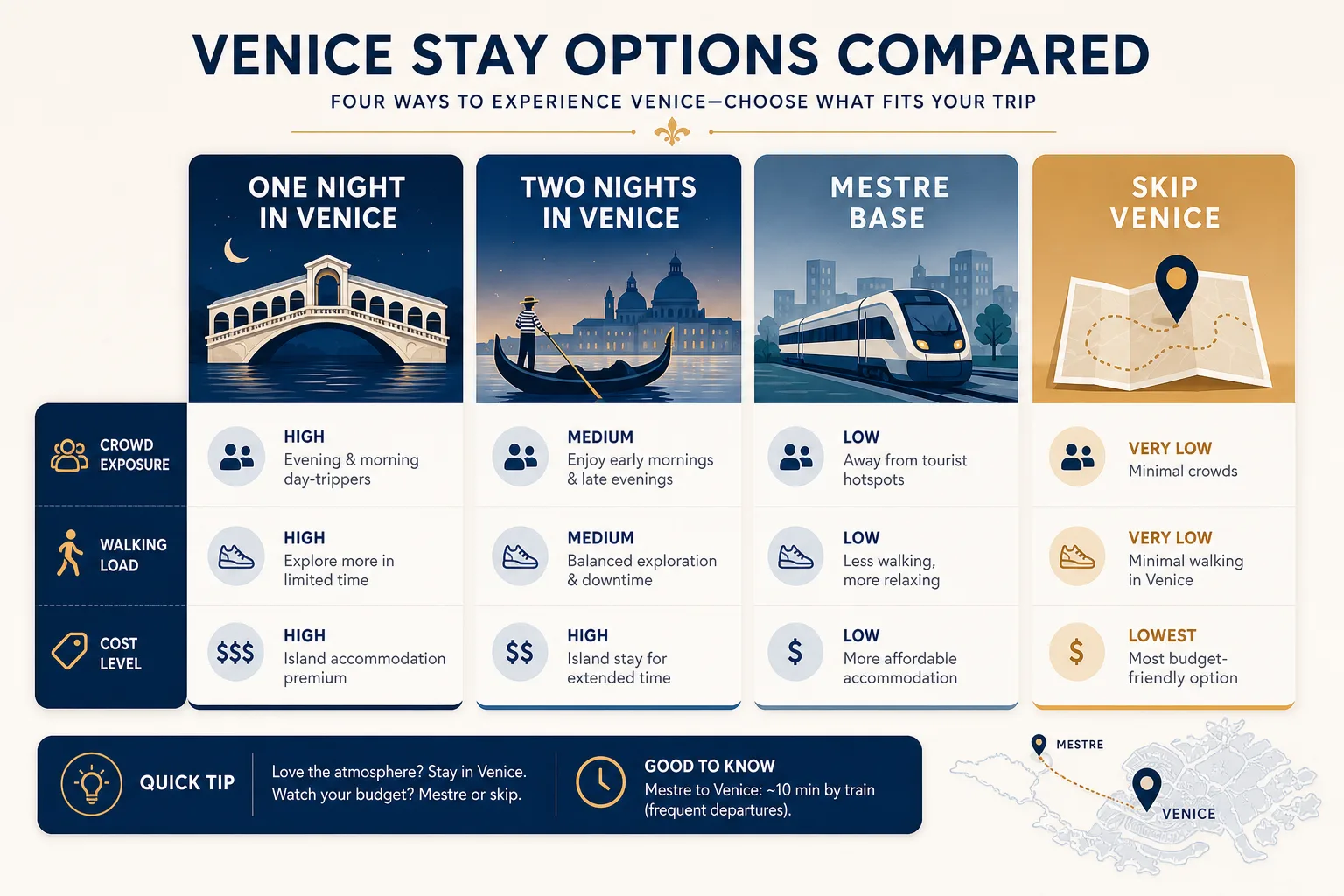 An infographic comparing stay options in Venice by crowd levels, walking distance, and cost.
Who Will Probably Love One Night in Venice
A short overnight works best for travelers who are honest about what they want from Venice and who pick atmosphere over coverage.
- You want the look and feel of Venice, not a museum checklist.
- You sleep on the island and treat the evening and early morning as your real visit, not the daytime hours.
- You are happy walking 2 to 4 kilometers across uneven ground and a handful of bridges.
- You are fine eating one good dinner and one quick breakfast instead of chasing reservations.
- You are using Venice as a connector between two larger stops and want a flavor, not a deep dive.
If that describes you, one night is not rushed. It is right-sized.
Who Might Regret One Night in Venice
The same trip becomes a regret stop for a different profile. The mismatch usually shows up in one of these patterns.
- You wanted to add Murano, Burano, or Torcello. Each island is a half-day commitment by vaporetto and cannot be squeezed into a single overnight without cutting Venice itself.
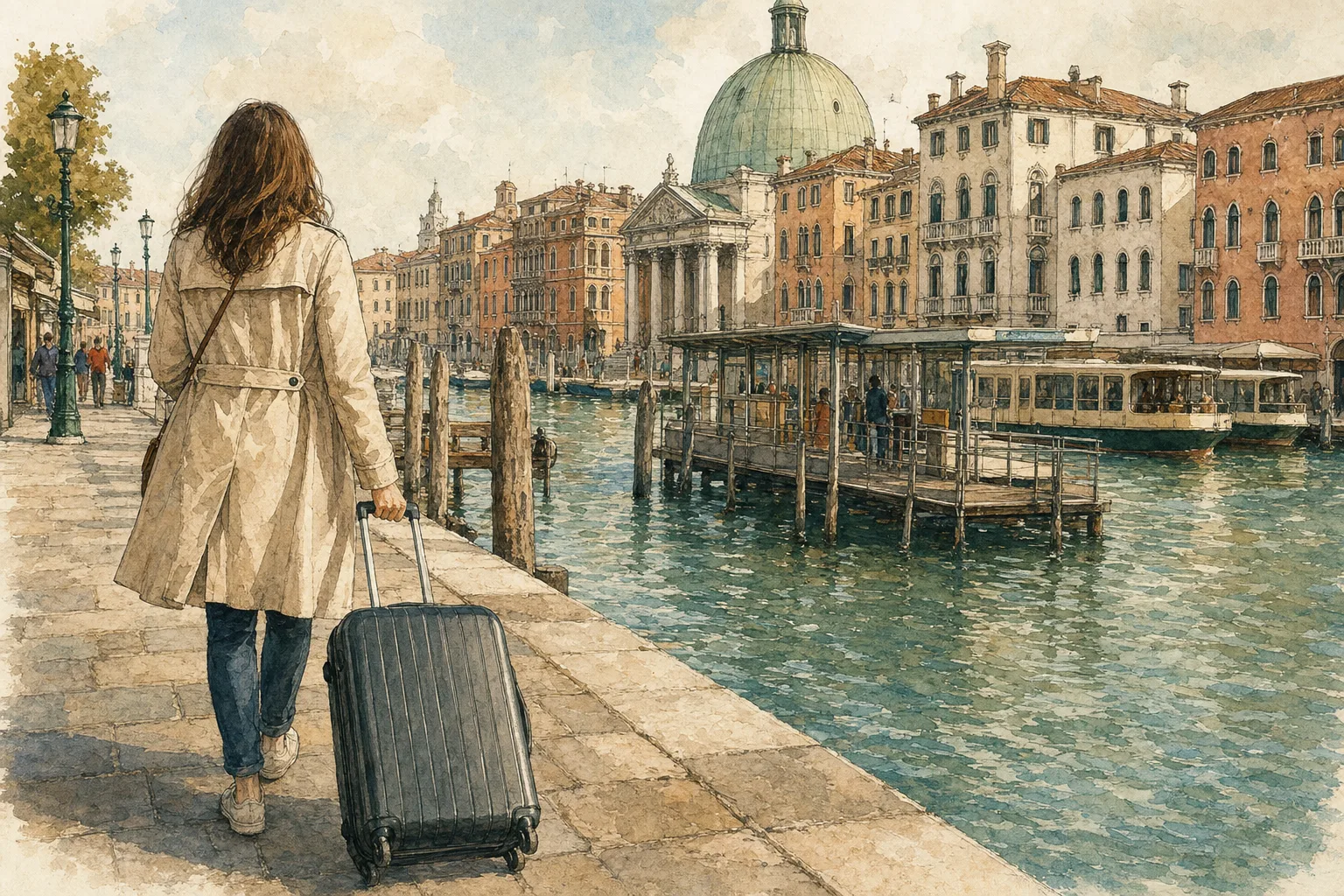
- You have knee, hip, or foot issues. The walk from the train station to St. Mark's is roughly 2.5 kilometers and crosses multiple stepped bridges. Doing that with luggage on arrival day is where most physical regret starts.
- You dislike crowds and arrive midday in peak season. Between roughly 10:00 and 16:00, the Rialto and St. Mark's corridor is dense and slow, and a one-night visitor often hits exactly that window.
- You expected boats to feel romantic. Vaporetti are commuter water buses, frequently full, and private water taxis start at around 110 euros per ride.
- You wanted slow meals and quiet alleys. One night forces you to pick: linger over dinner, or actually see the city before checkout.
The disappointment risk is not that Venice underdelivers. It is that a one-night plan quietly assumed two nights of activity.
Mistake and Consequence Table
These are the specific decision variables that turn one night from "enough" into "rushed."
| Decision | Common mistake | Consequence | Better move |
|---|---|---|---|
| Arrival time | Arriving after 18:00 | Lose the only low-crowd evening window | Arrive by 15:00 to 16:00 |
| Hotel location | Booking the cheapest island room far from a vaporetto stop | Long luggage drag over 5 to 8 bridges | Pay more for a hotel within a step-free zone |
| Outer islands | Adding Murano and Burano | Half a day gone on boats, central Venice cut to nothing | Skip them or add a second night |
| Day-trip fee | Forgetting overnight guests still need a free exemption QR | Fines from 50 to 300 euros on peak dates | Register on cda.ve.it before arrival |
| Transit pass | Buying a 24-hour vaporetto pass for one walking day | 25 euros spent for one or two short rides | Buy single 9.50 euro tickets only as needed |
| Departure | Leaving late morning | Drag luggage through the daily crowd peak | Check out and leave before 10:00 |
Hidden Friction Points
These are the parts of a one-night Venice plan that look fine on paper and bite in person.
Rushed itinerary. A single overnight gives you roughly two usable blocks: late afternoon to dinner, and breakfast to checkout. That is not enough time for St. Mark's Basilica plus the Doge's Palace plus a gondola plus Rialto plus a museum. Trying to fit all of it is the single biggest cause of "Venice felt stressful" reviews.
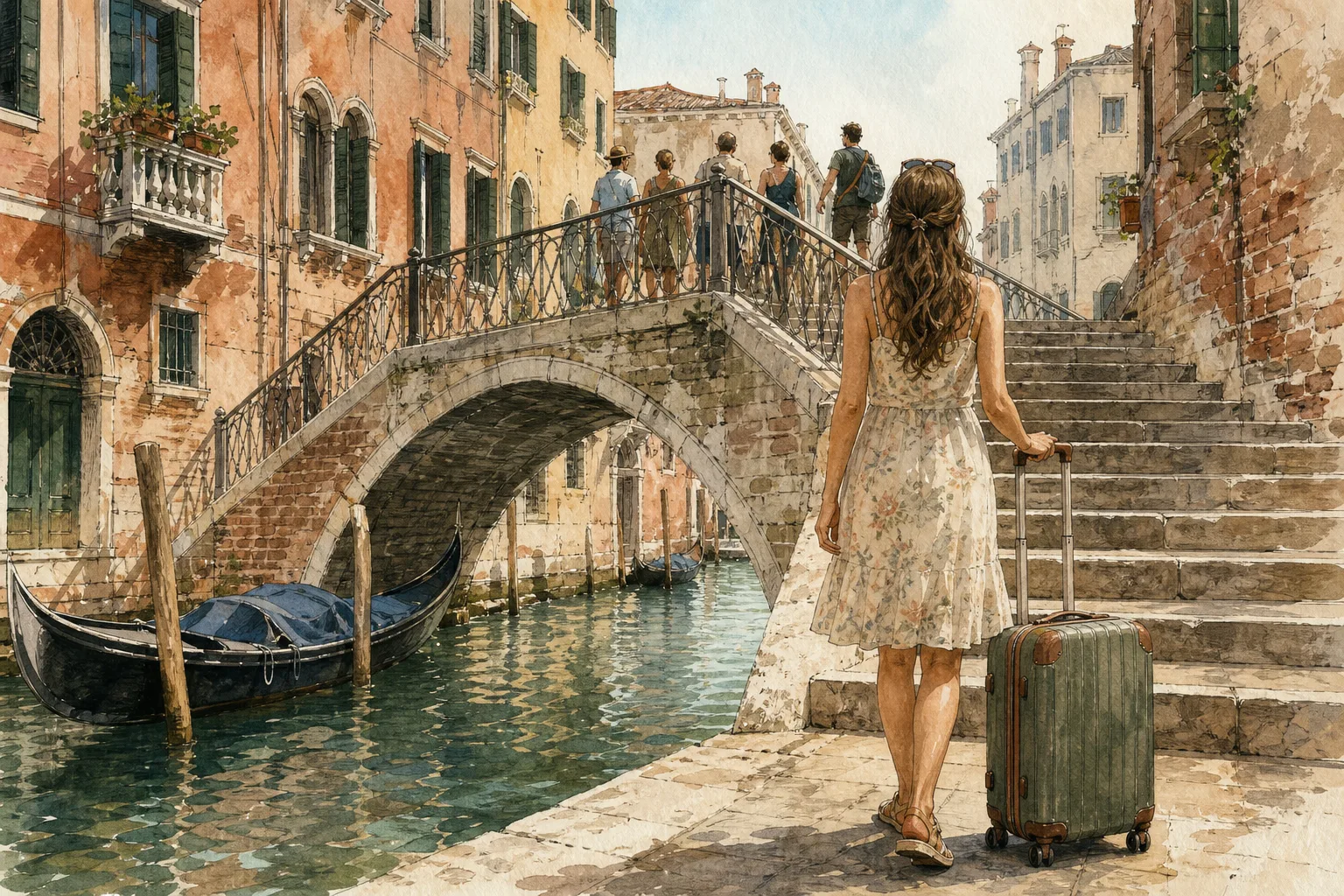
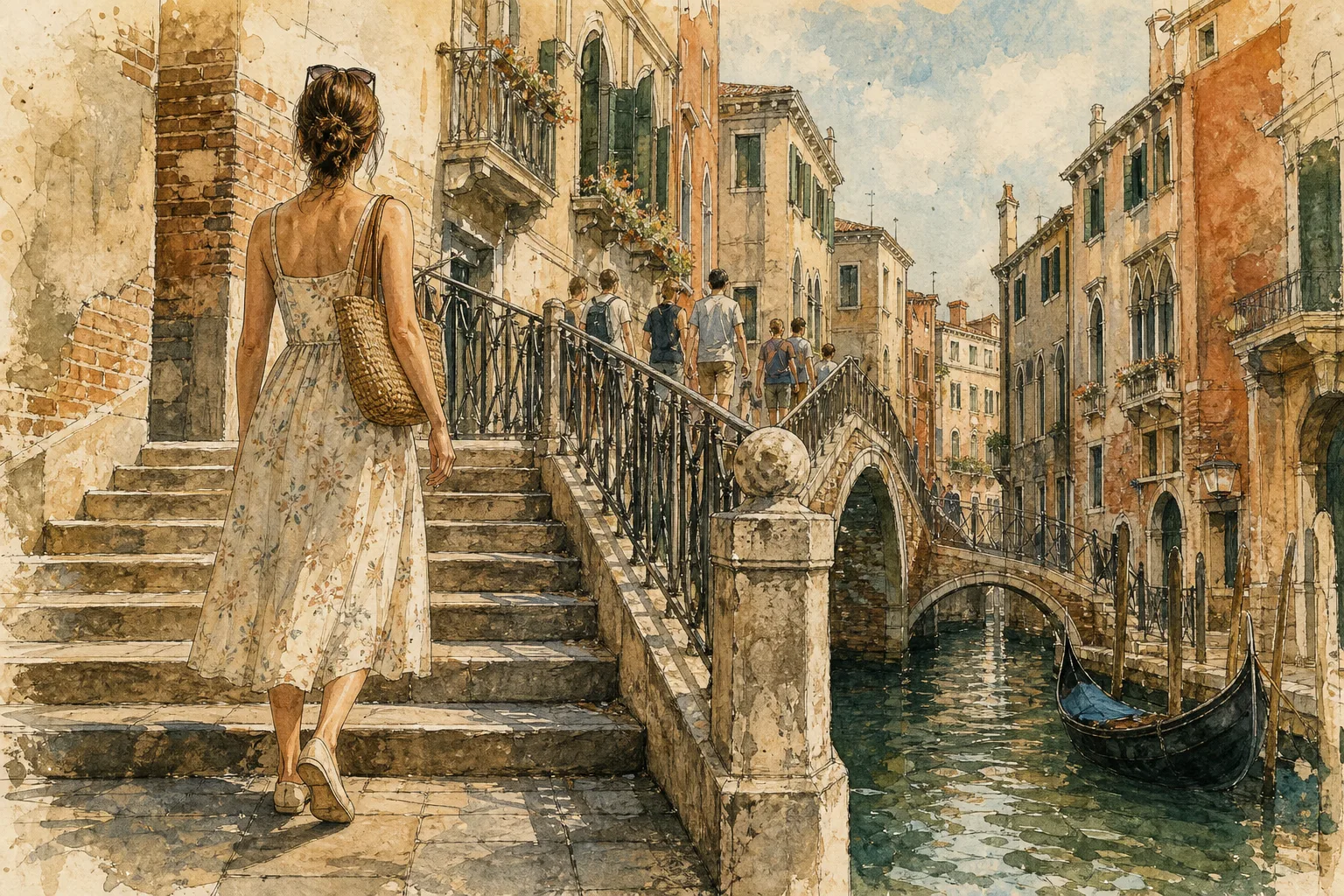
Bridge fatigue. Walking from Piazzale Roma or Santa Lucia Station to Rialto Bridge covers about 1.5 kilometers and crosses at least 7 stepped bridges. Walking to St. Mark's Square is roughly 2.5 kilometers and takes 30 to 45+ minutes once pedestrian bottlenecks are factored in. With a suitcase, those numbers roughly double in effort.
Boat logistics. A single 75-minute vaporetto ticket is 9.50 euros, passes are 25 euros for 24 hours and 35 euros for 48 hours, and a private water taxi typically starts at 110 euros. Bicycles are banned in the city, even pushed by hand, so there is no middle option between walking and boats.
Crowd pressure. The central spine from the train station to St. Mark's is the same route nearly every day-tripper takes. Between mid-morning and late afternoon in peak season, it moves at a shuffle. Tour groups are now capped at 25 people and guides cannot use loudspeakers, which helps, but it does not change the basic density on the main corridor.
The access fee trap. On 60 peak dates between April 3 and July 26, 2026, day-trippers must pay 5 euros booked at least 4 days ahead or 10 euros last-minute, valid 8:30 to 16:00. Overnight guests are exempt but still must register for a free exemption QR or risk fines of 50 to 300 euros. This catches a lot of one-night visitors who assume the exemption is automatic.
How to Make One Night Easier
You can take most of the friction out of a one-night trip with a small number of upstream choices.
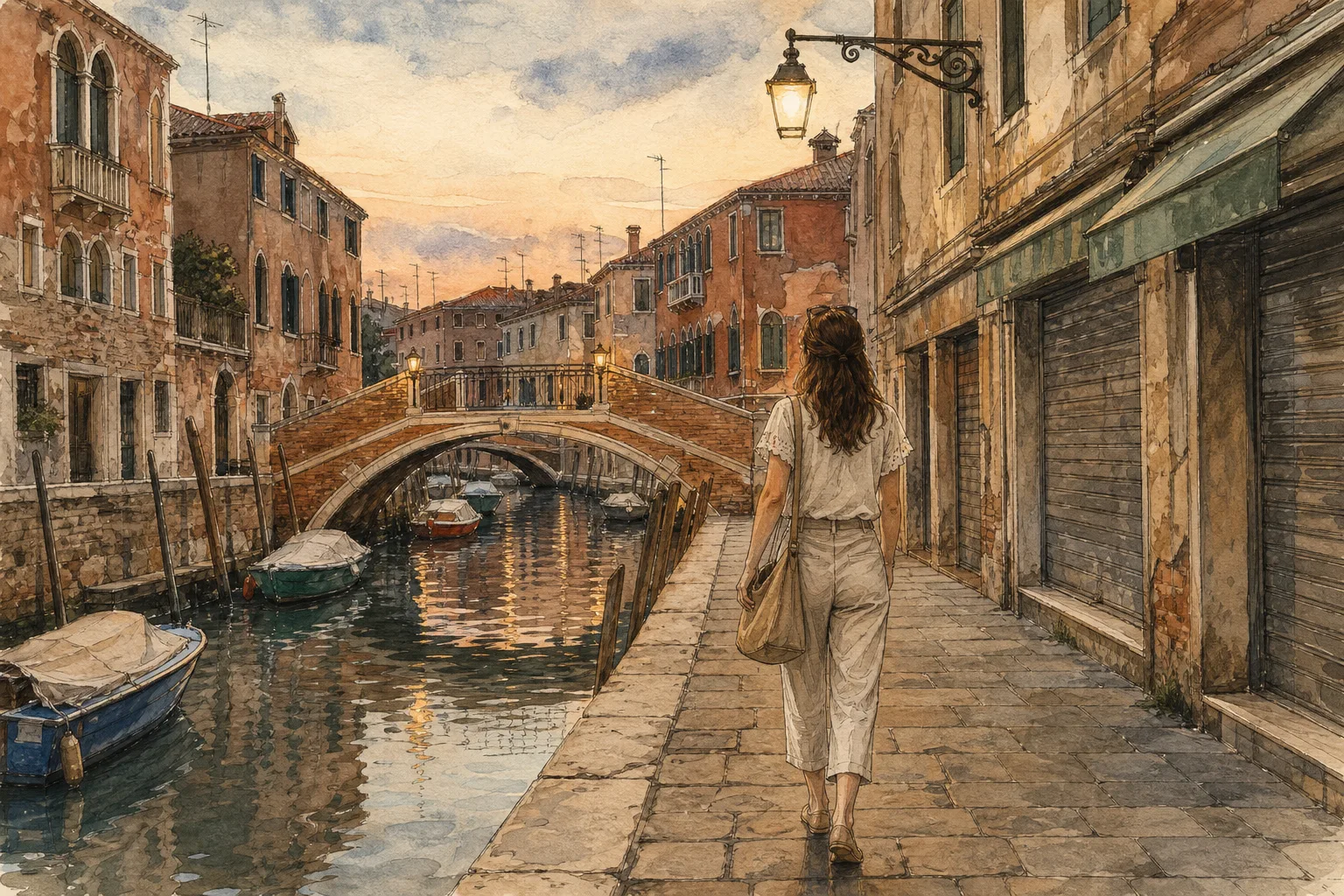
- Time-shift the visit. Plan your walking for 17:00 to 21:00 and 7:00 to 10:00. Skip the midday corridor entirely if you can.
- Stay inside a step-free zone. Venice has mapped about 14 kilometers of accessible, step-free routes, concentrated in St. Mark's Square, the Rialto Marketplace, and the Zattere waterfront. Booking near one of these clusters means most of your walking avoids stepped bridges.
- Pack a single carry-on. Every extra kilo of luggage is felt on every bridge. A backpack or a small wheeled bag changes the arrival experience more than any other single choice.
- Register the exemption QR before you fly. Use cda.ve.it as soon as your hotel is booked. It is free and removes the fine risk.
- Pick one boat moment, not three. A short vaporetto ride down the Grand Canal at dusk is memorable. A gondola is a 30-minute set piece. Pick one. Do not try to also add Murano.
- Eat dinner late and breakfast early. Reverse the tourist clock. You get quieter restaurants and quieter streets in the same move.
- Pre-decide your one museum. If you want one interior visit, pick it before you arrive (Doge's Palace, Basilica, Accademia, or Peggy Guggenheim) and book the timed entry. Walking up and deciding is what eats the day.
Better Alternatives If One Night Does Not Fit
If the friction list above sounds like a no, there are cleaner alternatives than forcing a stressful overnight.
Two nights on the island. This is the single biggest upgrade. A second night lets you separate "see central Venice" from "do one boat trip or one museum" without compressing either. It also gives you a second low-crowd morning, which is the part of Venice most one-night visitors say they wish they had more of.
Sleep in Mestre, day-trip in. Mainland Mestre hotels run roughly half the price of island ones, with direct 10 to 15 minute train or bus transfers for 2 to 4 euros return. You lose evening and early-morning Venice, which is the real reason to sleep on the island, but you keep your budget and avoid dragging luggage over bridges. Best for travelers who want to see Venice once and move on.
Skip Venice on this trip. If you dislike bridges, boats, and crowds, and you only have one night, you may be paying a high friction cost for a stop that will not be your favorite memory anyway. Verona, Padua, or Bologna give you canals, history, or food culture with far less physical strain and far smaller crowds. Saving Venice for a trip with two or three nights is often the better long-term choice.
Self-Checklist Before You Book
Run through this list before you lock in the one-night plan. If you check three or more, one night is fine. If you check fewer than two, add a night or change the base.
- My arrival in Venice will be by 16:00, not after dinner.
- I have a hotel within a 10-minute walk of a vaporetto stop and inside or near a step-free zone.
- I am traveling with a carry-on, not a full suitcase.
- I have registered the free overnight exemption QR on cda.ve.it (if visiting on a peak date).
- I have picked at most one museum or interior visit, with a timed ticket.
- I am not trying to also visit Murano, Burano, or Torcello on this trip.
- I am comfortable with 2 to 4 kilometers of walking and a handful of stepped bridges.
- I am budgeting roughly 180 to 260 euros (3-star) or 270 to 440 euros (4-star) for the island hotel, and I am okay with that vs. a Mestre base at roughly half.
- I am planning dinner late and the next morning's walk early.
- I have a clear answer for why one night, not two.
FAQ
Is one night in Venice actually enough to see the city? One night is enough to walk a loop around St. Mark's, Rialto, and a quieter sestiere, plus see the city twice in low-crowd light (evening and early morning). It is not enough to add a separate Murano or Burano boat day, multiple museums, and a gondola without feeling pushed.
Can I avoid bridges in Venice if I have knee or foot pain? You cannot avoid them entirely, but you can reduce them. Venice has mapped roughly 14 kilometers of step-free routes concentrated around St. Mark's, the Rialto Market area, and the Zattere waterfront. Stay near one of those zones and you can walk most of the day with only a few unavoidable bridge crossings.
Is it cheaper to sleep in Mestre and day-trip into Venice? Yes, mainland Mestre hotels run roughly half the price of island ones, and the train or bus into Venice is only 10 to 15 minutes and a few euros return. The tradeoff is you lose the quiet early-morning and late-evening Venice that day-trippers never see, which is the main reason to sleep on the island.
Do I have to pay the Venice access fee if I stay overnight? Overnight guests are exempt from the day-tripper access fee on the 60 peak dates in 2026, but you still need to register on cda.ve.it to get a free exemption QR code. Skipping registration risks fines of 50 to 300 euros, so do it before you arrive.
Should I take the vaporetto or just walk everywhere? If you dislike boats and crowds and your hotel is well-placed, walking handles most of central Venice. A single vaporetto ride is 9.50 euros, and passes start at 25 euros for 24 hours, so only buy a pass if you plan three or more rides or want to reach the outer islands.
What is the single biggest mistake one-night visitors make? Arriving late and trying to do daytime sightseeing the next morning. You lose both quiet windows and only experience Venice during its busiest hours. Flipping that, arriving by mid-afternoon and walking at dawn, changes the entire feel of the trip without adding a single hour.