travel-decisions
Is Summer the Wrong Time for Florence If You Hate Heat and Crowded Museums?
A direct decision guide for travelers weighing Florence in summer when heat on stone streets, museum crowds, and standing fatigue are real concerns.
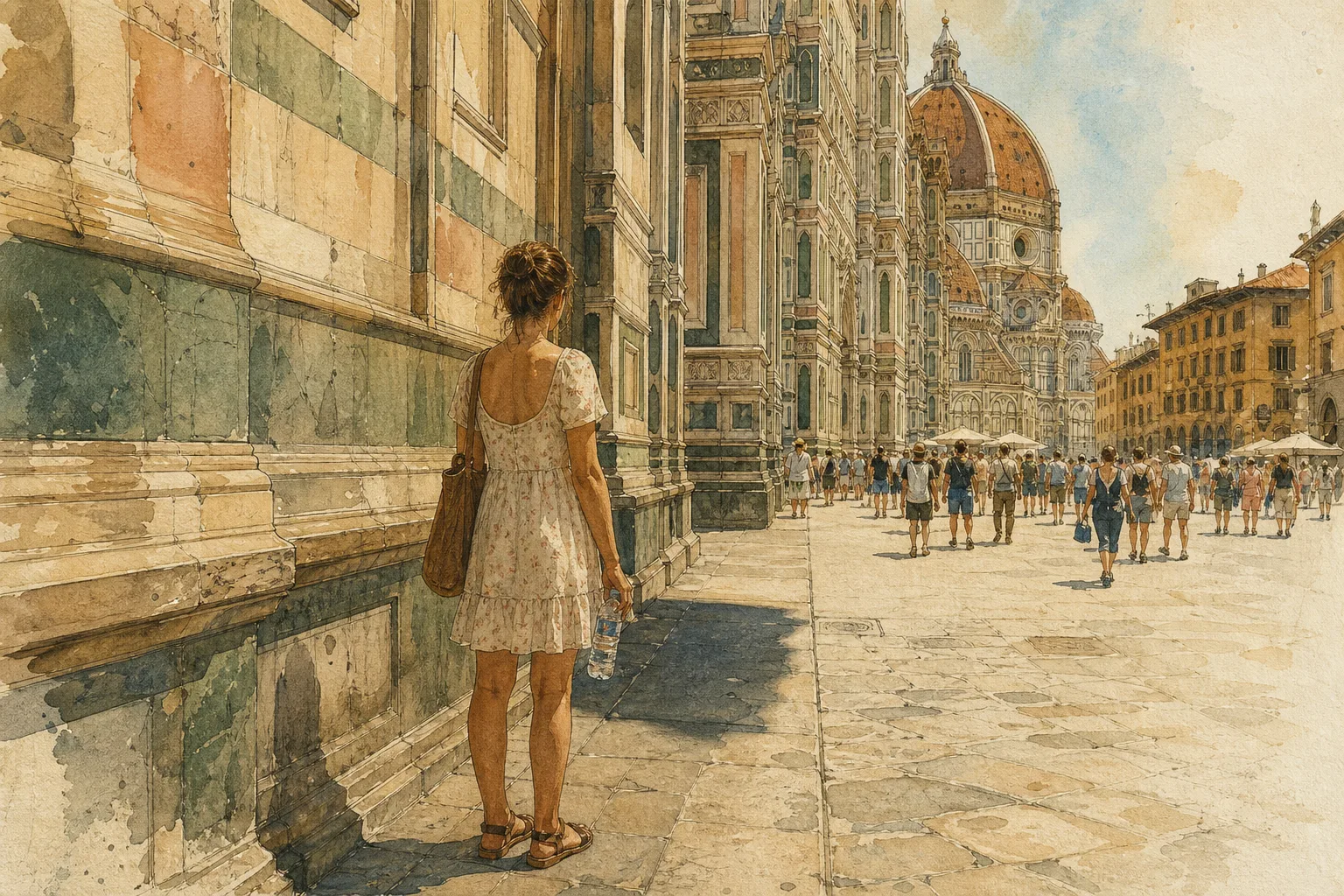
If you already suspect that midsummer Florence will overwhelm you, you are probably right to hesitate. This guide is for travelers who do not want to romanticize a hard trip and want a direct decision instead.
Quick Verdict
Summer is the wrong time for Florence if you check two or more of these boxes: you wilt above 30C, you cannot stand in line for 30 to 60 minutes, you feel anxious in dense museum rooms, or you need a calm midday pace. July and August routinely sit at 30 to 32C and push past 35C on peak days, and the Uffizi and Accademia run at their highest demand of the year.
Summer can still work if you are willing to start sightseeing by 8 am, retreat indoors from about 1 to 5 pm, pre-book every major museum weeks in advance, and accept hotel pricing roughly double the shoulder season. If that sounds exhausting just to read, choose late September to mid-October or late April to early May instead.
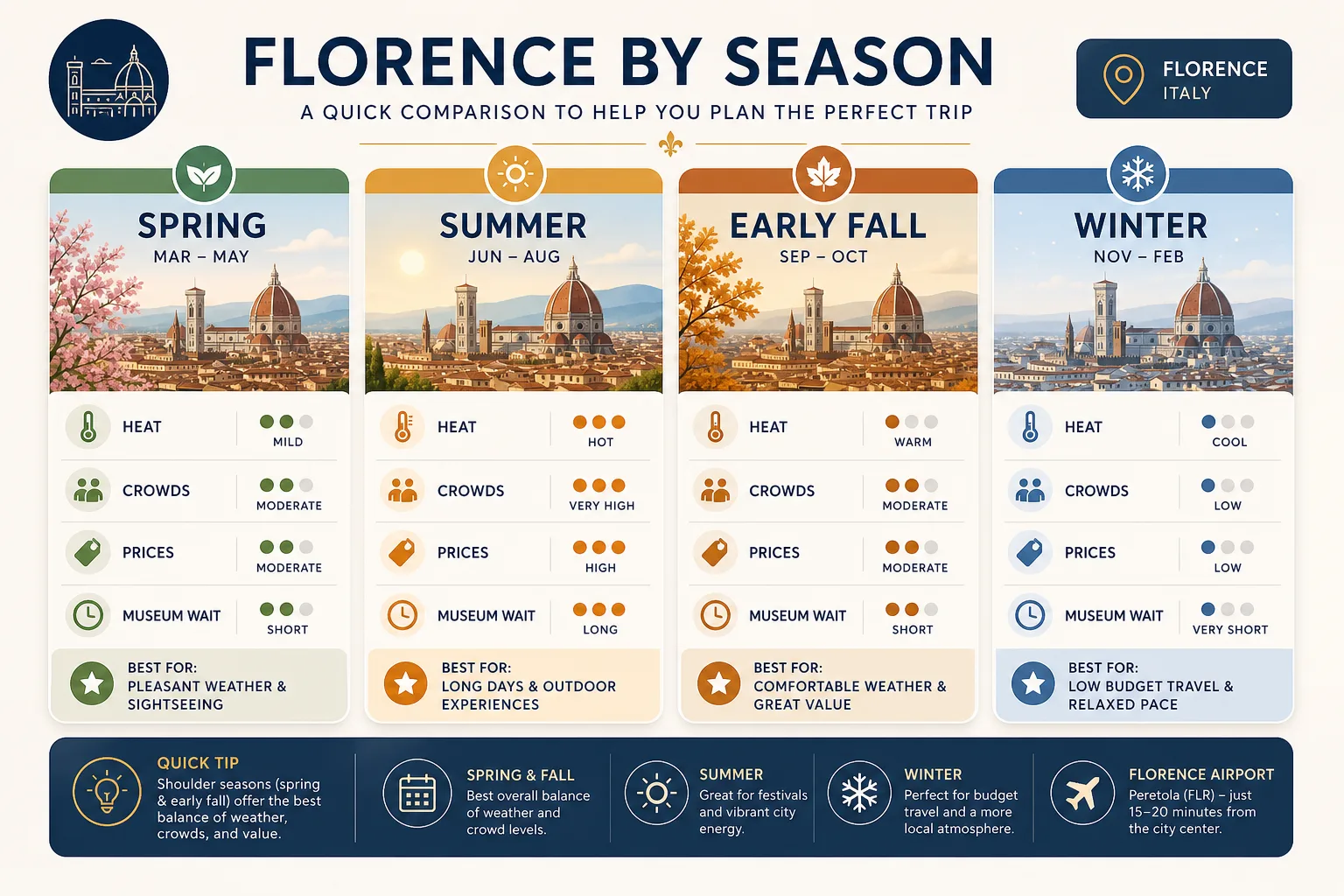 Infographic comparing Florence's seasons across heat, crowds, prices, and museum wait times.
The Real Friction: Heat, Stone, and Standing Time
The reason Florence punishes heat-sensitive and low-stamina travelers in summer is not just the temperature reading. It is the combination of:
- Heat radiating off stone. The historic center is compact stone and brick. Surfaces stay hot well after sunset, and shaded relief between sights is limited.
- Museum crowd pressure. Rooms in the Uffizi and Accademia hit their tightest density in July and August. Even with timed entry, you move at the pace of the slowest cluster.
- Standing time you did not budget for. Walking distances look short, but you stand far more than you walk: in entry queues, in front of works, at security, waiting for groups to clear.
- Short-rest fatigue. Cafes are crowded, outdoor seating is being further restricted (Florence's March 2026 rules ban outdoor tables and bright signage across 73 streets in the UNESCO core), and finding a cool place to sit for 20 minutes is harder than it sounds.
- Price pressure. Peak hotel rates average about 200 to 478 USD per night, weekends can spike to 1,000 to 1,200 EUR, and the nightly tourist tax adds 6 to 8 EUR per person for up to 7 nights.
The good news: distances are short. Santa Maria Novella station to the Duomo is a flat 650 meters, about 10 to 15 minutes. Duomo to Uffizi is 5 to 10 minutes. Uffizi to Ponte Vecchio is 3 minutes, and on to Pitti Palace or Boboli is another 10. The problem is not getting between sights. It is surviving the air and the queues in between.
Friction Comparison by Season
| Window | Heat load | Museum crowd pressure | Standing fatigue | Lodging price | Best for |
|---|---|---|---|---|---|
| Late April to May | Mild, occasional warm days | High but moving | Moderate | Shoulder, around 500 to 600 EUR weekend tier | Most travelers |
| June | Warming fast, low 30s common | Rising sharply | High | Approaching peak | Tolerable if you start early |
| July to August | 30 to 32C average highs, 35C+ peaks | Highest of the year | Severe | Peak, weekend spikes to 1,000 to 1,200 EUR | Only well-prepared, heat-tolerant travelers |
| Early to mid September | Still warm but easing | Still high | Moderate to high | Easing | Decent compromise |
| Late September to mid October | Comfortable daytime | Noticeably lighter | Manageable | Shoulder | Heat-sensitive and crowd-averse travelers |
| November to early March | Cool to cold, some rain | Lowest of the year | Low | Lowest | Museum-focused trips |
Who Will Feel Summer Florence Most
Skip a July or August trip if you fit any of these profiles:
- Heat-sensitive travelers. If you get headaches, nausea, or fatigue above 28 to 30C, the stone-radiated heat will define your trip, not the art.
- Museum-averse or crowd-anxious travelers. Peak summer is when the Uffizi feels least like a gallery and most like a corridor. If you already dislike museum density, this is the worst possible test.
- Low-stamina travelers. Mobility issues, recent surgery, pregnancy, or simply low baseline endurance: queues, security, and standing time add up to far more on-feet hours than the map suggests.
- Travelers who need spontaneity. Summer Florence punishes anyone who has not pre-booked tickets a month or two out. Walk-up plans collapse quickly.
You may still enjoy a summer trip if you are a confirmed early riser, you have done hot-climate cities before, you are willing to plan strictly, and your group is aligned on a midday rest block.
How to Reduce the Friction If You Still Go in Summer
If summer is your only option, build the day around heat and standing time, not around a wish list of sights.
- Anchor the morning. Be at your first museum or church at opening. Use the Accademia or Uffizi as your morning block before crowds and heat peak.
- Pre-book everything. Book Accademia tickets at least 2 months out and Uffizi at least 1 month out. Expect to pay 25 EUR in person or 29 EUR online due to the 4 EUR pre-sales fee. Book Uffizi under the exact name on the ID you will carry, since from October 13, 2025 mismatches mean no entry and no refund.
- Schedule a real midday break. Plan a 1 to 5 pm indoor block at your hotel. This is not optional in July and August.
- Choose lodging for the break, not the view. A quiet, well-cooled room within 10 to 15 minutes walk of the Duomo is more valuable than a rooftop you will rarely use. Our hotel location checklist is built for exactly this tradeoff.
- Plan in-person check-in. Self-check-in lockboxes have been banned in the historic center since February 25, 2025, so confirm arrival windows directly with your host.
- Reverse the evening. Save outdoor sights like Piazzale Michelangelo, the Boboli perimeter, and Oltrarno walks for after 6 pm.
- Hydrate and shade-hop. Carry water, refill at public fountains, and route through the shaded north sides of streets when possible.
Better Alternative Windows
If your dates are flexible, these windows solve the core friction with very little compromise:
- Late September to mid October. The strongest overall window for heat-sensitive and crowd-averse travelers. Daytime is comfortable, museum demand is softer than July or August, and pricing has eased from peak.
- Late April to mid May. Similar weather profile to early fall. Watch for Italian public holidays and school trips, which can briefly bunch crowds.
- November to early March. Best for travelers whose main goal is museums. Lowest crowds, lowest prices, but expect cool, sometimes rainy days and shorter daylight.
- Not Florence at all. If your real interest is Renaissance art without the crowd intensity, smaller Tuscan cities like Siena, Lucca, or Arezzo carry less summer pressure, though they have their own peak days.
Pre-Booking Decision Checklist
Use this before you commit to summer dates:
- I can tolerate 30 to 35C while walking on stone for short stretches.
- I will start sightseeing by 8 to 9 am at least 4 days of the trip.
- I will accept a 3 to 4 hour indoor break in the afternoon.
- I have booked Accademia at least 2 months out and Uffizi at least 1 month out.
- My Uffizi booking name matches the physical ID I will carry.
- My lodging is within roughly 15 minutes walk of the Duomo and has reliable cooling.
- I have confirmed an in-person check-in time with my host.
- I have budgeted for peak rates plus 6 to 8 EUR per person per night tourist tax.
- My travel companions agree on the early-start, midday-rest rhythm.
If you cannot honestly tick at least seven of these nine, shift your dates to late September or May.
FAQ
Is Florence bearable in July and August if I am heat-sensitive? Only with structural changes to your day. July and August highs average 30 to 32C and frequently exceed 35C, and the historic center radiates heat off stone well into the evening. If you cannot start sightseeing by 8 am, take a long indoor break from roughly 1 to 5 pm, and end with a late stroll, you will likely be miserable. Heat-sensitive travelers usually do better in late April, May, or late September.
Will I really get into the Uffizi and Accademia in summer if I plan ahead? Yes, but the planning window is non-trivial. Book Accademia at least 2 months in advance and Uffizi at least 1 month in advance during high season. Walk-up entry is often sold out. Also note that effective October 13, 2025, Uffizi tickets must match the visitor's physical ID, with no refund for mismatches, so book under the correct name.
Is summer in Florence much more expensive than spring or fall? Yes. Peak summer hotel rates average roughly 200 to 478 USD per night, and weekend stays can spike to 1,000 to 1,200 EUR versus 500 to 600 EUR in shoulder season. The nightly tourist tax adds 6 EUR per person at most 3-star and lower properties and 8 EUR at 5-star hotels, charged for up to 7 consecutive nights.
What is the single best alternative window if I want fewer crowds and cooler weather? Late September into mid-October is the strongest all-round window. Daytime temperatures are usually comfortable, museum demand softens versus July and August, and accommodation pricing eases. Late April and May are similar on weather but can still see crowd spikes around Italian holidays.
Are there new rules in 2025 and 2026 that affect summer planning? Yes. Self-check-in lockboxes have been banned in the historic center since February 25, 2025, so expect in-person check-in. Effective March 2026, outdoor restaurant tables, terraces, and bright signage are banned across 73 streets in the UNESCO core, which changes evening dining choices. And from June 2026, new short-term rentals are restricted in outer neighborhoods including Campo di Marte, San Jacopino, Statuto, Rifredi, Gavinana, and Oltrarno.