travel-decisions
Is Florence in Winter Better for Museum-Focused Travelers Who Want Quieter Days?
A practical decision guide for art-focused travelers weighing winter Florence: shorter waits at the Uffizi and Accademia, short daylight, weather risk, and quiet evenings.
Quick Verdict
Winter Florence is the right choice if your trip is built around museums, slow lunches, and a calm pace, and you accept short days and quiet evenings as part of the deal. From November through February, weekday walk-up waits at the Uffizi and Accademia drop under 10 minutes, which is the single biggest reason art-focused travelers come in this window.
Skip winter Florence if you want long daylight for outdoor wandering in the Boboli Gardens and Oltrarno, a lively late-night scene, or guaranteed clear weather for views from Piazzale Michelangelo. Also skip the last two weeks of December: holiday crowds erase most of the quiet-museum advantage.
A useful rule: if you would describe your ideal day as "two museums, a long lunch, one church, dinner at 7:30," winter works. If you would describe it as "wander all afternoon and stay out late," shoulder season is a better fit.
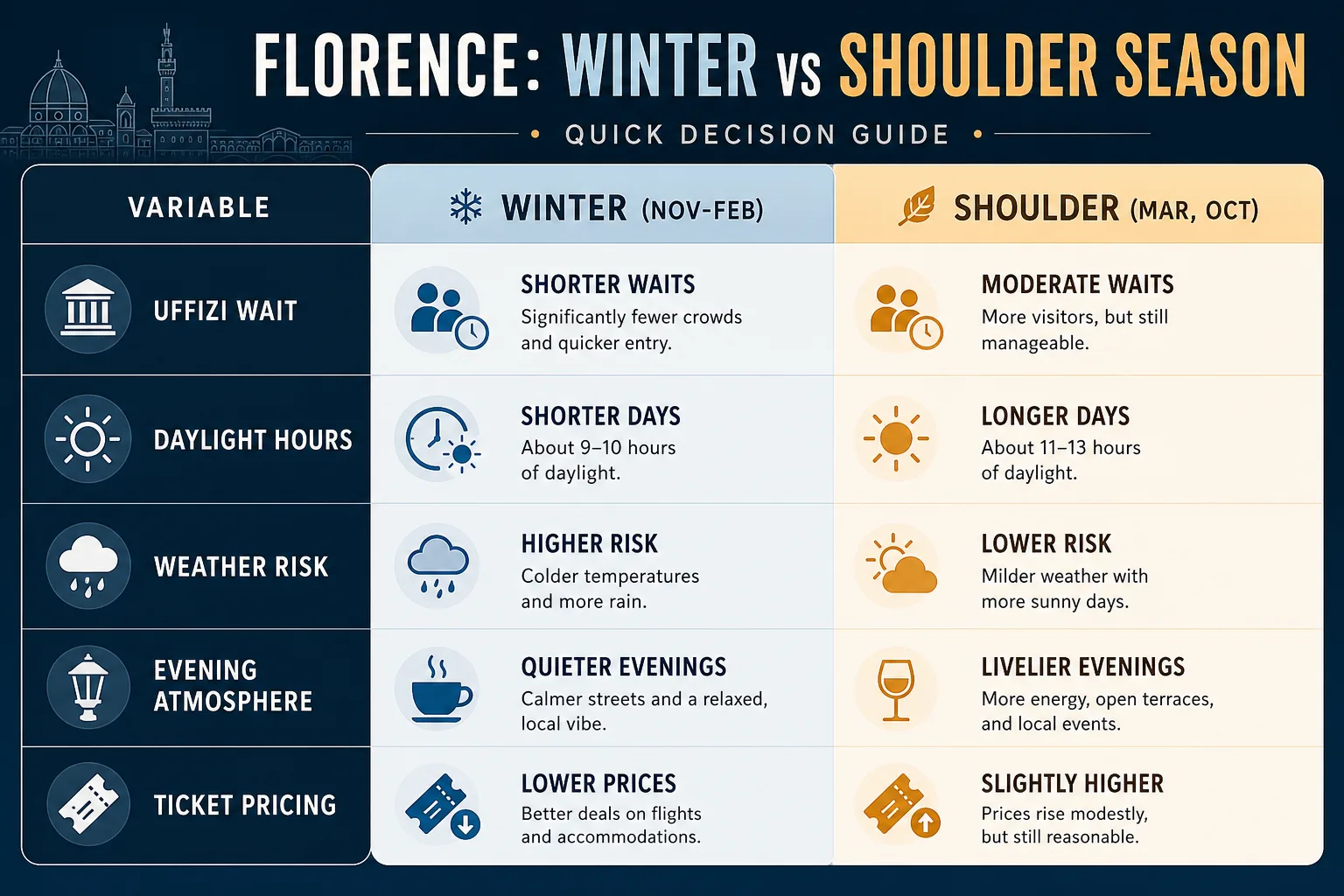 An infographic table comparing winter versus shoulder season in Florence across key travel metrics.
The Real Friction of Winter Florence
The friction is not the cold. Florence winters are damp and gray more often than they are bitter. The friction is structural, and it stacks in ways that catch museum-focused travelers off guard.
Short daylight compresses the day. On December 21 you get 8 hours 55 minutes of daylight, with sunset between 4:40 PM and 5:00 PM through December and January. If you start a museum at 10:00 AM and spend three hours inside, you finish in fading light. Outdoor sights like Piazzale Michelangelo, the Boboli Gardens, and Oltrarno rooftop views need to be morning or early-afternoon decisions, not "after dinner" decisions.
Museum quiet is real, but conditional. The under-10-minute wait holds on weekdays from November through February, excluding the Christmas and New Year weeks. Weekends still draw Italian domestic travelers, and the late-December holiday window pulls in international crowds for Christmas markets. Plan your Uffizi and Accademia visits for Tuesday through Friday outside those holiday weeks, or the main reason you came in winter evaporates.
Mondays close the major museums. The Uffizi, Accademia, and Pitti Palace are all closed on Mondays. On a four-day trip that lands Saturday to Tuesday, you lose a full museum day if you do not plan around it.
Weather is uncertain, not extreme. Expect a mix of crisp clear days, gray drizzle, and occasional heavy rain. The risk is not safety; it is itinerary stress when you have already lost two daylight hours to a late breakfast and a wet morning.
Evenings are quieter than first-time visitors expect. Most authentic Florentine restaurants open at 7:00 PM or 7:30 PM and locals rarely arrive before 8:15 or 8:30 PM. Between an early winter sunset and a late local dinner culture, there is a long indoor evening to fill.
Friction Table: Winter vs Shoulder Season
| Variable | Winter (Nov-Feb, non-holiday) | Shoulder (March, October) |
|---|---|---|
| Uffizi / Accademia weekday wait | Under 10 minutes walk-up | 20-60 minutes without reservation |
| Daylight | About 9-10 hours, sunset 4:40-5:30 PM | About 11-12 hours, sunset 6:00-7:30 PM |
| Weather risk | Damp, gray, occasional heavy rain | Variable, more clear days, some rain |
| Outdoor time (Boboli, Piazzale Michelangelo) | Morning only, often cut short | Comfortable most of the day |
| Evening atmosphere | Quiet, early-closing shops, late local dinner | Lively streets, longer aperitivo windows |
| Uffizi standard ticket | 25 EUR in person / 29 EUR online | Same pricing, longer queues without booking |
| Uffizi after-4 PM discount (from Jan 1, 2026) | 16 EUR in person / 20 EUR online, but light is gone | 16/20 EUR with usable evening light |
| Accademia standard ticket | 20 EUR in person / 24 EUR online | Same pricing, longer queues |
| Firenze Card (72-hour) | 85 EUR, excludes Duomo Complex | Same |
| Combined Accademia + Bargello pass (from Mar 15, 2026) | 26 EUR (48h) / 38 EUR (72h) | Same |
| Bus single / day pass | 1.50 EUR / 5 EUR | Same |
| SMN station to Duomo on foot | About 10 minutes, 800 meters | Same |
The pricing rows are flat across seasons, which is worth naming clearly: winter does not save you money on tickets. It saves you time in line and gives you calmer galleries.
Who Will Feel It Most
Best fit for winter Florence:
- Museum-first travelers who want to actually stand in front of the Birth of Venus or David without a moving crowd behind them.
- Slow travelers who prefer two-museum days over five-stop sprints.
- Repeat Italy visitors who have already done the outdoor postcards and want interior depth.
- Low-stress planners who hate timed-entry roulette and the 60-minute queue gamble.
Worst fit for winter Florence:
- First-timers who also want long Tuscan day-trip afternoons; winter cuts the usable countryside daylight in half.
- Photographers who came for Arno golden hour and Piazzale Michelangelo views; the weather lottery is real.
- Atmosphere-first travelers expecting a buzzing piazza scene every night.
- Travelers with a tight three-day window that includes a Monday: the museum closures plus short days make it feel rushed.
Mixed fit:
- Couples wanting a romantic, unhurried trip: works if you both like long indoor dinners and early nights; struggles if one of you wants nightlife.
- Families: the shorter queues help, but evening boredom is a risk with kids who do not want a 7:30 PM sit-down dinner.
How to Reduce the Friction
You can engineer most of winter Florence's downsides away if you decide before you book.
Solve the daylight problem with sequencing. Outdoor first, indoors second. Piazzale Michelangelo at 9:00 AM, Boboli Gardens before noon, museums in the early afternoon. Save churches and indoor sights for the dim hours.
Solve the Monday closure with arrival timing. Arrive Tuesday or Wednesday so your first full day is a museum day with fresh legs. If you must arrive Sunday, treat Monday as a walking, market, and Duomo Complex day, since the Duomo is not on the standard state-museum closure rule.
Solve the holiday-week trap. If quiet museums are your main reason for coming, avoid roughly December 23 through January 6. Mid-November, early December, late January, and February weekdays consistently deliver the under-10-minute wait without the holiday spike.
Solve evening boredom on purpose. Book one cooking class, one wine tasting, or one evening concert per two nights. Long indoor evenings only feel quiet if you did not plan for them.
Solve the weather gamble with a flex day. On a five-day trip, leave one day unbooked. Use it as a museum day if it rains, or a day-trip day (Siena, Lucca) if it is clear.
Solve the ticket question rationally. If you are going on a winter weekday outside holiday weeks, the 4 euro online booking fee for the Uffizi mainly buys peace of mind, not faster entry. The new ID-matching rule (starting October 2025) means whoever holds the booking must be present with matching physical ID, so do not book in someone else's name to save effort.
Better Alternatives if Winter Does Not Fit
If the friction list above made you flinch, the answer is not necessarily "skip Florence." It is usually "shift the window."
- Late October or early November (pre-holiday shoulder): You still get noticeably shorter queues than summer, daylight until around 5:30 PM, and warmer outdoor afternoons. Best compromise for travelers who want quiet-ish museums plus usable outdoor time.
- Mid-March: Daylight stretches past 6:00 PM, weather is improving, and major-museum crowds have not yet hit Easter levels. Good for first-timers who want both Florence's interiors and its streets.
- Late January and early February (deep winter, non-holiday): The truest quiet-museum window, but commit to the slow-pace tradeoff fully. This is the right pick for a dedicated art trip, not a generalist Italy trip.
- Skip Florence entirely this season: If your real priority is winter atmosphere with active outdoor evenings, Rome and Bologna handle short days better because their evening street life starts earlier and runs denser.
Decision Checklist
Use this before you book. If you cannot answer yes to most of these, winter is probably not your window.
- My trip is at least 50 percent museums and churches by intent.
- I can arrive Tuesday through Friday for at least my first museum day.
- My dates fall outside roughly December 23 to January 6.
- I am okay with indoor evenings and dinners starting after 7:30 PM.
- I have a backup indoor plan for the likely one or two rainy days.
- I do not need Tuscan countryside afternoons in long daylight.
- I would rather walk straight into the Uffizi than sit in a sunny piazza.
- I have checked which sights need timed booking (Duomo dome climb, Uffizi for groups) versus walk-up.
- My hotel is within roughly 10-15 minutes on foot of the Duomo, so short daylight does not become a transit problem.
- I have accepted that ticket prices are flat year-round; winter buys time and quiet, not savings.
FAQ
Are the Uffizi and Accademia really quieter in winter, or is that overstated? On weekdays from November through February, excluding the Christmas and New Year weeks, walk-up waits at both the Uffizi and Accademia typically drop under 10 minutes. Weekends and the late-December holiday window are the exceptions and can still feel busy.
Do I still need to book Uffizi tickets in advance in winter? You can often walk up on a winter weekday, but starting October 2025 Uffizi tickets require personal ID details at booking and the name on the ticket must match your physical ID at the gate. Booking online costs 29 euros versus 25 euros in person, so the choice is really about certainty, not crowd avoidance.
How much daylight do I actually lose in December and January? December 21 has about 8 hours and 55 minutes of daylight in Florence, with sunset between roughly 4:40 PM and 5:00 PM through December and January. That is enough for two museum sessions if you start by 9:00 AM, but golden-hour rooftop views are gone before most people finish lunch.
Will dinner and nightlife feel dead? Evenings are quieter, not empty. Most authentic Florentine restaurants open at 7:00 PM or 7:30 PM, and locals rarely sit down before 8:15 PM or 8:30 PM. If you want a buzzing late-night scene, winter Florence will disappoint; if you want unhurried dinners after a museum day, it fits well.
Is a Firenze Card worth it for a museum-focused winter trip? The 72-hour Firenze Card is 85 euros and does not cover the Duomo Complex; a 48-hour digital extension adds 28 euros. If your list is mainly Uffizi, Accademia, Pitti and Bargello, doing the math against single tickets (Uffizi 25 to 29 euros, Accademia 20 to 24 euros) usually decides it. Heavy museum days tilt toward the card; a slow two-museum trip does not.
Does the new Accademia plus Bargello combined pass change the math? For travelers who want both, yes. Launched March 15, 2026, the combined pass is 26 euros for 48 hours or 38 euros for 72 hours, which often beats two separate online tickets. Winter is a good time to use it because you are not racing the clock against queues.
Should I stay near Santa Maria Novella or closer to the Duomo in winter? Either works, because the SMN station to Duomo walk is only about 10 minutes (800 meters). In winter, prioritize a hotel within a 10 to 15 minute walk of the Duomo so short daylight and possible rain do not turn every outing into a transit decision. Bus tickets are cheap at 1.50 euros single or 5 euros for a day pass, but walking remains the realistic default in the historic center.