travel-decisions
Is Tokyo Good for Travelers Who Want Quiet Nights?
A decision guide for travelers who value calm evenings over nightlife. Where Tokyo fits, where it does not, and how to pick a base that protects your sleep.
Quick Verdict
Tokyo is a strong fit for travelers who want quiet nights, as long as you pick the ward you sleep in deliberately. The city is enormous, and the loud Tokyo people imagine, Shibuya crowds, Kabukicho neon, late karaoke streets, lives inside maybe four or five named districts. Everywhere else trends residential, low-rise, and surprisingly hushed after about 9 PM.
Strong fit if you:
- Want to be back at the hotel by 10 or 11 PM most nights.
- Prefer small dinners, quiet cafes, and walking over bar-hopping.
- Are willing to base yourself one or two stops outside the major hubs.
Weak fit if you:
- Want the hotel itself to be in the middle of the action.
- Plan to stay out past the last train regularly and dislike taxi costs.
- Expect a single famous district to feel both iconic and peaceful at night.
Best for First-Time Visitors Who Want Calm Evenings
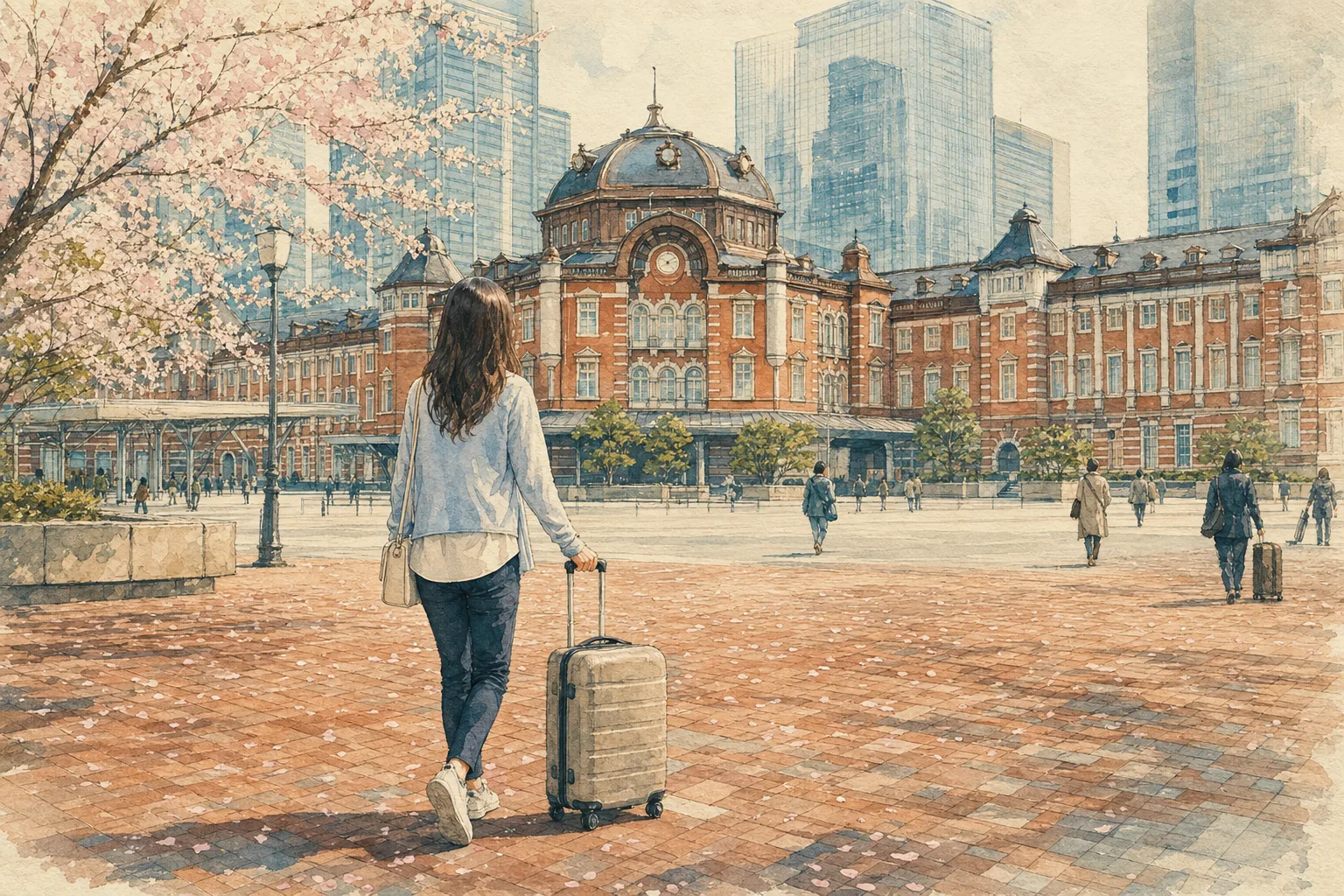
First-time visitors often book near Shinjuku or Shibuya because those names feel safe and central. For quiet-night travelers, that is the trap. Shinjuku Station processes more than 3.5 million passengers daily, and the surrounding blocks reflect that volume well into the night.
A better first-timer move: stay one ring out. Kagurazaka, for example, connects to Shinjuku Station directly in 10 minutes via the Toei Oedo Line from Ushigome-Kagurazaka. You get full access to landmark Tokyo by day and a residential street by night. You are not punished for being a first-timer, you just trade one subway stop for several hours of better sleep.
Best for Couples
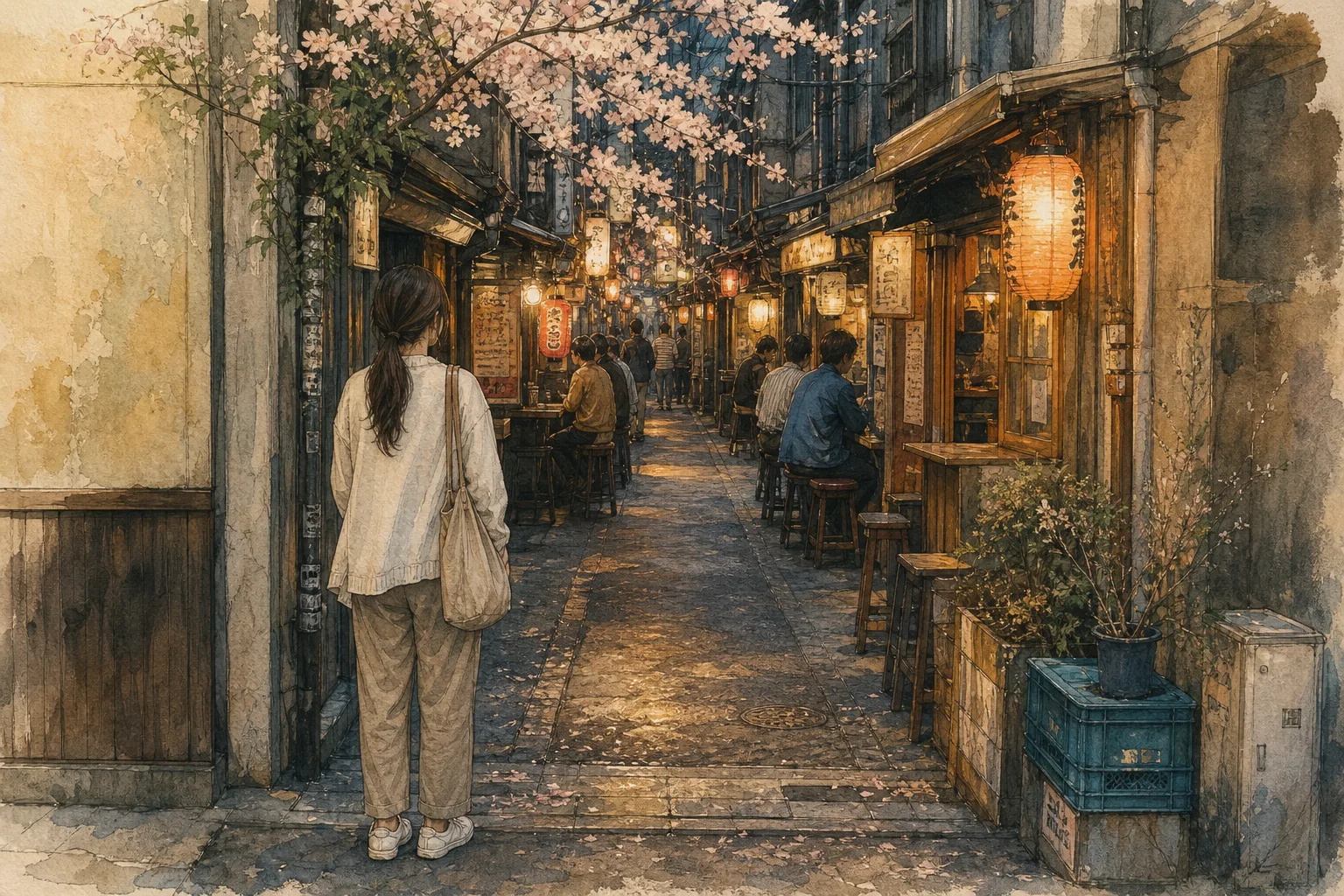
Couples who travel for atmosphere rather than nightlife do unusually well in Tokyo. The city is full of small, early-closing restaurants, narrow lantern-lit lanes, and neighborhoods built for walking after dinner.
Kagurazaka leans romantic and slightly upscale, with stone-paved side streets and mid-range to boutique hotels typically priced 15,000 to 35,000 per night. Yanaka leans quieter and more old-Tokyo, with similar boutique pricing in the 15,000 to 30,000 range. Both let a couple eat well, walk home slowly, and avoid the sensory overload that ruins evenings for people who want to actually talk to each other.
Best for Slow Travelers
Slow travelers, the ones who would rather sit in one cafe for two hours than tick five neighborhoods in a day, get more out of Tokyo than almost any other traveler type, on the condition that they refuse to base near a major terminal.
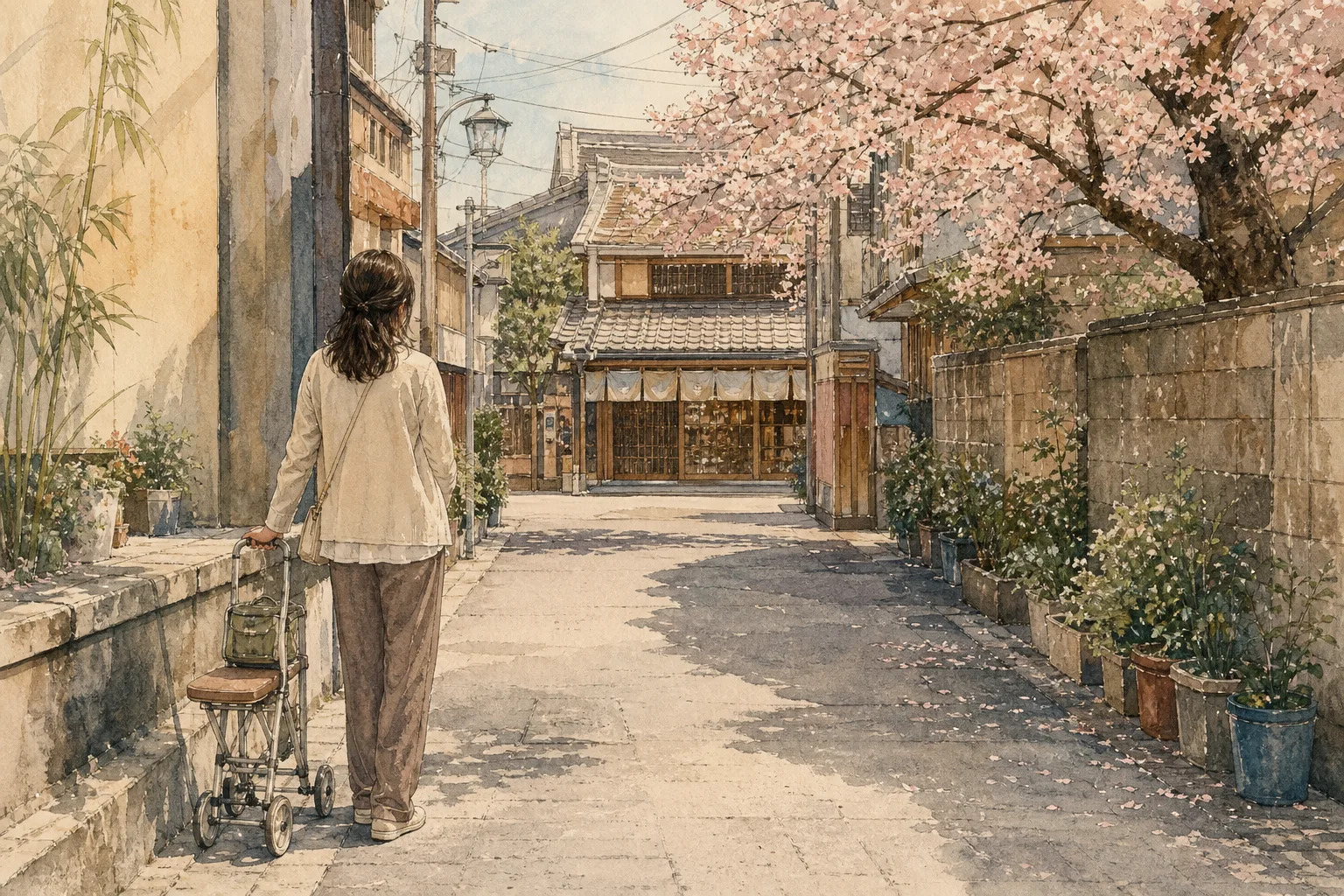
Yanaka is the classic slow-travel base. The walk from Yanaka to Ueno Park takes 25 to 30 minutes (about 2.6 to 2.7 km), or 4 minutes by train from Nippori to Ueno. That ratio matters: you can drift on foot when you want to, and skip to the train when you are tired. Evenings here close down early in a way that feels intentional rather than dead.
Best for Low-Stress Travelers
Low-stress planners should think about Tokyo as a hotel-location problem first and a sightseeing problem second. The right ward removes most of the friction the city is famous for.
Oji is underrated for this. It sits two stations (about 5 minutes) from Nishi-Nippori on the JR Yamanote Line, which means you are technically on Tokyo's most useful loop line, but you sleep in a normal residential neighborhood. Standard business hotels in Oji typically run 10,000 to 18,000 per night, noticeably cheaper than central wards, with none of the late-night street noise.
Low-stress checklist for picking a Tokyo base:
- Hotel is at least one stop outside Shibuya, Shinjuku, or Roppongi.
- Walk from station to hotel is under 8 minutes and well-lit.
- The street the hotel sits on has residential buildings, not bars.
- Last train from the central hub you will visit most leaves before 12:30 AM.
- You have a rough taxi budget for at least one late return.
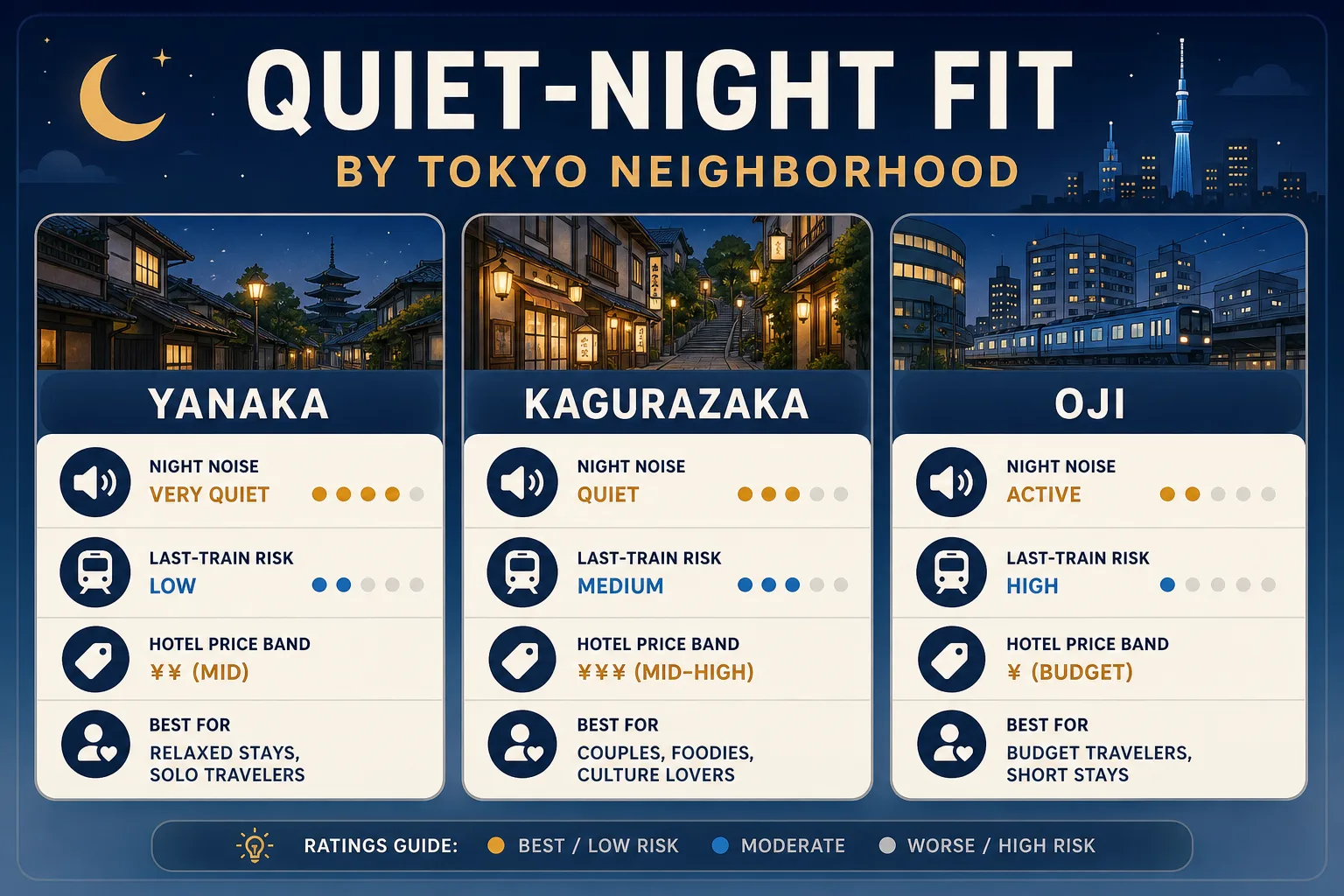
Traveler Type Table: Where the Fit Comes From
| Neighborhood | Night noise | Last-train risk | Hotel price band (mid-range) | Best for |
|---|---|---|---|---|
| Yanaka | Very low, residential, early-closing | Low if back by 11:30 PM via Nippori | 15,000 to 30,000 | Slow travelers, couples, quiet-night first-timers |
| Kagurazaka | Low, calm side streets despite central location | Low, 10 min direct to Shinjuku on Oedo Line | 15,000 to 35,000 | Couples, atmosphere-led travelers |
| Oji | Very low, normal residential ward | Low, Yamanote Line access via Nishi-Nippori | 10,000 to 18,000 | Low-stress and value-led planners |
| Shibuya | High, formal ban on outdoor drinking 6 PM to 5 AM near the station | High, last trains crowded | Higher | Travelers who want nightlife, not quiet |
| Shinjuku (Kabukicho side) | High, drinking bans enforced during peak periods | High | Higher | Not recommended for quiet nights |
Notice what the table is actually saying: the quiet bases are not cheaper or more expensive in a clean line, they are sorted by what kind of evening you want. Oji wins on value. Yanaka wins on atmosphere. Kagurazaka wins on the balance between central access and calm.
Common Mismatches and Regret Patterns
The travelers who later say "Tokyo was too much" almost always share one of these patterns:
- They booked the hotel by station name recognition, ending up in Shinjuku West or near Shibuya Scramble, then discovered the street noise and crowd density at 10 PM.
- They planned full-day itineraries that ended with a 11:45 PM scramble for the last train, turning every evening into a logistics problem rather than a wind-down.
- They assumed all of central Tokyo would feel like the famous photos, then felt overstimulated by the sheer crowd volume in transit hubs.
- They underestimated taxi costs for late returns. Base fare is roughly 500 for the first kilometer in the 23 wards, plus about 100 for every additional 230 to 255 meters, with a 20% late-night premium between 10:00 PM and 5:00 AM. A cross-ward ride after midnight adds up faster than people expect.
If any of those sound like your default planning style, the fix is not skipping Tokyo. The fix is choosing a quieter base and accepting an earlier evening rhythm.
Final Match Recommendation
Choose Tokyo for quiet nights if:
- You will base in Yanaka, Kagurazaka, Oji, or a similarly residential ward.
- You are comfortable being back at the hotel before the last train, or paying a late-night taxi premium once or twice.
- Your version of a good evening is a long dinner and a walk, not a club or a late bar.
Reconsider Tokyo, or at least reconsider your dates and base, if:
- You want a hotel literally inside the entertainment district.
- You travel with someone who gets restless in residential neighborhoods after dark.
- You are visiting during a period when central wards enforce extra crowd-control measures (Shinjuku Ward, for example, enforces public drinking bans in Kabukicho during high-congestion periods such as Halloween), and you wanted those nights to feel relaxed.
The honest summary: Tokyo is one of the better large cities in the world for quiet-night travelers, but only after you stop treating "central" as a synonym for "good base." Sleep one ring out, and the city quietly cooperates.
FAQ
Is Tokyo actually quiet at night, or just in some areas? Tokyo is loud in a handful of named entertainment zones and surprisingly residential almost everywhere else. If you sleep more than a few stations away from Shibuya, Shinjuku Kabukicho, or Roppongi, most nights are quiet by capital-city standards.
Will last-train timing ruin a quiet evening plan? It can if you ignore it. Most Tokyo trains and subways stop running around midnight, with final departures from central hubs typically between 12:00 AM and 12:30 AM. Quiet-night travelers should aim to be back at the hotel well before then, or budget for a taxi with the 20% late-night surcharge added between 10:00 PM and 5:00 AM.
Is staying near Shinjuku or Shibuya a bad idea for quiet sleepers? Generally yes. Shinjuku Station alone processes more than 3.5 million passengers daily, and Shibuya Ward permanently banned outdoor public drinking near the station, Scramble Crossing, Miyashita Park, and Center-gai daily from 6:00 PM to 5:00 AM as of October 2024. Those rules exist because the area is loud and crowded, not because it has become calm.
Which Tokyo neighborhoods are best for a quiet, low-stress base? Yanaka, Kagurazaka, and Oji are the most reliable picks. All three are residential, have early-closing shops, and still connect to central Tokyo in roughly 10 minutes or less by train.
Is Tokyo a good fit for couples who want calm evenings over nightlife? Yes, with the same condition: choose the ward carefully. Tokyo rewards couples who like long dinners, small bars that close early, and walking home through quiet streets, as long as the hotel is not in a designated nightlife district.