where-to-stay
Where to Stay in Osaka on a First Trip If You Want Easy Nights and Low Transit Stress
A first-timer's guide to choosing an Osaka base that keeps transit simple, nights quiet, and airport arrival easy without missing the food districts.
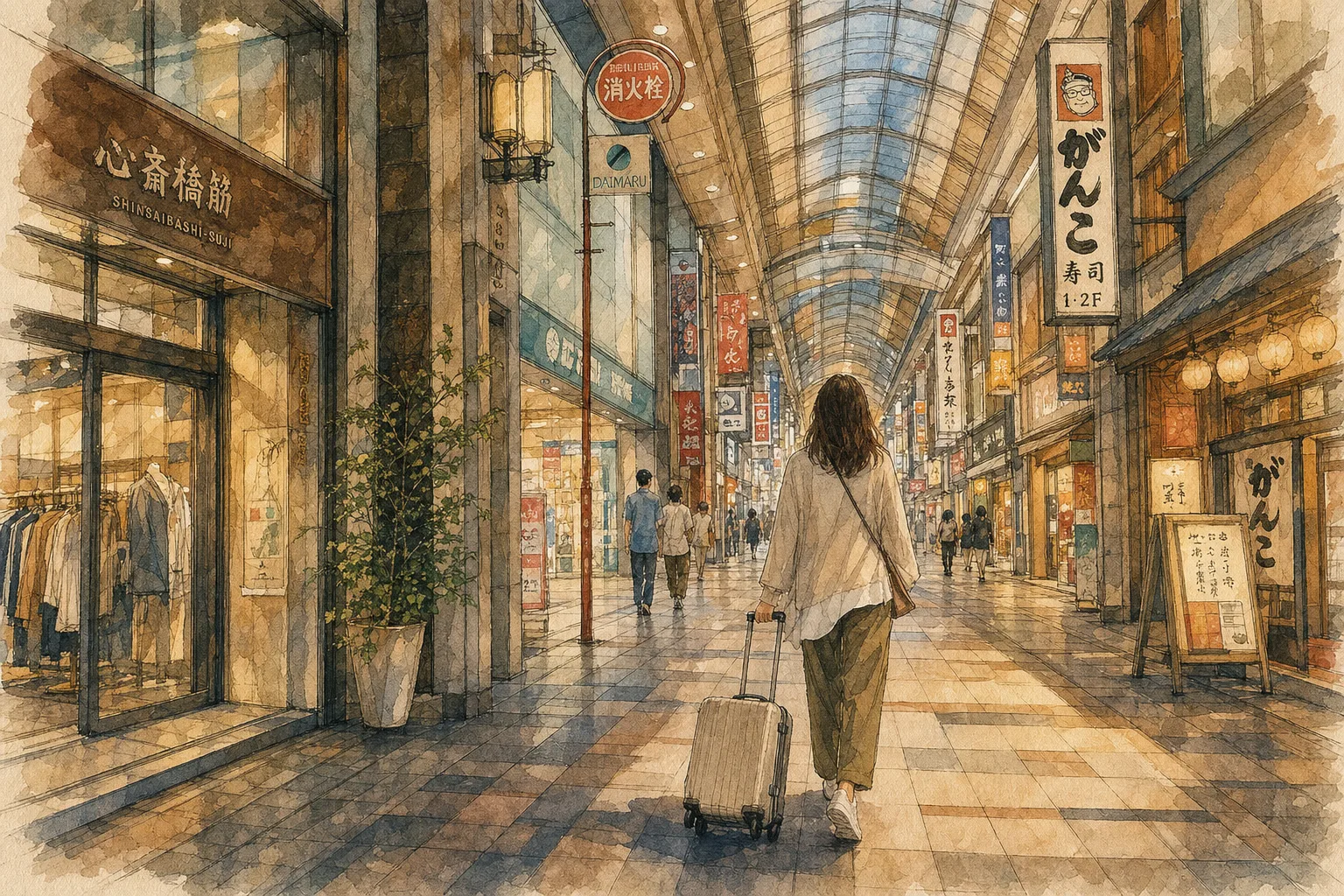
Most first-time Osaka regret is not about the city. It is about the hotel address. You can land at Kansai, drag a suitcase through two transfers, sleep above a karaoke bar, and decide Osaka is exhausting, when really you just picked the wrong block. This guide is for travelers who would rather optimize for quiet sleep, one-train airport access, and short walks to food than for being inside the loudest intersection on the map. In Osaka, the usual mistake is confusing food access with having to sleep inside food-district noise.
Quick Answer
For a first trip to Osaka focused on easy nights and low transit stress, stay in Honmachi or in the quieter fringe of Namba (Namba-South or Shinsaibashi-East). Honmachi is the strongest single answer: three subway lines, a 4 to 5 minute ride to either Namba or Umeda, a 15 to 20 minute flat walk to Dotonbori, and a business-district silence after 8 PM.
- Choose this if: you want one calm base, dislike complex transfers, plan late dinners but early bedtimes, and want a clean airport route.
- Skip this if: you want to step out of the lobby into nightlife, you are staying only one night and want maximum Dotonbori time, or your trip is built around Kyoto day trips (then weight toward Umeda).
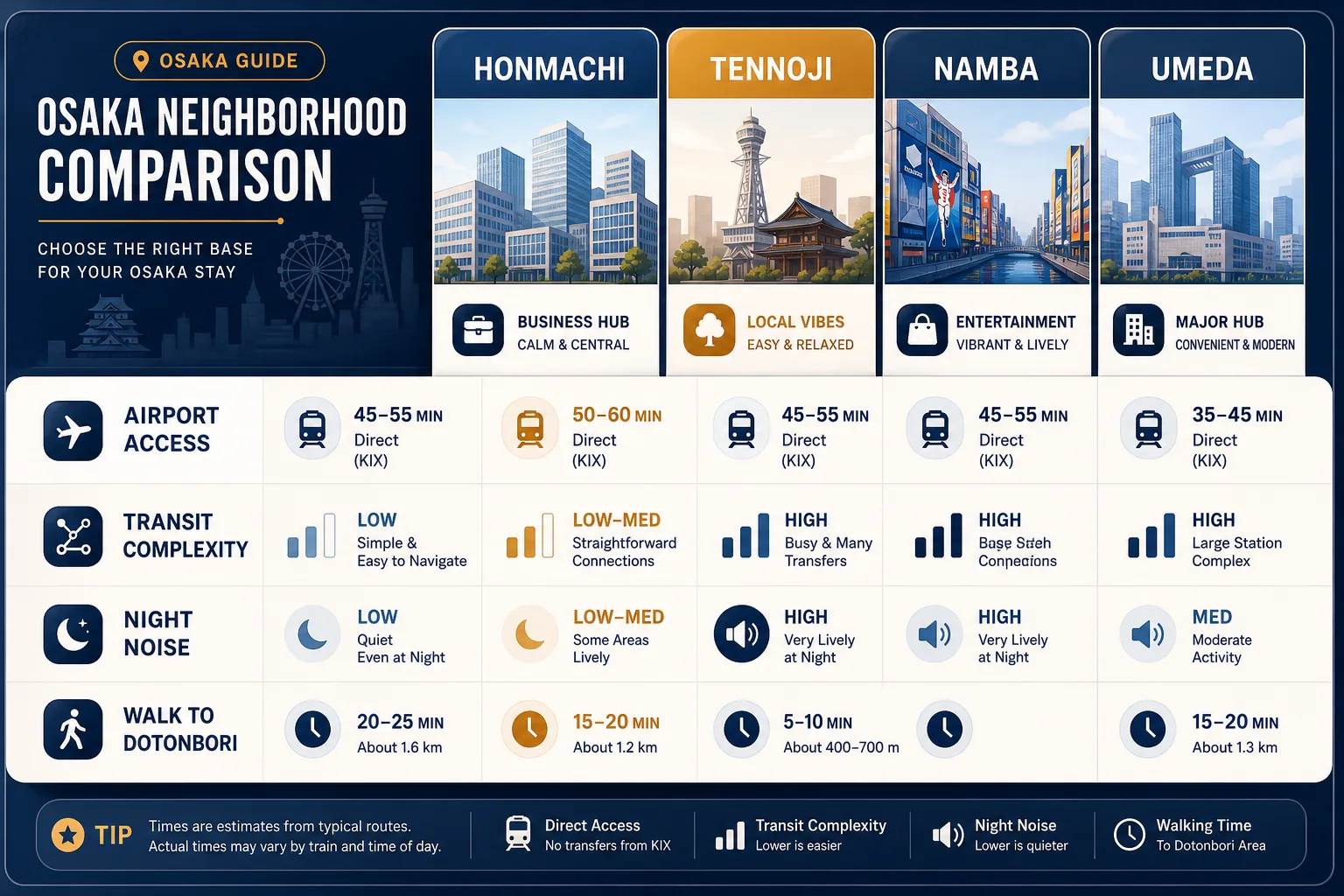 A comparison chart of Osaka neighborhoods Honmachi, Tennoji, Namba, and Umeda, detailing airport access, transit complexity, night noise, and walking times.
Hotel Location Risk Summary
The risks first-timers underestimate in Osaka are not safety or distance. They are friction.
| Risk | What it actually looks like |
|---|---|
| Transfer stress | Booking near a station that looks central on a map but requires switching lines with luggage, especially at Umeda's multi-operator maze. |
| Airport drag | Picking a hotel that needs a subway transfer after the airport train, turning a 35-minute ride into a 70-minute ordeal. |
| Night noise | Rooms directly above Dotonbori or Shinsaibashi that stay loud past 1 AM, with thin walls in older buildings. |
| Late-return anxiety | Bases that require a transfer on a line whose last train is earlier than you expect. |
| Luggage logistics | Narrow elevators, stairs at exits, and station codes that send you out the wrong side of a 1 km underground complex. |
The fix is to choose a hotel whose nearest station is on the Midosuji subway line (the spine that connects Umeda, Honmachi, Shinsaibashi, Namba, and Tennoji) and whose street feels residential or commercial-office after dinner. The regret pattern here is almost always sleeping too close to the entertainment you only wanted to visit for two hours.
Best Areas at a Glance
These are the four neighborhoods most first-timers actually consider, scored against the friction this article cares about.
| Area | Airport access | Transit complexity | Night noise | Walk to Dotonbori | Typical mid-range rate |
|---|---|---|---|---|---|
| Honmachi | Subway from Namba after Rapi:t, or transfer from Haruka | Low (3 subway lines meet here) | Very quiet after 8 PM | 15 to 20 min, covered arcade | 8,000 to 16,000 yen |
| Namba (central) | Direct Rapi:t from KIX, ~34 min, 1,490 yen | Low | Loud near Dotonbori, calmer south | On top of it | Varies widely |
| Namba-South / Shinsaibashi-East | Same as Namba, plus short walk | Low | Moderate, calmer than core | 5 to 10 min | Mid-range |
| Tennoji | Direct Haruka from KIX, 33 to 35 min, 1,200 to 1,800 yen with tourist ticket | Low to medium | Quiet residential pockets | 6 min on Midosuji Line (3 stops) | 9,000 to 17,000 yen |
| Umeda | Multiple airport routes, but bigger station to navigate | High (JR, Hankyu, Hanshin, 3 subway lines all converge) | Moderate, business district | 5 min subway, no easy walk | Generally higher |
Honmachi wins on the combination most first-timers actually need. Tennoji wins if you prioritize the cheapest direct airport train and do not mind being a few stops further from the food core.
Best Area by Traveler Type
First-time visitors who want one simple base. Honmachi. You arrive at Namba on the Rapi:t, take the Midosuji Line two stops (5 minutes) north, and you are home. From there, every major sight is one short ride or one flat walk. You do not have to learn the JR system, the Hankyu system, or which Umeda exit you want.
Low-stress planners who hate transfers. Stay on the Midosuji Line, full stop. Honmachi, Shinsaibashi, or Namba-South. The Midosuji Line is the one Osaka subway line a first-timer can use without thinking. It runs north-south through every district you care about.
Food-led travelers who want late dinners without sleeping in the noise. Namba-South or Shinsaibashi-East. You are 5 to 10 minutes on foot from central Dotonbori, which means you can stay out until the kitchens close and still walk home to a quieter block. Honmachi works too if you do not mind a 15 to 20 minute walk back through the arcade, which is well-lit and covered.
Areas to Be Careful With
These are not bad neighborhoods. They are mismatches for the easy-nights persona.
- Inside Dotonbori or directly on Shinsaibashi-suji. The street energy is the attraction, but rooms here stay loud well past midnight. Older buildings have thin windows. If you book here, ask explicitly for a room not facing the canal or the arcade, and on a high floor.
- Shin-Imamiya and parts of Nishinari. Cheap rates draw first-timers in. The area is safe enough in daytime but has a rough late-night feel that catches first-time visitors off guard. Skip it on a first trip unless you have specific reasons.
- Umeda for a short stay. Umeda is a regional hub, not a neighborhood. The station complex is genuinely confusing on arrival with luggage, and you may walk 10 minutes underground just to reach your hotel exit. Better for repeat visitors or Kyoto-heavy itineraries.
- Far-out business hotels near JR loop stations like Bentencho or Fukushima. They look cheap and close on a map, but every outing becomes a transfer.
Budget vs Convenience Tradeoff
Osaka rewards spending a little more on location, not on the room itself.
- Under 8,000 yen per night: You are likely choosing between a small room in a quiet but inconvenient area, or a noisy room in a central one. Pick quiet and accept the 15-minute walks.
- 8,000 to 16,000 yen (Honmachi mid-range): The sweet spot. Modern compact rooms, three subway lines at the door, near-silent streets at night. This is where the friction-first traveler lands.
- 9,000 to 17,000 yen (Tennoji): Comparable price band, with the upside of the cheapest tourist-discounted Haruka ticket (around 1,200 to 1,800 yen) directly from KIX. Slightly further from Dotonbori but a clean single ride.
- Above 17,000 yen: You are now paying for view, brand, or breakfast. Location no longer improves much. If your priority is easy nights, do not upgrade past mid-range for location alone.
The honest tradeoff: paying 2,000 to 4,000 yen more per night to be on the Midosuji Line in a quiet block usually saves more than that in taxis, wasted time, and bad sleep.
Hotel Location Checklist
Run any candidate hotel through this list before booking.
- Nearest station is on the Midosuji subway line (or one short walk from it).
- No more than one transfer from KIX, ideally zero (Rapi:t to Namba, or Haruka to Tennoji).
- The street has offices, residential buildings, or covered shopping, not bars directly below the hotel.
- The hotel exit is on the same side of the station as the listed address (check on the station map, not just Google Maps).
- Room is not facing Dotonbori canal, Shinsaibashi arcade, or a major road if you are noise-sensitive.
- Elevator exists and the building is not walk-up if you have a real suitcase.
- Last train back to your station is after 11:30 PM from the food districts you plan to visit.
- Walking time to dinner area is under 20 minutes on a flat, lit route.
If a hotel fails two or more of these, keep looking. There are dozens of mid-range options in Honmachi alone that pass all of them.
Use the Hotel Location Checklist tool to score your shortlisted hotels before booking, and the travel budget calculator to sanity-check your nightly spend.
Final Recommendation
If you want one answer: book Honmachi for a first Osaka trip focused on easy nights and low transit stress. You get business-district quiet after 8 PM, three subway lines at your door, a 4 to 5 minute ride to either Namba or Umeda, and a covered walk to Dotonbori when you feel like the energy. Mid-range rates of 8,000 to 16,000 yen per night put it in the same band as noisier or less convenient alternatives.
Choose Tennoji instead if your priority is the cheapest, simplest direct airport train (Haruka, 33 to 35 minutes, 1,200 to 1,800 yen with tourist discount) and you are happy being 6 minutes south of Namba on the Midosuji Line.
Choose Namba-South or Shinsaibashi-East if food is the entire trip and you want to roll out of bed into Dotonbori while still sleeping on a calmer block.
Avoid staying directly inside Dotonbori, in deep Umeda, or in far-out cheap districts on a first trip. The savings rarely survive the friction.
FAQ
Is Dotonbori a bad place to stay for a first trip to Osaka? Not bad, but mismatched if you want easy nights. Dotonbori is loud past midnight, crowded for luggage, and the same energy you came to enjoy is what you have to sleep through. Many first-timers prefer staying a 5 to 10 minute walk away in Namba-South or Shinsaibashi-East and walking in for dinner.
Should I stay near Umeda or Namba? Namba is closer to Dotonbori food and has the most direct airport train. Umeda is a larger transit hub connecting JR Osaka, Hankyu, Hanshin, and three subway lines, which is useful if you plan day trips to Kyoto or Kobe. For a single base focused on Osaka itself, Namba or Honmachi is usually simpler.
What is the easiest airport-to-hotel route from KIX for a first-timer? If your hotel is near Namba, take the Nankai Rapi:t to Namba Station in about 34 minutes for around 1,490 yen. If your hotel is near Tennoji or further along the Midosuji corridor, the JR Haruka express reaches Tennoji in 33 to 35 minutes with no transfers, and tourist tickets are discounted to roughly 1,200 to 1,800 yen one way.
Where should I stay in Osaka if I want to sleep quietly but still walk to Dotonbori? Honmachi is the most underrated answer. It is a business district that becomes very quiet after 8 PM, sits on three subway lines, and is a 15 to 20 minute flat walk to Dotonbori along the covered Shinsaibashi-suji arcade. You get food access without the late-night noise.
Is it worth paying more to be on the Midosuji Line specifically? Usually yes. The Midosuji Line is the one Osaka subway line a first-timer can navigate without thinking, and it directly connects Umeda, Honmachi, Shinsaibashi, Namba, and Tennoji. Paying a small premium to sleep one short walk from a Midosuji station saves transfer stress on every outing.