travel-decisions
Is Osaka Worth It for Food-Led Travelers Who Do Not Want Nightlife?
A decision-focused look at whether Osaka fits travelers who prioritize food and neighborhood rhythm over bar-hopping and late-night Dotonbori energy.
Osaka has a reputation problem for one specific kind of traveler: the person who wants the food and the neighborhood texture but does not want to spend their evening shouting over a Dotonbori crowd. Most guides answer "Is Osaka worth it?" by pointing at the neon. That answer is not useful if nightlife is exactly what you are trying to skip.
This article narrows the decision. We treat food-led travelers who want quiet evenings as the primary persona, then show where Osaka delivers, where it disappoints, and which base neighborhoods quietly carry the trip.
Quick Verdict
Osaka is a strong fit for food-led travelers who do not want nightlife, on one condition: you choose a base outside Namba and Dotonbori. The city's food density is real and not dependent on bar culture. Fukushima, Tenma, Kitashinchi side streets, and parts of Nakazakicho give you walkable restaurant clusters where dinner ends naturally by 9 or 10pm.
Strong fit if you:
- Care about specific meals (kappo, sushi, kushikatsu, okonomiyaki, tachinomi snacks) more than nightlife.
- Want to be in bed before midnight and walk to dinner.
- Are willing to book mid- and high-end restaurants in advance.
Weak fit if you:
- Expect every evening to feel like a "scene" and need bar density to enjoy a city.
- Want a quiet trip with zero crowd exposure (Osaka's food districts are calmer than Dotonbori, but still busy at peak dinner hours).
- Prioritize temples, gardens, and slow cultural sightseeing as your main reason to travel. Kyoto serves that better.
Best for First-Time Visitors Who Came for the Food
If this is your first trip to Japan and food is the reason you picked Osaka, the city rewards you faster than Tokyo does. Restaurant density per walking block is high, and the learning curve is gentler: counter seats, picture menus, and small portions make it easy to try several places in one evening without committing to a long tasting menu.
The risk for first-timers is hotel placement. Many first-time visitors book near Namba because guides default there. If nightlife is not your goal, that choice produces noise, drunk-crowd friction, and a long walk back to your room after dinner. Umeda or Fukushima as a base lets you stay near JR connections and still reach southern Osaka in about 15 minutes by train when you do want to visit Namba in daylight.
Best for Couples Who Want Slow Dinners, Not Late Bars
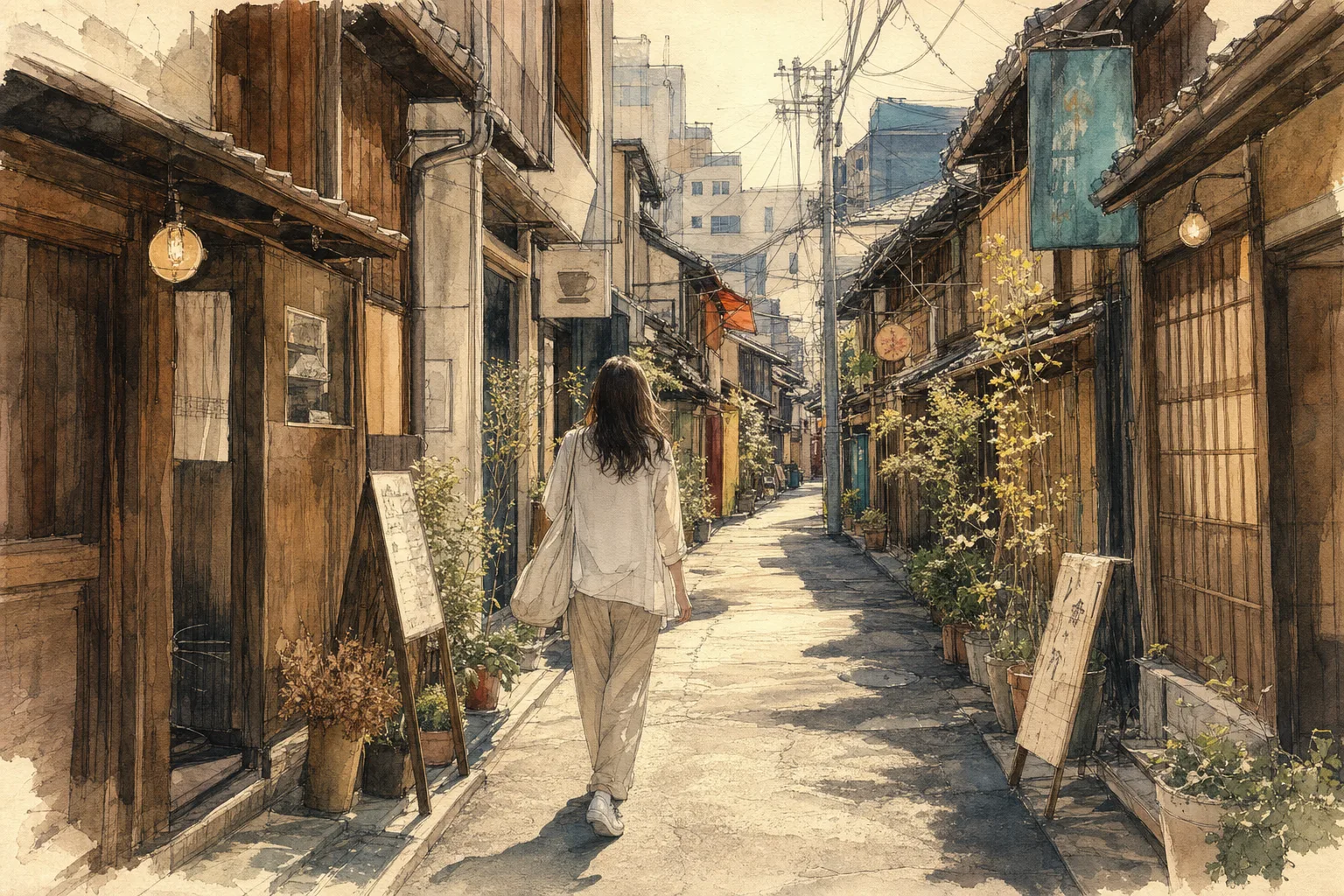
Couples who travel to eat together, talk, and walk home are well served by Osaka. Kappo counters in Fukushima and Kitashinchi specialize in slow, course-paced dinners that occupy a full evening without requiring a second venue. You finish dinner, walk 10 to 20 minutes through quiet residential streets, and you are back at the hotel.
A practical note: many traditional tachinomi and back-alley izakayas in Tenma remain strictly cash-only. If one of you prefers a structured reservation experience and the other wants to wander into standing bars, plan an ATM stop early in the day and split the evening into a booked first half and a wander second half.
Best for Slow Travelers Who Want a Neighborhood, Not a Checklist
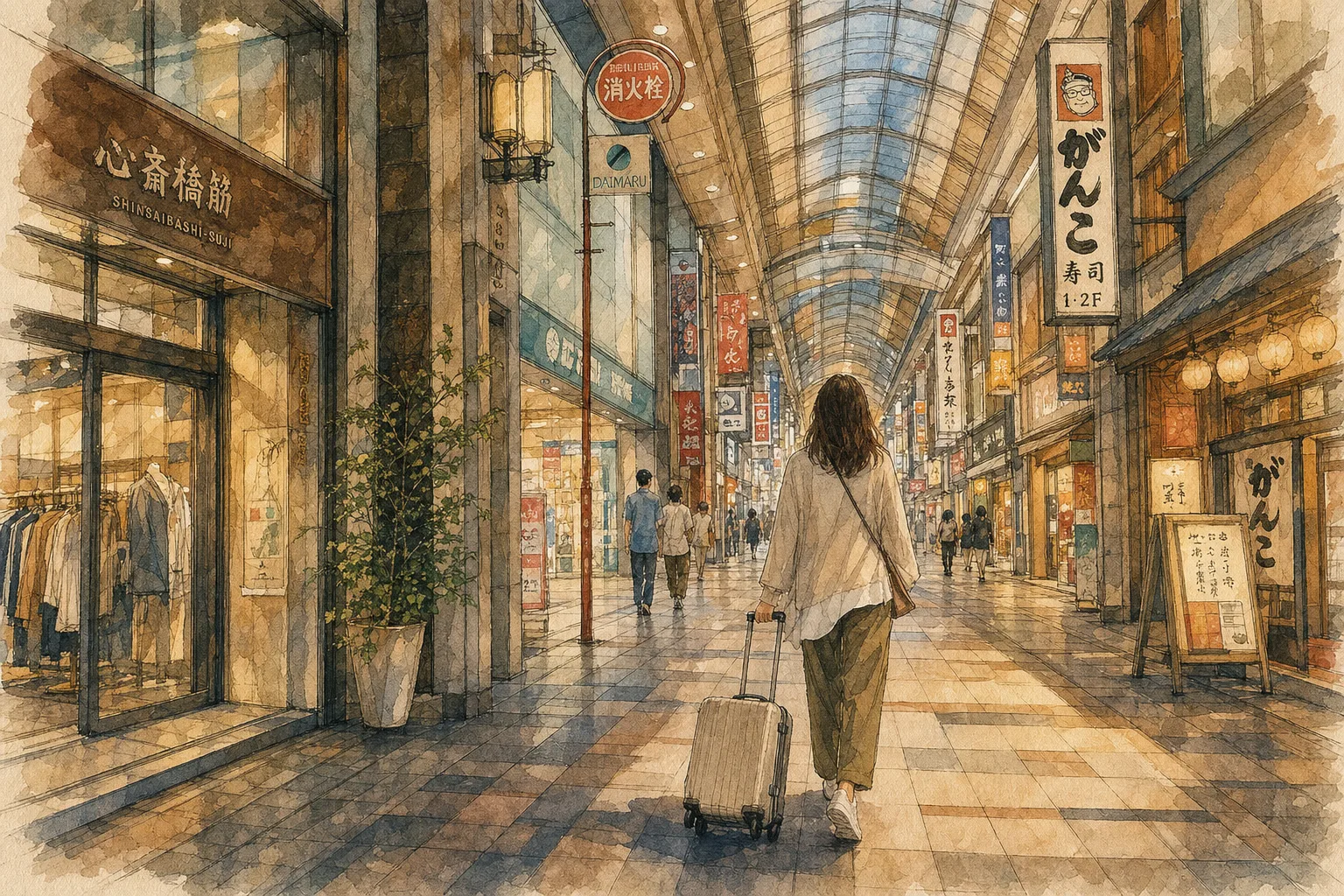
If your travel style is "live in one area for three or four days," Osaka rewards that more than people expect. Tenma is the clearest example. Tenjinbashi-suji Shopping Street, the longest covered shopping street in Japan at 2.6 kilometers, gives you a single spine to learn: coffee in the morning, lunch at a small counter, errands in the afternoon, tachinomi at 6pm, dinner at 8pm.
Slow travelers do not need to "see all of Osaka." Pick one of Fukushima or Tenma, walk it until you recognize shop owners, and treat the rest of the city as occasional day trips.
Best for Low-Stress Travelers Who Want an Easy Trip
Low-stress travelers benefit from Osaka's compactness. Transit between food districts is short. Fukushima to Namba is about 15 minutes by train. Tenma to Osaka Station is 2 minutes on the JR Loop Line. You can plan a calm day with one museum, one long lunch, and one early dinner without time pressure or transfer anxiety.
The friction to manage is reservation logistics for higher-end meals. On Tabelog, restaurants rated 3.5 or higher are considered exceptional and book out early. If you want one or two of those meals, lock them in before you leave home. Everything else can be walk-in.
Traveler Type Table: Where the Fit Comes From
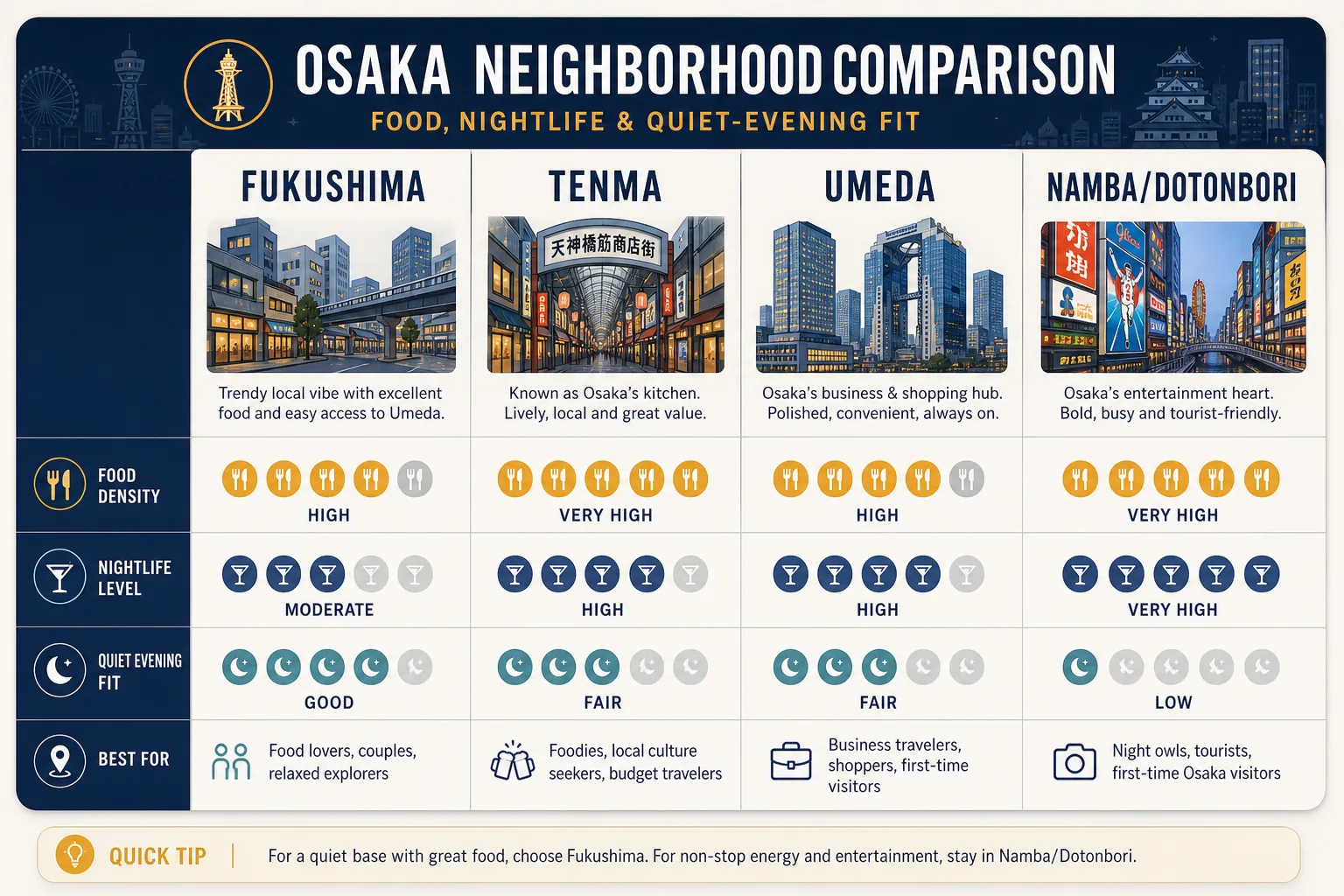
The fit depends more on neighborhood choice than on Osaka itself. This table compares four common bases against the food-led, quiet-night persona.
| Base area | Food density | Nightlife pressure | Quiet-evening fit | Best for |
|---|---|---|---|---|
| Fukushima | High (includes 3-Michelin-star Hajime) | Low | Strong | Couples, kappo-focused diners |
| Tenma | Very high (tachinomi, izakaya, market food) | Moderate, but ends earlier than Namba | Strong if you finish by 10pm | Slow travelers, casual eaters |
| Umeda / Kitashinchi | High, leans mid- to upper-range | Moderate (business district bars) | Good, especially north side streets | First-timers wanting train convenience |
| Namba / Dotonbori | High, but tourist-skewed | Very high, late and loud | Weak | Travelers who actually want nightlife |
Lodging anchors this decision. The 3-star Toyoko Inn Osaka JR Noda Ekimae in the Fukushima district averages about 48 USD per night. The 3-star APA Hotel Osaka Umeda and Hotel Hanshin Annex Osaka both average about 56 USD. The 4-star Hotel Hanshin Osaka averages about 72 USD. None of these require you to sleep above a club.
Common Mismatches: Who Misreads Osaka
Several traveler patterns lead to disappointment even when the food itself is excellent.
- The "Osaka means Dotonbori" booker. Picks a hotel one street off the neon, then complains about noise and feels the trip was lower quality than the food deserved. The food was fine. The base was wrong.
- The temple-and-garden traveler in disguise. Says they came for food, but really wants the visual calm of Kyoto. Osaka's beauty is in counters, signage, and steam, not gardens. If the photos in your head are mossy stone paths, you booked the wrong city.
- The late-eater. Many quieter food districts wind down by 10 or 11pm. If you want kitchens open at midnight, you will end up back in Namba anyway, which contradicts the original goal.
- The "no reservations" traveler. Walk-ins work for casual food. They do not work for Tabelog 3.5+ or starred restaurants. Expecting same-day access to Hajime or top kappo counters is the most common preventable regret.
- The all-cash-averse traveler. Tenma tachinomi culture runs on cash. If you refuse to carry yen, you cut off a real slice of the experience.
Final Match Recommendation
Choose Osaka for this trip if:
- Food is the primary reason you are traveling, not a bonus.
- You will base in Fukushima, Tenma, Umeda, or Kitashinchi, not Namba.
- You can pre-book one or two higher-end meals and walk in for the rest.
- You are comfortable with an evening that peaks at 7pm and ends by 10pm.
- You carry some cash for tachinomi and small counters.
Skip Osaka, or demote it to a day trip from Kyoto, if:
- Your real interest is temples, gardens, or traditional craft districts.
- You need late-night dining open past midnight as part of the trip.
- You will not pre-book any restaurants and expect top counters to be walk-in.
- You would rather optimize for visual calm than for taste.
Practical checklist before you commit:
- Hotel is in Fukushima, Tenma, Umeda, or Kitashinchi, not Dotonbori-adjacent.
- At least one Tabelog 3.5+ or kappo reservation is booked 2 to 6 weeks ahead.
- You have a plan for cash (ATM on arrival day).
- You have accepted a 5pm to 9pm dinner window as the core of each evening.
- You have checked whether the Osaka accommodation tax revision effective September 1, 2025 affects your nightly rate (the tax-exempt limit drops from 7,000 yen to 5,000 yen).
If most of those are true, Osaka is one of the strongest food-led, low-nightlife city picks in Japan. If half of them are false, the friction will outweigh the meals.
FAQ
See the answers above this section for the most common decision questions about choosing Osaka as a food-led, quiet-night base.