city-matchups
Tokyo vs Osaka: Which Is Easier for a Low-Stress First Trip to Japan?
A friction-first comparison of Tokyo and Osaka for first-time Japan travelers who want an easy, comfortable trip without overpaying or overplanning.
By the Trip Persona Editorial Team. Last updated June 6, 2026. This guide is independent and not sponsored. We do not earn affiliate commissions on the hotels, transit passes, or tools mentioned here.
If you are planning your first trip to Japan and your honest priority is "I want this to feel easy, not heroic," the Tokyo vs Osaka debate is not really about which city is more famous. It is about which city makes every ordinary day, from finding your hotel to picking dinner, slightly less tiring.
This guide answers that directly, then shows you where the friction actually lives.
Quick Verdict
For a low-stress first trip to Japan where comfort and value matter more than novelty, base yourself in Osaka.
- Choose Osaka if you want a smaller, walkable core, simpler subway navigation, cheaper mid-range hotels, and easy day trips to Kyoto and Nara from one base.
- Choose Tokyo if your must-see list is specifically Tokyo-coded (Shibuya, teamLab, Ghibli Museum, Akihabara, Disney) or you want day trips to Hakone, Nikko, or Kamakura.
- Do not pick Tokyo as your base just because it is the default first-trip answer online. The default is not optimized for low-stress travel.
Not sure which traveler type you actually are? The Travel Personality Quiz gives you a clearer read in about two minutes.
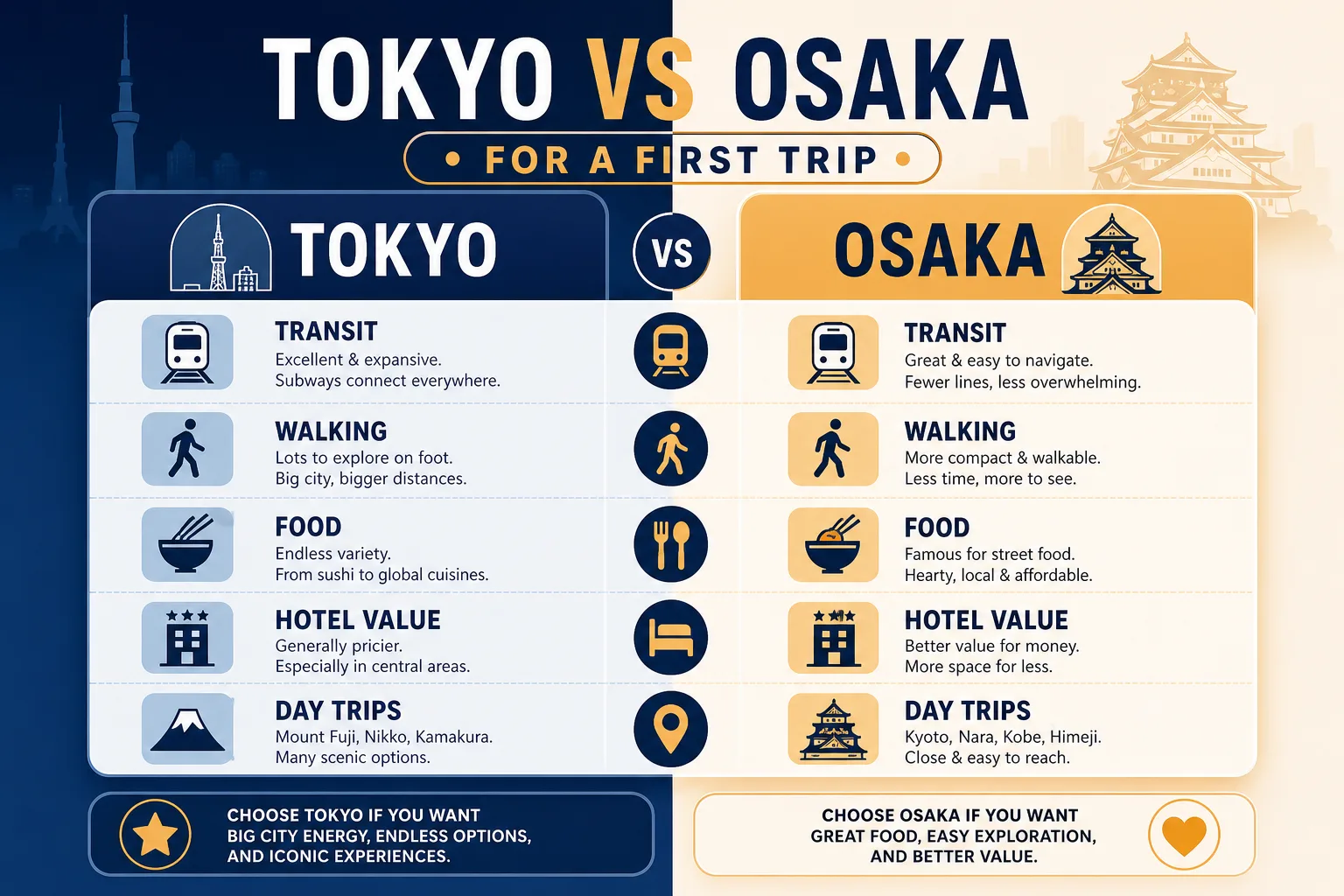 A comparison infographic contrasting Tokyo and Osaka across key travel categories like transit, walking, food, hotel value, and day trips.
The Main Friction Problem on a First Trip
The real difference between Tokyo and Osaka for a first-timer is not sights. It is how much the city quietly taxes your energy each day. Four frictions matter most.
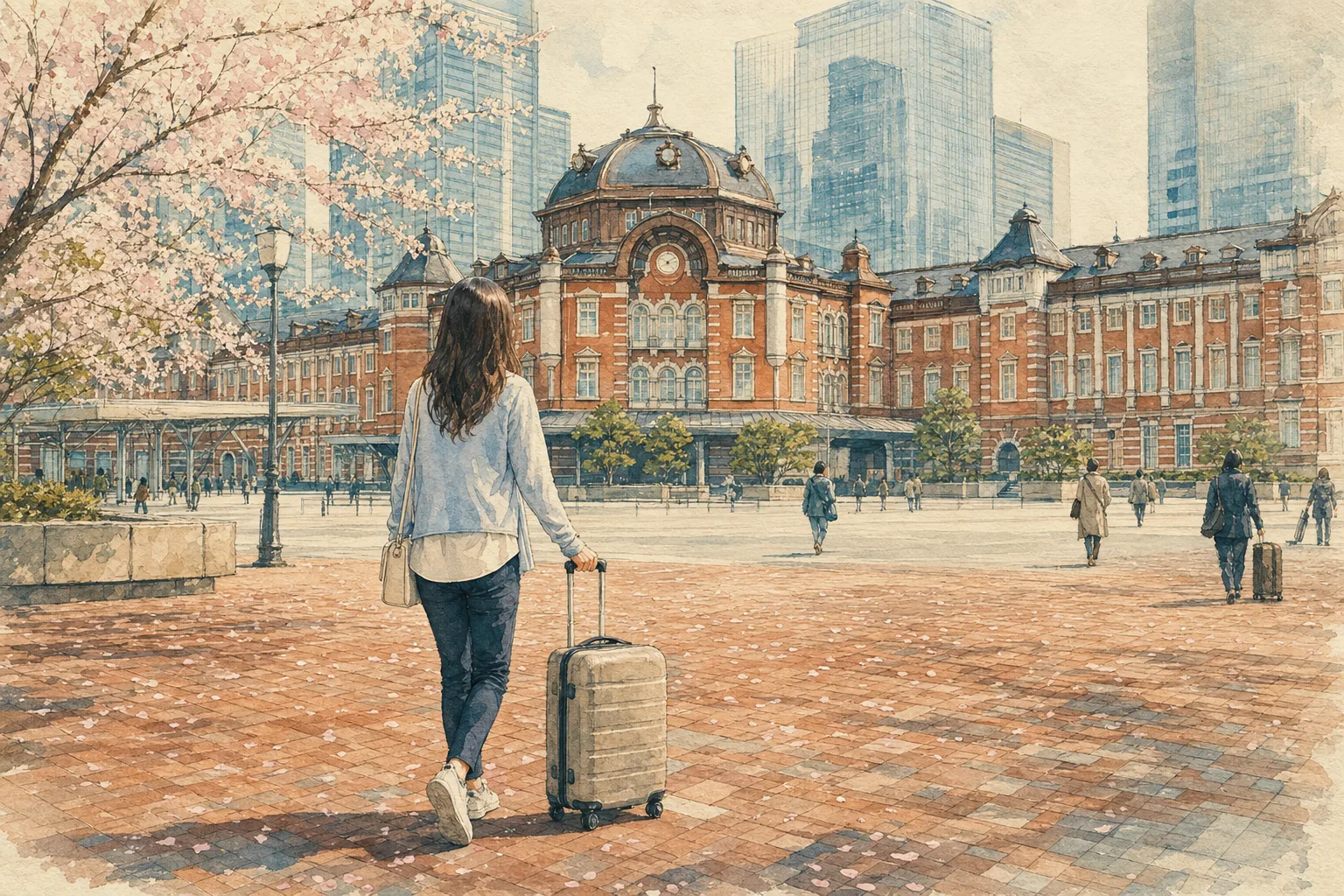
Transit and station complexity. Tokyo runs on a layered network of JR lines, Tokyo Metro, Toei Subway, and private railways. Shinjuku and Shibuya stations are genuinely confusing on day one. Osaka has fewer lines, a simpler central spine (the Midosuji line connects almost everything a first-timer wants), and stations you can cross without a map.
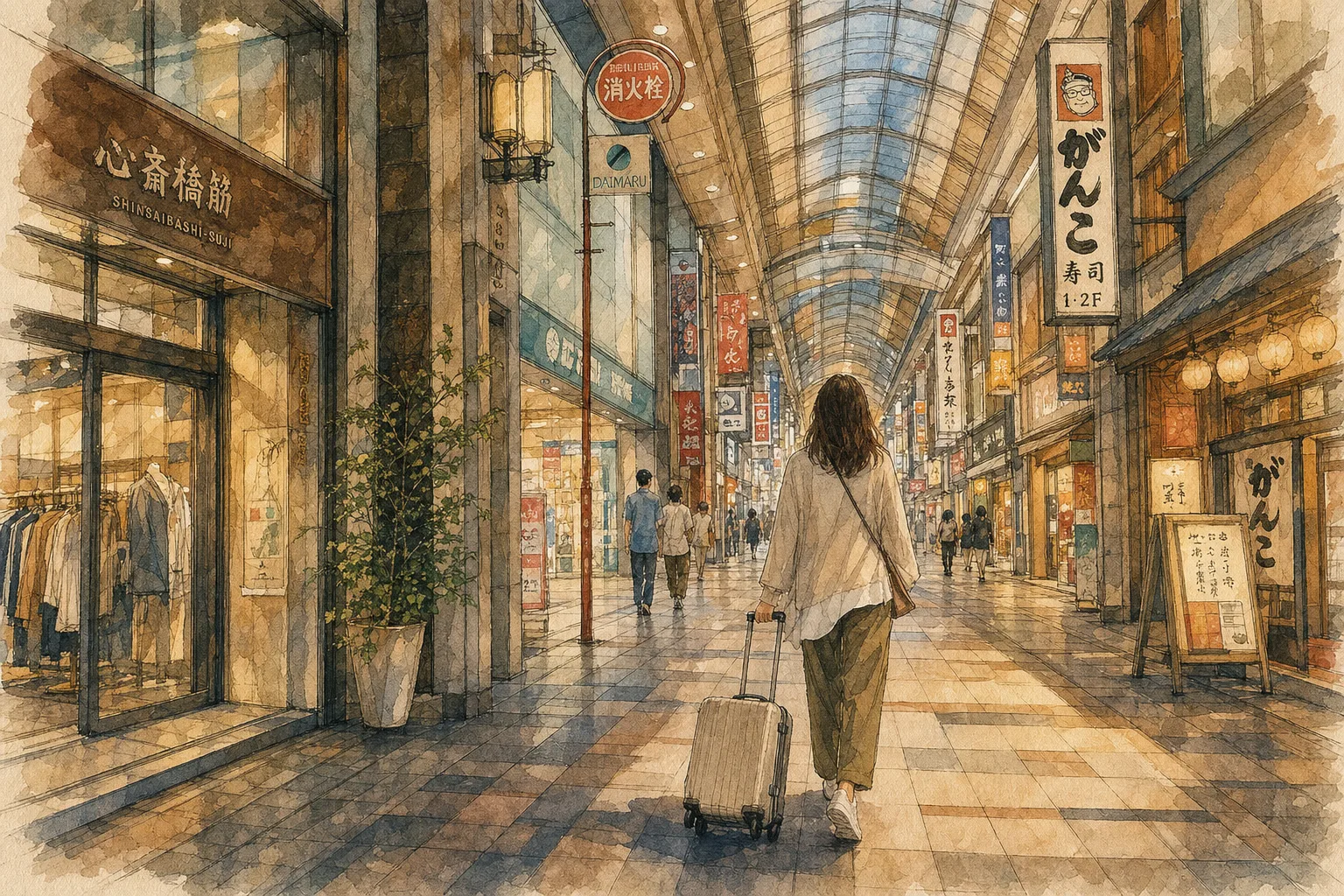
Daily walking and fatigue. Tokyo neighborhoods are far apart. Walking from Shibuya to Harajuku is roughly 1.5 to 2 kilometers and takes 20 to 30 minutes, and that is one of the shorter "famous" walks. In central Osaka, the main shopping districts of Shinsaibashi and Namba sit only about 600 meters apart, a flat 7 to 10 minute walk. Over a week, that compounds.
Food comfort and dining ease. Both cities have incredible food. Osaka is friendlier on the wallet and the brain: a filling street-food meal of takoyaki, okonomiyaki, or kushikatsu typically costs 800 to 1,500 yen, and the dining core is concentrated in a few square blocks around Dotonbori. Tokyo's best meals are scattered across many neighborhoods, which means more transit just to eat.
Day-trip and base-city logistics. Osaka is the better hub for the most-wanted first-trip side trips, Kyoto and Nara, both under an hour. Tokyo's day trips (Hakone, Nikko, Kamakura) are excellent but longer and require more planning.
Friction Table: Tokyo vs Osaka, Day to Day
| Friction | Tokyo | Osaka | Lower-stress winner |
|---|---|---|---|
| Subway learning curve | Multi-operator, layered | Mostly one spine line covers the core | Osaka |
| Walking between key sights | 1.5 to 2 km is common (Shibuya to Harajuku) | 600 m between Shinsaibashi and Namba | Osaka |
| Mid-range hotel price | Shinjuku 18,000 to 25,000 yen; Asakusa 12,000 to 15,000 yen | Namba and Dotonbori 7,000 to 11,000 yen, often with breakfast | Osaka |
| Equivalent-quality hotel | Baseline | Roughly 20 to 30 percent cheaper | Osaka |
| Accommodation tax friction | From March 2026, paid separately at check-in at many major chains (100 to 200 yen per person per night) | Bundled normally; from Sep 2025, exempt under 5,000 yen, then 200 to 500 yen per night | Osaka |
| Transit pass clarity | Tokyo Subway Ticket: 1,000 / 1,500 / 2,000 yen for 24 / 48 / 72 hours | Osaka Amazing Pass: 3,500 yen 1-day or 5,000 yen 2-day, fully digital QR | Tie (different purposes) |
| Best day trips from base | Hakone, Nikko, Kamakura | Kyoto, Nara, Kobe, Himeji | Depends on list |
| Iconic must-sees in city | Shibuya, Asakusa, Akihabara, teamLab | Dotonbori, Osaka Castle, Umeda Sky | Tokyo for sheer count |
Note: the HEP FIVE Ferris Wheel in Umeda is closed for renovation from October 14, 2025 through late April 2026, so adjust if it was on your Osaka list.
Who Will Feel the Friction Most
The shortcut: the more your trip looks like the top of this table, the more Osaka pays off. The further down you go, the more Tokyo earns its keep.
| Traveler type | Recommended base | Why |
|---|---|---|
| First international trip, ever | Osaka | Smaller core, simpler subway, shorter daily walks reduce decision fatigue. |
| Couple or solo, 5 to 8 nights, wants Kyoto and Nara | Osaka | Both day trips are under an hour by local train from one base. |
| Family with young kids or grandparents | Osaka | Flat 600 m walks between districts, cheaper family-sized rooms with breakfast. |
| Budget-aware mid-range traveler (under 15,000 yen per night) | Osaka | Equivalent quality runs 20 to 30 percent cheaper; less tax friction at check-in. |
| Light planner who wants to wing it daily | Osaka | The food and shopping core is walkable from any Namba or Shinsaibashi hotel. |
| Anime, gaming, or pop-culture-focused first trip | Tokyo | Akihabara, Nakano, Shibuya, and Ghibli Museum are Tokyo-only and clustered. |
| Wants Disney, teamLab, or Studio Ghibli on the itinerary | Tokyo | All three are in or near greater Tokyo and impractical from Osaka. |
| Experienced city traveler (NYC, Paris, Seoul) on a 4-night trip | Tokyo | Already comfortable with dense transit; gets more iconic density per day. |
| Wants Hakone, Mt. Fuji views, or Nikko | Tokyo | These day trips work cleanly from Tokyo stations, not Osaka. |
If two or more rows describe you and they point at the same city, that is your answer.
How to Reduce the Friction (in Either City)
If you have already committed to Tokyo, or you want to make Osaka even easier, these moves cut the most stress per effort.
Pick a base near a single hub station.
- In Tokyo: Asakusa for value and calm, or Shinjuku if you want everything on the JR Yamanote loop.
- In Osaka: Namba or Shinsaibashi puts you inside the food and shopping core on foot.
Buy the right transit pass, once. The Tokyo Subway Ticket (1,000 / 1,500 / 2,000 yen) is the single best first-trip purchase in Tokyo. In Osaka, only buy the Osaka Amazing Pass if you will actually use 3 or more of its included attractions in a day; otherwise an ICOCA card is enough.
Plan around walking, not sights. Group sights by neighborhood and give each day one transit transfer maximum. This is the single biggest fatigue reducer.
Eat early or late. Both cities get long lines from 6 to 8 p.m. for famous spots. Aim for 5 p.m. or 9 p.m. dinners.
Budget for the accommodation tax separately. Especially in Tokyo from March 2026 onward, expect to pay 100 to 200 yen per person per night at check-in at many major chains, even if you prepaid the room.
Better Alternatives if Neither Feels Right
If after all this neither Tokyo nor Osaka feels like the right base, two patterns work better than forcing the matchup.
Kyoto as your base instead. If your trip is mostly temples, gardens, and traditional Japan, Kyoto is calmer than both Tokyo and Osaka and connects to Osaka and Nara in under an hour. You give up Tokyo's variety but gain a much slower daily rhythm.
Two bases, not three. A common low-stress structure is 4 nights Osaka (covers Osaka, Kyoto, Nara day trips), then 3 to 4 nights Tokyo. Fly into Osaka (KIX) and out of Tokyo (HND or NRT), or the reverse. One Shinkansen ride, one hotel change, no backtracking.
Avoid the "1 night here, 1 night there" loop on a first trip. Packing and checking in is the real fatigue, not the trains.
Decision Checklist Before You Book
Run through this list before locking in flights or hotels.
- My priority is comfort and ease, not maximizing famous sights.
- My must-see list has fewer than 4 Tokyo-only attractions.
- Kyoto and Nara are on my list (favors Osaka base).
- My total trip is 5 to 8 nights, so one base is realistic.
- My hotel budget per night is under about 15,000 yen for mid-range comfort.
- I am okay walking 6 to 10 km on a sightseeing day, but not 15.
- I have checked whether my Tokyo hotel charges accommodation tax separately at check-in.
- If I am combining both cities, I have planned exactly one hotel change, not two or three.
If you ticked 5 or more, Osaka is almost certainly your better base. If you ticked 2 or fewer, Tokyo is fine.
Related Tools
These are the Trip Persona tools most useful for finishing this specific decision:
- Travel Personality Quiz to confirm whether you actually optimize for low-stress travel or for variety.
- Travel Budget Calculator to model Tokyo vs Osaka nightly costs with the accommodation tax included.
- Hotel Location Checklist to confirm your chosen base puts you within a short walk of the transit lines you need.
FAQ
Is Osaka actually easier than Tokyo for a first trip to Japan? For most first-time visitors who prioritize comfort, yes. Osaka has a smaller core, simpler subway lines, shorter walks between major districts, and cheaper mid-range hotels, which reduces daily decision fatigue.
Can I do both cities on a first trip without it feeling stressful? Yes, but only if you base in one city at a time and limit yourself to one hotel change total. The Shinkansen between Tokyo and Shin-Osaka is straightforward, but packing, checking out, and re-orienting in a new neighborhood is the real friction cost.
Which city is better for day trips like Kyoto, Nara, and Hakone? Osaka is much better positioned for Kyoto and Nara, both reachable in under an hour by local train. Tokyo is better for Hakone, Nikko, and Kamakura. If your bucket list leans Kyoto and Nara, that alone can decide it.
Is Tokyo too expensive for a first trip if I want decent hotels? Not too expensive, but noticeably tighter. Equivalent hotel quality in Osaka tends to run 20 to 30 percent cheaper, and from March 2026 many major Tokyo hotel chains require a separate accommodation tax payment at check-in, which adds a small but real planning step.