travel-decisions
Will Kyoto Feel Too Expensive If You Care More About Experience Than Luxury?
A decision-focused look at whether Kyoto fits experience-led, non-luxury travelers, and how to avoid budget regret without defaulting to the cheapest plan.
Quick Verdict
Kyoto is a strong fit if you care about atmosphere, walking, temples, and small lanes, and a weak fit if your idea of value depends on luxury hotels or premium dining. The city does not punish experience-first travelers. It punishes travelers who book like luxury travelers but expect mid-range comfort.
Choose Kyoto if:
- You will trade hotel square meters for location or for a cheaper outer ward.
- You are willing to start days early or visit key sites after 6 PM.
- You are comfortable using buses, subway, and walking instead of taxis.
Skip or delay Kyoto if:
- You want a spacious Western-style hotel room at a mid-range price in a central area during spring.
- You expect short taxi hops between every sight.
- You are visiting only in peak cherry blossom weeks with a fixed daytime schedule.
The Real Friction: You Are Not Paying for Kyoto, You Are Paying for When and Where
The honest friction in Kyoto is not the city's baseline cost. Buses are a flat 230 yen per ride. Most temple entries are modest. Walking is free, and the best lanes cost nothing. The friction stacks in four specific places.
Budget pressure comes from hotel pricing in central wards during spring. Hostels in March average around 68 USD per night versus 27 USD in January, and central hotels move in the same direction. If you book a central room during peak weeks, you are paying the peak-season multiplier on the most squeezed inventory.
Expectation mismatch is the quieter problem. Travelers see Higashiyama or the Arashiyama Bamboo Grove in photos taken at sunrise and then visit at 11 AM. The place is the same, but the experience is not. If you paid a premium expecting the photo and got the crowd, the trip feels overpriced even when the bill is reasonable.
Hotel value is where central Kyoto looks worst on paper. A small room in Gion or near Kyoto Station during spring can cost the same as a larger, better-located room in a quieter Tokyo ward. The fix is not to pay more. The fix is to move one ward out or shift the dates.
Crowd-linked price inflation affects food, taxis on temple approach roads, and last-minute hotel rebooking. Tourist-heavy alleys in Gion have had access restrictions since April 2024, which also pushes foot traffic and pricing onto nearby streets.
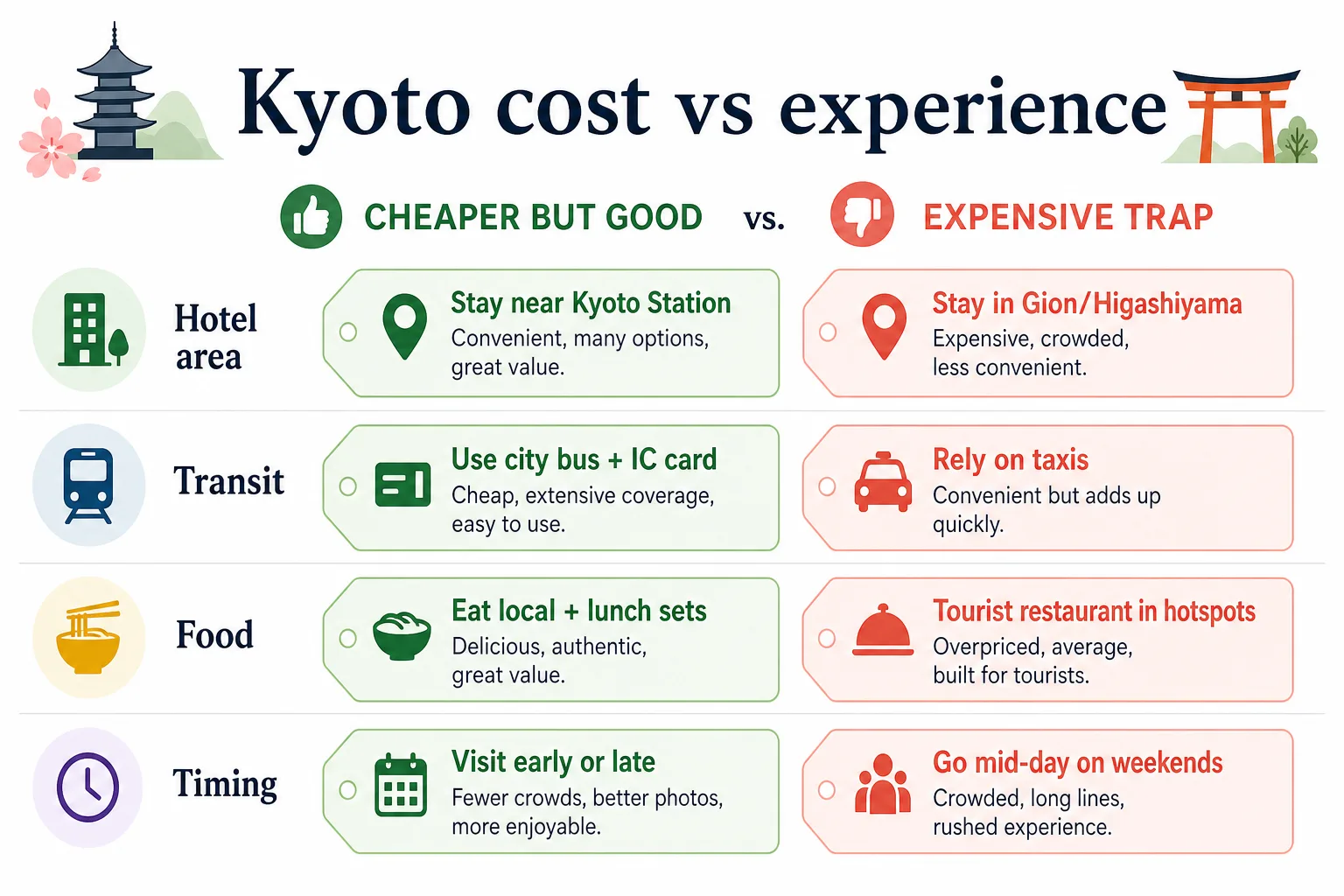
Friction Table: Where the Cost Pressure Actually Comes From
| Variable | Cheaper, still high-experience | Expensive trap |
|---|---|---|
| Hotel area | Fushimi (around 62 USD per night average) or near a subway line out from center | Central Gion or Higashiyama in peak spring |
| Month | January (hostels around 27 USD) or shoulder weeks | Late March (hostels around 68 USD) and cherry blossom peak |
| Transit | City Bus and Subway Pass at 1,100 yen for combined use | Repeated taxi hops on temple roads |
| Single bus ride | Flat 230 yen, paid on exit by IC card or exact change | Multiple short taxi rides starting at 500 yen plus 100 yen per 279 m |
| Timing at top sites | Higashiyama at sunrise (around 6 AM in summer), Bamboo Grove near 7 AM, Fushimi Inari at dawn or after 6 PM | Same sites between 10 AM and 4 PM in peak season |
| Meals | Neighborhood lunch sets, market stalls, convenience-store breakfast | Tourist-strip dinners on temple approach roads |
The pattern is consistent. The city rewards travelers who shift one variable, not travelers who pay their way through every variable.
Who Will Feel the Cost Most
Three traveler profiles tend to feel Kyoto as overpriced even though their actual spending is normal.
The first is the central-hotel mid-range traveler in peak season. They are paying luxury-zone prices for non-luxury rooms because they refused to consider Fushimi or a one-stop-out neighborhood. The room disappointment then bleeds into how they judge the rest of the trip.
The second is the daytime-only sightseer. They visit Higashiyama at 11 AM, Fushimi Inari at 2 PM, and Arashiyama Bamboo Grove at noon. They get the crowds, not the atmosphere. The cost stays the same, but the perceived value drops sharply.
The third is the taxi-default traveler. Kyoto's taxis are reasonable for a group of four on a single trip across town, but using them as a default instead of buses and the subway can add the equivalent of a hotel night over a 4-day trip.
Travelers who do not feel the cost are usually slow walkers, early risers, couples who do not mind a small room, and value-led optimizers who let location, timing, and transit do the heavy lifting.
How to Reduce the Friction
You do not need to pick the cheapest option in every category. You need to break the stacking.
- Stay in Fushimi or near a subway line out of center for at least part of the trip. The average rate around 62 USD per night is well below central spring pricing, and Fushimi Inari at dawn or after 6 PM is on your doorstep.
- Buy the 1,100 yen City Bus and Subway Pass on any day you will use both. The single bus fare is 230 yen, so the pass pays off quickly when you combine modes.
- Walk the southern Higashiyama route. A 2.8 km self-guided loop with 6 stops takes about 1.5 hours at a relaxed pace, with around 35 minutes of pure walking. This is the highest experience-per-yen block of time in Kyoto.
- Arrive at major sites outside peak windows. Higashiyama near sunrise, Bamboo Grove around 7 AM, and Fushimi Inari at dawn or after 6 PM consistently change the experience.
- Accept the walk-in from the station. From Kiyomizu-Gojo station exit 4 to Kiyomizu-dera is almost 1 mile (about 1.6 km), uphill in places. Doing it on foot saves taxi cost and lines you up with smaller approach lanes.
- Avoid restricted private alleys in the Gion geisha districts. Access has been limited since April 2024, and the public streets around them carry the same atmosphere without the friction.
Better Alternatives If Kyoto Is a Mismatch
If after the checks above Kyoto still does not fit, the mismatch is usually about expectation, not budget. Two redirects work well.
- If you want traditional atmosphere with smaller crowds and lower hotel pressure, consider Kanazawa or Takayama. You lose Kyoto's depth of sites, but you gain rooms that feel proportional to their price.
- If you want temples and gardens without the peak-season multiplier, shift Kyoto to late autumn after the main foliage week, or to January. January is the cheapest month for hostels (around 27 USD per night average) and a sharply different feel.
- If you want a luxury or comfort-first trip without the experience-first early mornings, Tokyo will give you better hotel value per yen at the mid-to-upper range, and you can visit Kyoto for one or two days as a side trip.
Kyoto rewards the traveler who is willing to plan around it. It does not reward the traveler who wants it to behave like a resort destination.
Decision Checklist Before You Book
Use this as a final filter. If you cannot tick at least four, Kyoto in your current plan will probably feel overpriced.
- I am willing to stay outside the central tourist core for at least part of the trip.
- I am willing to do at least one sunrise or after-6-PM visit.
- I will use the 1,100 yen Bus and Subway Pass instead of defaulting to taxis.
- I am not booking only the peak cherry blossom weeks at central hotels.
- I accept that hotel rooms in Kyoto are smaller than equivalent Western rooms.
- I am planning meals in neighborhoods, not on temple approach roads.
- I am okay walking 1.5 to 2 km blocks like the Higashiyama loop without a taxi.
A traveler who checks six or seven of these almost never reports Kyoto as overpriced. A traveler who checks two or three almost always does.
FAQ
Is Kyoto more expensive than Tokyo for a non-luxury traveler? For mid-range and budget travelers, Kyoto is usually similar to Tokyo on food and transit, but hotels in well-located central areas can feel tighter and pricier per square meter. The pressure comes from hotel inventory in tourist-favored areas, not from daily spending.
When does Kyoto stop feeling worth the price? It stops feeling worth the price when you stack peak-season pricing, a central tourist-zone hotel, taxis instead of buses, and daytime visits to the most crowded sites. Remove any two of those and the value usually returns.
Can I experience Kyoto well on a strict budget? Yes. Hostels in January average around 27 USD per night, hotels in Fushimi average around 62 USD per night, and the City Bus and Subway Pass at 1,100 yen covers most movement. The experience layer (temples, lanes, gardens) is largely free or low cost.
Is it worth paying more for a central hotel in Kyoto? Only if you plan to do early-morning or late-evening visits to places like Higashiyama, Fushimi Inari, or Arashiyama. If you are sightseeing mostly between 10 AM and 5 PM, a cheaper area like Fushimi plus the transit pass is usually the better value.
Will I regret skipping kaiseki and ryokan stays? Most experience-led travelers do not regret skipping them if they replace that spend with timing, such as sunrise Higashiyama or after-6-PM Fushimi Inari. The atmosphere payoff per yen is higher than a single premium meal.