travel-decisions
Is Kyoto Worth Choosing for a Short 2 to 3 Day Trip?
A decision-led look at whether Kyoto fits a 2 to 3 day itinerary, with friction points, traveler fit, and a checklist to avoid short-trip regret.
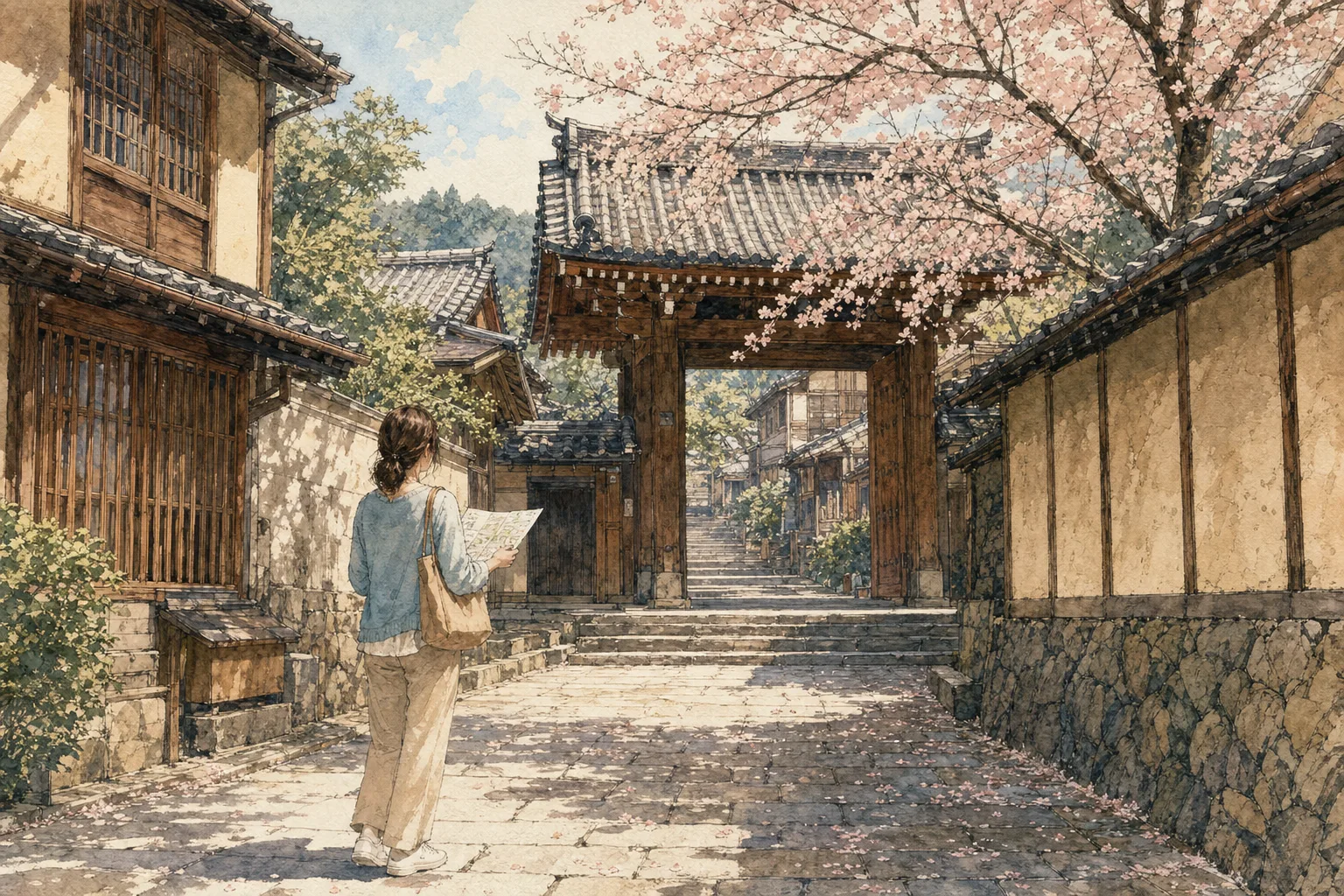
Kyoto is one of the few cities where a short trip can either feel like a highlight reel or a stressful blur. The difference is not the city. It is whether your itinerary respects the friction baked into how Kyoto is laid out.
Quick Verdict
Kyoto is worth a 2 to 3 day trip if you want temples, traditional streetscapes, and atmosphere, and you are willing to pick two or three areas rather than chase the full greatest-hits list.
It is not worth a 2 to 3 day trip if you want a wide cross-section of Japan in one stop, if long walking days are hard on you, or if you need to also fit in Tokyo, Osaka, and Nara in the same window.
- Good fit: first-time visitors who accept a curated route, couples who want a calm mood-led trip, atmosphere-led travelers.
- Poor fit: travelers wanting maximum variety, low-stamina travelers planning a packed itinerary, anyone hoping to "see Kyoto" comprehensively in 48 hours.
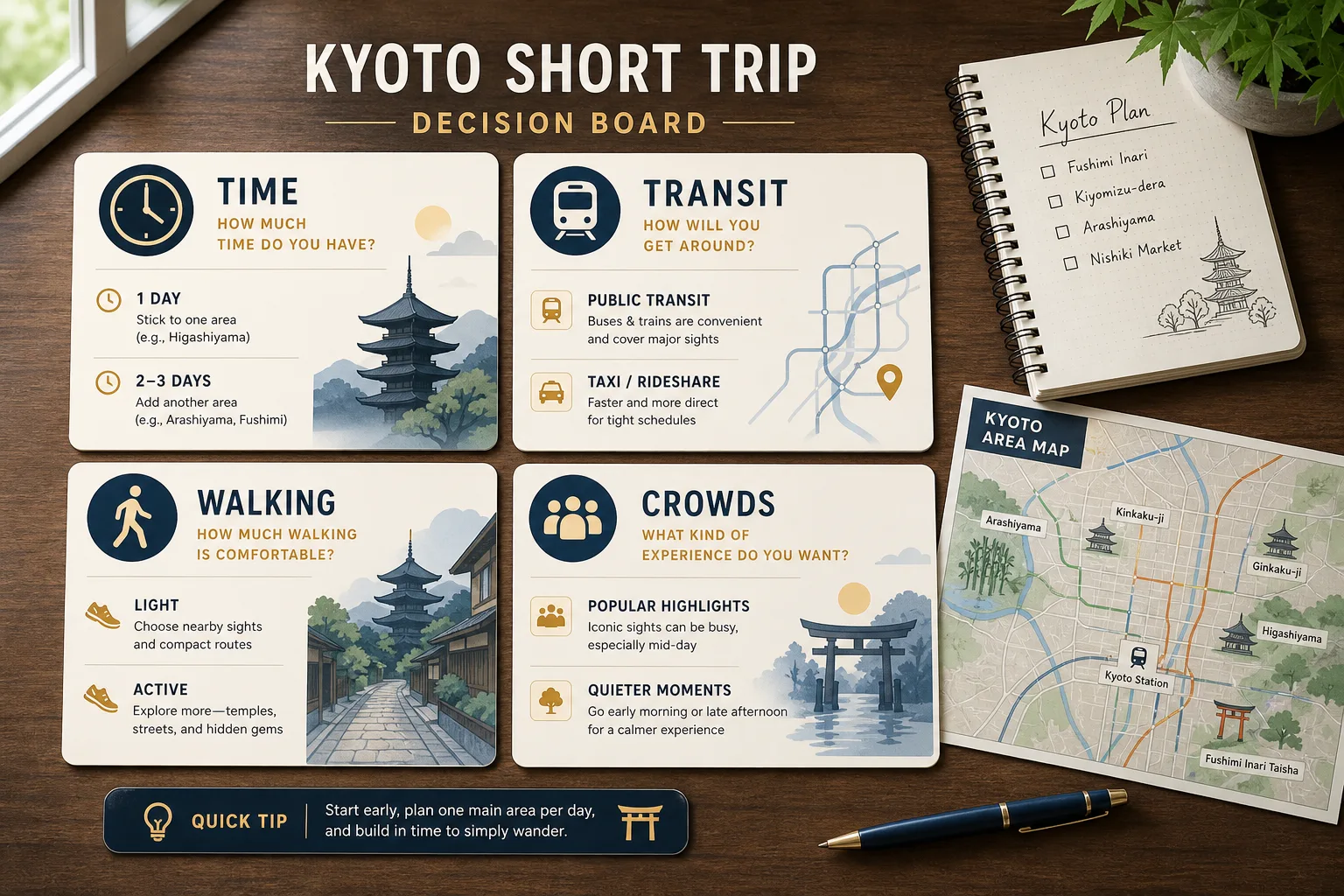
The Real Friction on a Short Kyoto Trip
The friction in Kyoto is not the city itself. It is the gap between how close the famous sites look on a map and how long it actually takes to move between them with luggage, crowds, and elevation.
Time compression. Half of a 2 day trip is consumed by arrival, hotel check-in, and the return to the station. A realistic 2 day trip is closer to 1.25 sightseeing days.
Walking fatigue. Kyoto's signature sites involve real elevation. Kiyomizu-dera requires a steep uphill walk of 10 to 12 minutes from the Gojo-zaka bus stop, or 20 to 25 minutes from Kiyomizu-Gojo Station. The full Fushimi Inari mountain trail loop is 2 to 3 hours of continuous uphill walking. These are not flat strolls between photo stops.
Transit inefficiency. Famous areas are not connected the way short-trip planners assume. There is no direct train between Arashiyama and Kinkaku-ji. The trip requires the JR Sagano Line to Enmachi Station and a transfer to City Bus 204 or 205, taking 40 to 50 minutes. Going from Kiyomizu-dera to Fushimi Inari means a 20 minute walk to Kiyomizu-Gojo Station, a 7 minute Keihan Main Line ride for 220 yen, and a 5 minute walk to the shrine.
Itinerary regret. The most common short-trip mistake is treating Kyoto like a checklist of four headline sites. Travelers who try this typically remember transit, queues, and tired feet more than the places themselves.
Friction Table
The point of this table is not to scare you off Kyoto. It is to show which tradeoff bites first so you can plan around it.
| Decision variable | What short-trip travelers assume | What actually happens | Consequence |
|---|---|---|---|
| Time on the ground | "I have 2 full days" | Arrival, check-in, and departure consume roughly 0.75 of a day | You get 1.25 real sightseeing days, not 2 |
| Arashiyama to Kinkaku-ji | "They are both on the west side" | No direct train; JR Sagano Line plus bus transfer, 40 to 50 minutes | One area must be cut, or both feel rushed |
| Kiyomizu-dera access | "It is near the bus stop" | 10 to 12 minute steep uphill from Gojo-zaka, longer from the station | Adds real walking fatigue before the temple itself |
| Fushimi Inari | "Quick photo at the gates" | Full loop is 2 to 3 hours uphill | Either skip the upper trail or lose half a day |
| Bus pass strategy | "Flat-rate bus pass like before" | The 700 yen flat-rate Bus One-Day Pass is discontinued | Default to the 1,100 yen Subway and Bus One-Day Pass |
| Luggage on buses | "I can ride from the station with my suitcase" | Large suitcases and oversized baggage are barred from Kyoto city buses | Drop bags at the hotel or use forwarding before any bus leg |
| Gion atmosphere | "Wander the back alleys at dusk" | Since April 2024, tourists are banned from specific private alleys off Hanamikoji Street, with a 10,000 yen fine for violations | Stay on permitted streets; plan Gion as a short visit |
Who Will Feel the Friction Most
The same itinerary lands very differently depending on who is walking it.
- First-time visitors with a fixed bucket list. If your mental picture of Kyoto is Fushimi Inari, Arashiyama bamboo, Kinkaku-ji, and Gion in one trip, two days will feel like a loss. Three days makes it possible but still tight.
- Couples who want a calm mood-led trip. Kyoto rewards this style well, as long as you commit to two areas, not four.
- Low-stamina or older travelers. The elevation at Kiyomizu-dera and Fushimi Inari is the issue. Either pick the flatter sites (central temples, Nishiki Market, Arashiyama lowlands) or build in a long midday break.
- Travelers hoping to also fit Nara or Osaka. Doable as a half-day each, but every add-on cuts directly into Kyoto time. On a 2 day window, do not add anything. On a 3 day window, one half-day side trip is the maximum without regret.
How to Reduce the Friction
The short-trip version of Kyoto works when you stop trying to "cover" it and start choosing.
Cut to two areas per day, maximum. A reasonable 2 day shape: Day 1 Higashiyama (Kiyomizu-dera, Yasaka, Gion edges); Day 2 Arashiyama in the morning, central Kyoto or Fushimi Inari in the afternoon. Going from Kyoto Station to Saga-Arashiyama Station on the JR Sagano Line takes about 16 minutes and costs 240 yen one way, which is one of the few easy transit legs in the city.
Start each day before 8 AM. Kiyomizu-dera opens at 6:00 AM with 400 yen admission. Fushimi Inari is open 24 hours. Early starts are the single biggest crowd and fatigue lever.
Match your transit pass to your day. The Subway and Bus One-Day Pass costs 1,100 yen for adults and 550 yen for children and covers both networks. If a Sightseeing Limited Express Bus is running on your travel day (weekends, national holidays, and major peak periods), Route EX101 runs directly from Kyoto Station to Gojo-zaka in about 10 minutes for 500 yen per ride, or included in the day pass.
Solve luggage before you board a bus. Because large and oversized suitcases are barred from Kyoto city buses, either check in at your hotel first, use a coin locker at Kyoto Station, or use same-day luggage forwarding from the airport or station.
Pick uphill or downhill, not both. If you commit to the full Fushimi Inari loop in the morning, do not also schedule Kiyomizu-dera with its steep approach in the afternoon. Pair one elevation-heavy site with one flat one.
Budget for the accommodation tax. Kyoto's restructured progressive accommodation tax took effect March 1, 2026, with higher tiers. Check your booking total, not the headline room rate.
Better Alternatives if Kyoto Is the Wrong Fit
If the friction table looks like a list of reasons to regret your trip, Kyoto may not be the right anchor for your short window.
- Want maximum variety in 2 to 3 days? Tokyo gives more distinct neighborhoods inside one transit system, with less walking elevation.
- Want temples and tradition but with less walking? Kanazawa offers a smaller, flatter version of the same mood, with shorter sightlines between sites.
- Want a Kyoto feel without the peak-season crowd pressure? Consider Kyoto in early December or mid-January instead, when sites are open and crowds thin out.
- Want Kyoto plus food and a port city? A 3 day trip with 2 nights in Kyoto and 1 night in Osaka splits the load better than trying to add Osaka as day trips.
Decision Checklist
Run through this before you commit the 2 or 3 days.
- I have accepted that 2 days means roughly 1.25 real sightseeing days.
- I have picked at most 2 areas per day, not 3 or 4.
- I have checked whether any of my chosen sites involve heavy uphill walking, and I have not stacked two of them on the same day.
- My hotel is within walking distance of a train or subway station, not bus-only.
- I have a plan for luggage before any bus segment, because large suitcases are not allowed on city buses.
- I have priced the 1,100 yen Subway and Bus One-Day Pass against my actual route rather than assuming the old flat-rate bus pass.
- I have factored the updated accommodation tax into my hotel budget.
- If I am visiting in cherry blossom season, I have committed to starting before 8 AM each day.
- I am not also trying to fit Tokyo into the same 2 to 3 day window.
- If I want Nara or Osaka, I have only one half-day side trip planned, and only on a 3 day itinerary.
FAQ
Is 2 days enough to see Kyoto? Two days is enough to see two or three signature areas well, for example Higashiyama plus Arashiyama, or Fushimi Inari plus central Kyoto. It is not enough to cover the city's main districts without rushing. If your goal is a representative taste rather than a full survey, two days works.
Is Kyoto better than Tokyo for a short trip? Kyoto is better for travelers who want atmosphere, temples, and traditional streetscapes in a compact area. Tokyo is better for travelers who want food variety, neighborhoods, and shopping, and who do not mind larger transit distances. For a 2 to 3 day trip, pick one, not both.
What is the single biggest mistake on a short Kyoto trip? Trying to combine Arashiyama, Kinkaku-ji, Fushimi Inari, and Higashiyama in one day. The transit between them is not direct, and the walking inside each site is heavier than it looks on a map.
Should I use buses or trains in Kyoto on a short trip? Use trains and subway where they exist, and buses only when there is no train option. The Subway and Bus One-Day Pass at 1,100 yen covers both, and large suitcases are not allowed on city buses, so plan luggage drop-off before any bus segment.
Is Kyoto worth it during cherry blossom season for only 2 days? Yes for atmosphere, but expect crowds at every major site and slower walking. Book hotels early, start each day before 8 AM, and accept that one site per half-day is the realistic pace.
Can I add Nara on a 2 day Kyoto trip? Technically yes, practically no. Adding Nara to a 2 day Kyoto trip means cutting one of Kyoto's signature areas. Save Nara for a 3 day itinerary or a separate trip.