travel-decisions
Should You Use Kyoto as a Base or Change Hotels During the Trip?
A decision-focused guide on whether to stay in one Kyoto hotel or switch hotels mid-trip, weighing luggage friction, transit stress, and traveler fit.
Quick Answer
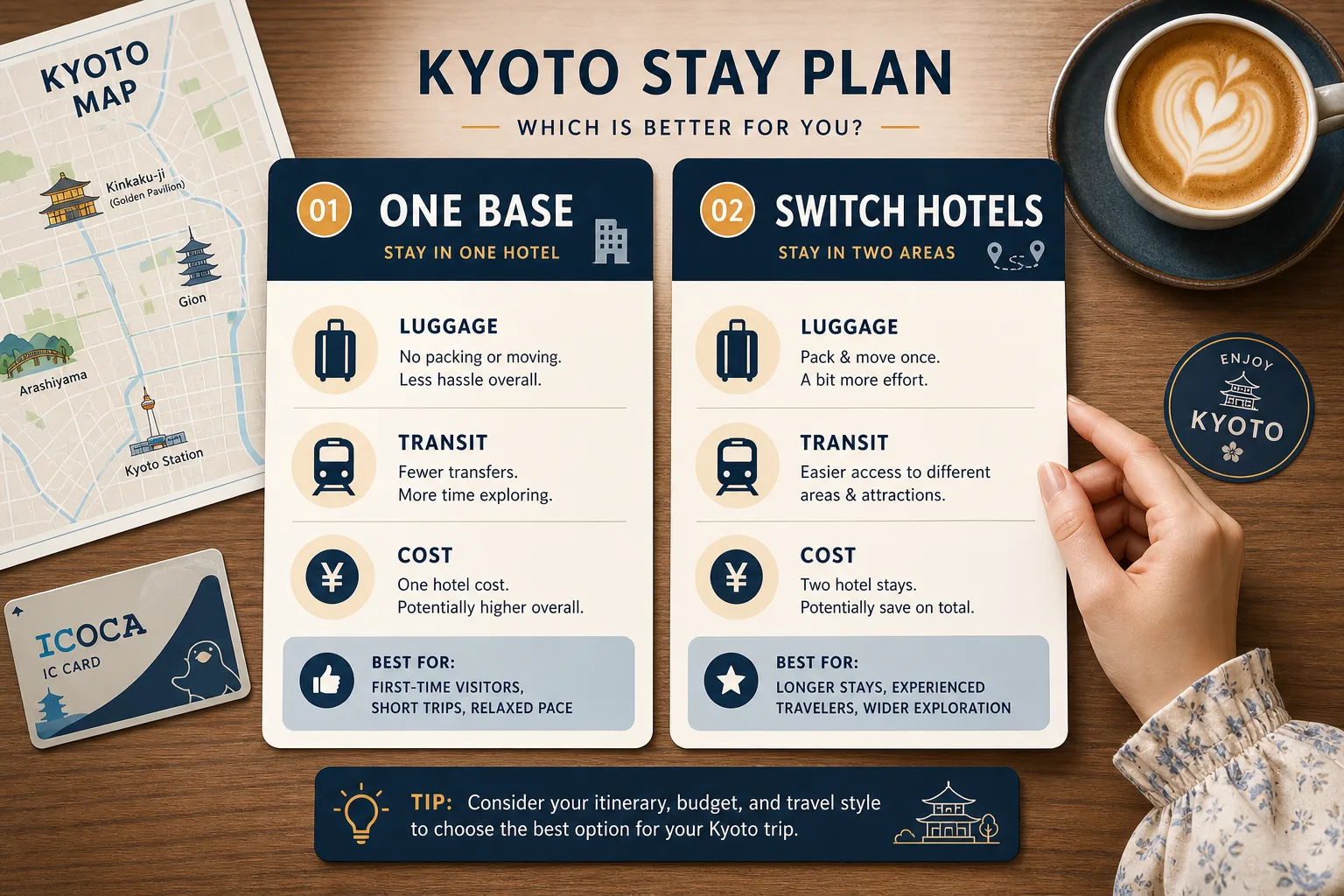
For most travelers, use one Kyoto hotel as a single base. The city rewards depth over coverage, the transit network is dense enough to reach Arashiyama, Higashiyama, Fushimi, and northern temples from one central location, and switching hotels mid-trip adds luggage stress that Kyoto's bus system actively penalizes. This is not mainly a romance-versus-efficiency question. It is a luggage-and-transfer question wearing a romantic disguise.
Choose a single base if you are a slow traveler, a couple wanting a calm rhythm, a low-stress planner, or anyone bringing a real suitcase rather than a backpack.
Consider changing hotels only if you specifically want a ryokan or machiya experience for one or two nights, you accept the cost of luggage forwarding, and you are emotionally fine with a partial repack mid-trip.
Do not switch hotels just to be physically closer to the next day's sights. In Kyoto, the time you save walking is almost always smaller than the time you lose to checkout, transit with bags, and check-in.
Hotel Location Risk Summary
Kyoto has a specific set of frictions that make hotel switching more painful than in cities like Tokyo or Osaka.
- City buses formally request that passengers not bring large suitcases or oversized backpacks, and drivers may deny boarding. That removes the cheapest, most flexible way to move between neighborhoods with luggage.
- The flat 700 yen Bus One-Day Pass was permanently discontinued to reduce bus congestion. The replacement Subway and Bus One-Day Pass costs 1,100 yen for adults and 550 yen for children, which slightly changes the math for a bus-heavy day.
- Major sights still require walking. Kiyomizu-dera, for example, is a steep 1.4 km uphill walk of 20 to 25 minutes from Kiyomizu-Gojo Station. No hotel location removes that climb.
- Since April 2024, tourists are banned from entering private alleyways off Gion's Hanamikoji Street, with violators facing a 10,000 yen fine. Sleeping in Gion does not unlock more access than sleeping near Shijo.
- Peak season pricing is sharp. In cherry blossom (April) and autumn foliage (November), average daily rates rise to around 30,640 yen with occupancy near 89.5 percent. Two hotels in peak season means paying that premium twice and risking limited availability for the switch night.
The honest summary: in Kyoto, hotel switching mostly converts time and money into discomfort, not into better access. The typical regret pattern is thinking two neighborhoods will make the trip feel richer, then realizing the transfer day erased the calm you were trying to buy.
Best Areas at a Glance
| Area | Best for | Transit access | Hotel switching risk |
|---|---|---|---|
| Kyoto Station area | First-timers, arrivals from Kansai Airport, Shinkansen days | Excellent, all lines converge | Lowest, easy to start or end here |
| Karasuma / Shijo / Kawaramachi | Couples, slow travelers, dinner-led nights | Karasuma subway, walkable to Gion and Nishiki | Lowest, central enough to skip switching |
| Higashiyama (near Gion, Kiyomizu) | Atmosphere-first travelers, ryokan stay | Limited subway, taxi or walk heavy | Medium, charming but luggage-unfriendly streets |
| Arashiyama | Mood-led one-night ryokan add-on | One train line, quieter at night | High if used as main base, low as a 1-night add-on |
| Northern Kyoto (around Kitayama) | Quiet stays, repeat visitors | Karasuma Line north, fewer transfers | Medium, longer rides to evening dining |
The subway from Kyoto Station to Shijo Station via the Karasuma Line takes 4 minutes for 220 yen, then a 10-minute walk to Kawaramachi. A taxi from Kyoto Station to Shijo-Kawaramachi takes 10 to 15 minutes and costs roughly 1,200 to 1,500 yen. These short, predictable transfers are why a single central base usually wins.
Best Area by Traveler Type
Slow travelers. Pick one hotel near Karasuma or Shijo and stay put. The reward of Kyoto is repeated visits to the same cafe, the same temple at a different hour, the same quiet street at dusk. Switching hotels breaks that rhythm and replaces it with packing.
Couples. A single central base near Kawaramachi or Karasuma gives you walkable dinner options, late-night returns, and short taxi rides home after temple-lit evenings. The exception is a deliberate one-night ryokan in Higashiyama or Arashiyama as a romantic interlude, with main luggage left at the base hotel or sent ahead.
Low-stress planners. Single base, near a subway station, ideally within a 10-minute walk of either Kyoto Station or Shijo. You want predictable luggage moments: one arrival, one departure. Every hotel switch is one more chance for a missed checkout, a late bag, or a wrong-platform moment with suitcases.
Atmosphere-first travelers. You may be tempted to sleep in Gion or Arashiyama for vibe. That is valid, but think of it as a one-night experience layered onto a central base, not as your main bed. The street access restrictions in Gion since April 2024 mean atmosphere is best enjoyed at dawn and dusk, not from your hotel doorstep.
Areas to Be Careful With
These patterns reliably create regret in Kyoto.
- Booking two or three different hotels across Higashiyama, Arashiyama, and central Kyoto to be "close to each day's sights." The transfer days erase the gains.
- Choosing a budget hotel far from any subway station to save money, then paying it back in taxi fares and time, especially after dinner.
- Relying on city buses to move suitcases between neighborhoods. The bus system is not designed for this and drivers can refuse boarding.
- Switching hotels on a weekend in peak season. Walking up to a front desk with bags during a 90 percent occupancy week is not the moment to discover a delayed check-in.
- Sleeping in Gion expecting to wander every alley. Many private alleyways off Hanamikoji are now off-limits to tourists.
The shared thread: switching hotels in Kyoto multiplies friction faster than it multiplies access.
Budget vs Convenience Tradeoff
Here is the honest tradeoff for a typical 4 to 6 night Kyoto stay.
| Decision | Likely cost impact | Likely time impact | Stress level |
|---|---|---|---|
| One central base, full stay | Highest per-night rate but no duplication | Lowest, no transfer days | Lowest |
| Central base + 1 ryokan night | Moderate premium for ryokan night | Half-day lost to transfer, partly recovered as experience | Low to medium |
| Two equal hotels, mid-trip switch | Two peak-season rates, possible delivery fees | Half day lost, plus check-in waits | Medium to high |
| Three hotels across the trip | Multiple booking fees, often higher total | One to one and a half days lost to logistics | High |
A few practical numbers to plug in. Crosta Kyoto at JR Kyoto Station B1F offers same-day luggage delivery to registered Kyoto hotels starting at 1,500 yen per item if you drop off by 2:00 PM. Daily temporary storage is 1,000 yen per bag, available 8:00 AM to 8:00 PM. Yamato Transport offers same-day hotel-to-hotel delivery within Kyoto City starting at around 1,240 yen per bag. These services make a one-night ryokan detour realistic, but they also mean a "free" hotel switch is rarely free once you add the bag.
Also note Kyoto's tiered accommodation tax now caps at 10,000 yen per person per night for ultra-luxury rooms of 100,000 yen or more. At the high end, tax alone discourages stacking multiple short luxury stays.
Hotel Location Checklist
Before you finalize your Kyoto plan, run through this checklist. If you check three or more boxes in the "single base" column, stop switching.
Single base is right for you if you can check most of these:
- You are bringing a suitcase, not just a daypack.
- You value evenings at the same neighborhood cafe or izakaya more than waking up next to a specific temple.
- You will be in Kyoto 3 nights or fewer and cannot afford a transfer day.
- You are traveling with a partner, parent, or anyone who tires from logistics.
- You are visiting in cherry blossom or autumn foliage season and want to lock in one good room.
- You are not planning a deliberate ryokan or machiya experience.
Switching is defensible if you can check most of these:
- You specifically want a ryokan or traditional inn for one or two nights as an experience, not a base.
- You will use a luggage delivery service (Crosta Kyoto, Yamato) to move main bags, not city buses.
- You have at least 5 nights in Kyoto so a transfer day does not eat your trip.
- You are traveling light or as a single traveler comfortable with one carry-on.
- You are not in the tightest peak weeks where re-booking risk is highest.
If the lists do not match cleanly, default to one base. The downside of one base is mild. The downside of an over-ambitious switch is a wasted afternoon during your most expensive week of the year.
Final Recommendation
Use one Kyoto hotel as your base. Place it within walking distance of either Kyoto Station, Karasuma Station, or Shijo, so every district is reachable with one short subway ride or a 1,200 to 1,500 yen taxi. Spend your switching energy on choosing the right single neighborhood, not on splitting the trip across two hotels.
If a ryokan or atmospheric machiya night genuinely matters to you, add it as a one-night extension using a luggage delivery service rather than a full base switch. The cost is predictable, the logistics are contained, and you keep the rest of the trip simple.
FAQ
Is Kyoto big enough that I need to switch hotels? No. Central Kyoto sights are concentrated enough that a well-placed single hotel near Karasuma, Shijo, or Kyoto Station reaches almost every major area within 30 to 40 minutes by subway, bus, or short taxi. Switching hotels inside the city rarely saves meaningful time and usually adds luggage friction.
What if I want to visit Arashiyama and Higashiyama on different days? You can still do both from one base. Arashiyama is a direct train ride from central Kyoto, and Higashiyama is reachable by bus, subway plus walking, or taxi. The travel time saved by sleeping closer to one area is usually less than the time lost packing and checking in again.
When does changing hotels actually make sense? When you want a deliberate change of mood, for example one or two nights at a ryokan in Arashiyama or a traditional inn near Higashiyama, and you are willing to send your main luggage ahead using a same-day delivery service. It is a comfort choice, not an efficiency one.
Will I save money by staying outside central Kyoto and moving later? Sometimes, but the savings shrink quickly. In peak cherry blossom or autumn foliage weeks, average daily rates push around 30,640 yen with very high occupancy, so cheaper outer hotels fill up too. Add taxi and luggage delivery costs and the gap often closes.
Can I bring suitcases on Kyoto city buses between hotels? It is officially discouraged. Kyoto City Bus formally asks passengers not to bring large suitcases or oversized backpacks on board, and drivers can refuse boarding. If you switch hotels, plan on taxi, train with luggage, or a delivery service rather than the city bus.