travel-decisions
Is Osaka Worth It If You Care More About Atmosphere Than Landmarks?
A traveler-fit guide to deciding if Osaka suits you when mood, alleys, and street life matter more than checking off famous sights.
By the Trip Persona Editorial Team | Last updated June 4, 2026
Osaka gets compared to Tokyo and Kyoto so often that the real question gets buried: is it the right city for someone whose trip is built around mood instead of monuments? This guide answers that directly, then maps it to four traveler types so you can decide before you book.
Quick Verdict
Osaka is a strong fit if your idea of a good travel day is walking a neighborhood until it changes character, eating standing up, and letting the evening run long. The city is dense, loud in the right places, quiet in the right places, and easy to read at street level.
It is a weak fit if you measure trips by landmark count, prefer museums and gardens over street life, or get frustrated when a city's best moments are unstructured. Osaka Castle and the aquarium exist, but they are not why atmosphere-first travelers come back.
Strong fit if you: like walking 15,000+ steps a day, enjoy night districts, take photos of textures and signs rather than monuments, want food to be the structure of your day.
Weak fit if you: plan trips around ticketed sights, dislike crowds after 6 PM, expect a city to be visually calm, or want a clear "things to see" checklist.
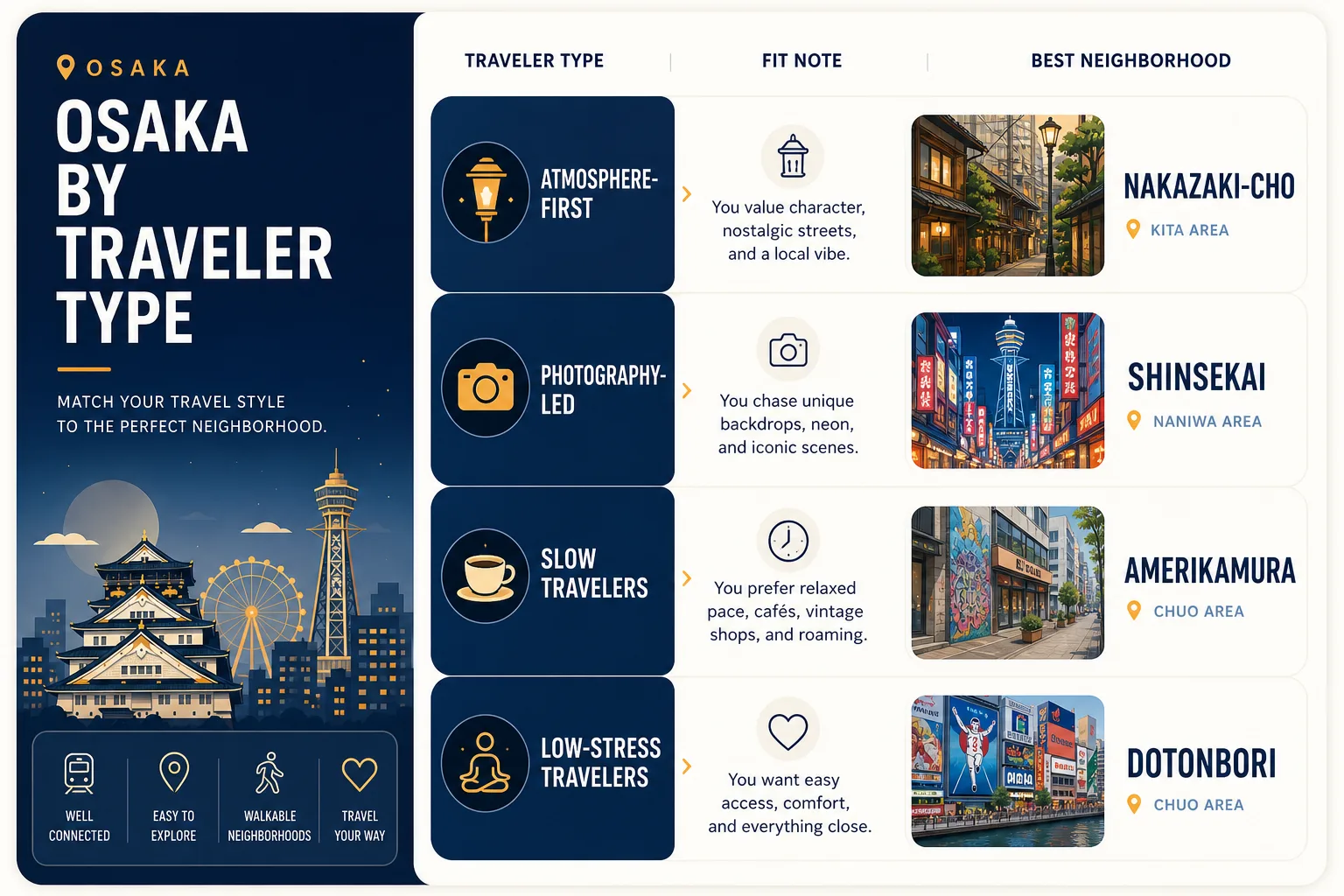 Gives the reader a scannable decision artifact for traveler fit.
Best for First-Time Visitors to Japan
If this is your first trip to Japan and you already know you care more about atmosphere than landmarks, Osaka works as a 2 to 3 day add-on rather than a base. The city teaches you quickly how Japanese urban density actually feels: Dotonbori and Namba are crowded and neon-heavy after 6 PM, and that contrast against quieter pockets like Nakazaki-cho gives you a useful mental map for the rest of the trip.
First-timers who skip Osaka entirely tend to regret it less than first-timers who give it only a half day between trains. A half day shows you the loudest streets and none of the texture.
Best for Couples
Couples whose travel style leans toward shared meals, late walks, and small bars usually do well in Osaka. The walk from Amerikamura to Dotonbori is only 500 meters to 1 kilometer across Midosuji Boulevard, so an evening can move naturally from vintage shops and coffee to street food without planning.
Couples looking for a romantic, quiet city should consider Kyoto or Kanazawa first. Osaka's intimacy is the kind you find on a side street at 11 PM, not in a designed setting.
Best for Slow Travelers
This is the strongest match. Slow travelers who stay 4 to 5 nights and repeat neighborhoods get the most out of Osaka. Nakazaki-cho, just north of Umeda, rewards return visits: the narrow alleys and converted wooden row houses change feel between morning coffee hours and evening. Shinsekai, built in 1912 with its Showa-era nostalgia and kushikatsu shops, deepens once you stop treating it as a single photo stop.
Slow travelers who base centrally and walk most days will find the metro is occasional, not constant. The Dotonbori to Shinsekai walk is around 2 kilometers and takes 25 to 30 minutes, which is the kind of distance that builds the trip rather than wastes it.
Best for Niche Interests
Specialty Coffee and Cafe Culture
For travelers comparing Osaka specialty coffee neighborhoods, Nakazaki-cho is the clearest fit in this itinerary. Its narrow alleys and converted wooden row houses make cafe stops part of the neighborhood walk, not a separate checklist, and the quieter morning pace creates a useful contrast with Dotonbori after dark.
Vintage Shopping and Indie Boutiques
Amerikamura is the stronger anchor if your atmosphere-first trip is built around browsing clothes, street fashion, and small independent shops. As an Osaka vintage shopping district, it works best as an unhurried afternoon around Sankaku Koen before walking across Midosuji toward Dotonbori for dinner, rather than as a single store-to-store mission.
Best for Low-Stress Travelers
Mixed. Osaka is logistically easy: signage is clear, the metro is legible, and the central wards are walkable. But the sensory load in Dotonbori and Namba after dark is high, and accommodation costs have shifted. Starting September 1, 2025, Osaka's tiered accommodation tax increased and is generally collected on-site per person, per night, and from July 1, 2026, the international tourist departure tax triples from 1,000 yen to 3,000 yen per person, added automatically to airline tickets.
Low-stress travelers who want atmosphere should base outside the loudest blocks, build in slow mornings, and avoid spring peak season (late March to early April) when cherry blossom crowds push hotel prices up sharply.
Traveler Type Table
This is where the fit actually comes from. Use the neighborhood column as your anchor when planning days.
| Traveler type | Osaka fit | Primary neighborhood | What works | What to watch |
|---|---|---|---|---|
| Atmosphere-first | Strong | Nakazaki-cho, Shinsekai | Layered street life, low cost to wander | Skip if you need polished settings |
| Coffee and vintage-focused | Strong | Nakazaki-cho, Amerikamura | Cafe alleys, indie shops, street-fashion texture | Leave time to browse without a fixed checklist |
| Photography-led | Strong | Shinsekai, Amerikamura | Showa textures, signs, street style around Sankaku Koen | Crowds after 6 PM limit clean frames |
| Slow travelers | Strongest | Nakazaki-cho, central wards | Walkable distances, repeat-visit payoff | Need 4+ nights to feel it |
| Low-stress travelers | Mixed | Outside Namba core | Easy transit, clear signage | Sensory overload, rising taxes |
| Landmark-focused | Weak | Castle area only | One or two ticketed sights | Better served by Kyoto or Tokyo |
Common Mismatches
The travelers who leave Osaka disappointed usually fall into recognizable patterns:
- The half-day visitor. Arrives from Kyoto, walks Dotonbori once, leaves. Sees only the loudest, most commercial face of the city.
- The landmark counter. Compares Osaka's sight list to Kyoto's and concludes there is nothing to do. Correct on paper, wrong about the experience.
- The peak-spring booker. Books late March or early April expecting calm wandering, finds inflated prices and shoulder-to-shoulder streets.
- The pass optimizer. Buys the Kansai Railway Pass Lite (5,200 yen for 2 days, 6,500 yen for 3 days) for a trip that is mostly walking, then feels pressure to use it. The pass excludes JR Lines, Kyoto Municipal Subway, and all local buses, so the value math only works with deliberate day trips on covered private lines.
- The night-averse traveler. Comes for atmosphere but leaves the central wards by 8 PM. Osaka's best mood hours start later.
If you recognize yourself in two or more of these, adjust the trip shape before you adjust the destination.
Final Match Recommendation
Choose Osaka if you want a city you can read with your feet, where the structure of a day comes from neighborhoods rather than tickets, and where 2 to 4 nights of unhurried wandering pays back more than a packed itinerary would.
Skip Osaka, or reduce it to a day trip from Kyoto, if your travel satisfaction depends on famous sights, calm visual environments, or a clear list of things accomplished. There is no shame in that, and forcing Osaka into the wrong trip shape is the most common reason travelers under-rate it.
A reasonable default for atmosphere-first travelers: 3 nights based in central Osaka outside the Namba core, evenings in Dotonbori and Shinsekai, mornings in Nakazaki-cho, one afternoon in Amerikamura, no pass, mostly walking.
Pre-booking checklist
- Trip is at least 2 full days, ideally 3
- Not traveling late March to early April
- Comfortable with evening crowds and neon
- Hotel is walkable to a metro station but not on top of Namba nightlife
- Not planning to buy a rail pass unless doing real day trips
- Budget accounts for on-site accommodation tax per person per night
FAQ
Is Osaka worth it if I do not care about Osaka Castle or theme parks? Yes, if you enjoy walking, neighborhood-level differences, and eating in dense street-food districts. Most of Osaka's emotional payoff lives in places like Dotonbori, Shinsekai, Nakazaki-cho, and Amerikamura, none of which require a landmark itinerary.
How many days does Osaka need if I only want atmosphere? Two to three full days is usually enough to feel each of the main mood zones without rushing. Slow travelers comfortable with repeating neighborhoods can stretch to four, especially if you base centrally and use the metro lightly.
Should I get the Kansai Railway Pass Lite for this kind of trip? Probably not if you mostly stay inside Osaka. The pass costs 5,200 yen for 2 days or 6,500 yen for 3 days (non-consecutive days allowed from April 1, 2026, as a digital e-ticket) and excludes JR Lines, the Kyoto Municipal Subway, and all local buses. Atmosphere-first travelers who walk between Amerikamura, Dotonbori, and Shinsekai rarely break even unless they also do day trips on covered private lines.
Will Osaka feel disappointing after Kyoto or Tokyo? It can, if you arrive expecting another sight-dense city. Osaka's appeal is loud, casual, and street-level. Travelers who liked Kyoto for temples or Tokyo for design districts often find Osaka best when treated as an evening and late-night city rather than a daytime sightseeing one. Plan dinner late, walk after, and let the city show itself on its own schedule.
Is spring the right time for an atmosphere trip to Osaka? Spring from late March to early April is peak season with heavy crowds and surging hotel prices. If you want mood over photo ops, late April, May, or autumn usually give you the same street energy with less friction and lower cost.